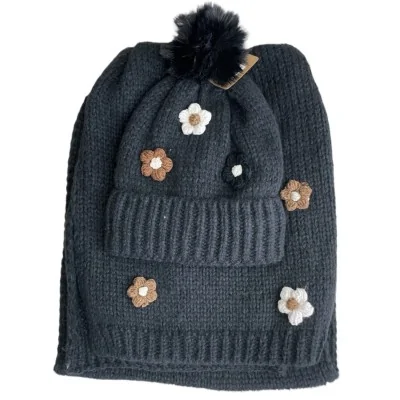
A black beanie knitted in a vertical rib, with glitter spun into the yarn rather than sequins sewn on top. The pom-pom is cut from long synthetic fibres in the same black, so it is the texture and not the colour that sets it apart.
Underneath the brim the hat is a different colour entirely: a cream fleece pile covers the inside of the crown and stays out of sight once the beanie is on. Hand wash, dry flat, one size.
Turned out, the hat stops looking like a plain black beanie. The whole crown is lined in cream fleece, a pile dense enough to hide the knit completely. From the outside not a thread of it shows, which is why the beanie still reads as solid black across a room. The contrast only exists for whoever is holding it.
On the head that pile does what the rib cannot: it fills the gap between head and knit, so the hat stands a little further out than its flat profile suggests, and the deep turned-back cuff stacks a second thickness of fleece across the ears.
Four things give the beanie its outline, and each one pulls in a different direction.
| Ribbed crown | Vertical columns of knit, even from brim to tip | Holds the width without stretching out of true |
|---|---|---|
| Turn-back cuff | One wide fold of the same rib | Keeps the brim straight instead of letting it curl |
| Fleece pile | Short cream curls covering the inside | Pads the crown and lifts the hat off the head |
| Pom-pom | Long synthetic fibres in the same black | Weights the tip and leans sideways when the hat lies flat |
From a few paces the knit does not read as black so much as very dark grey, and that cast is the glitter at work before any single point can be made out. Up close the flecks separate: silver specks caught in the yarn, not sewn on afterwards, so nothing on the surface can snag or lift. Under flat ceiling light indoors the effect all but vanishes.
This one declares itself in shop windows and under street lamps, then goes quiet the rest of the time. It belongs closer to a frost on a dark surface than to anything intended for an evening out, which is the difference between a hat you wear every morning and one that comes out twice a winter.
Friction is the problem here, not water. Wash by hand in cold water, press the water out between your palms instead of twisting the knit, and leave the hat flat well away from a radiator. Rubbing the surface, whether with a brush or against itself in a machine drum, is what takes the life out of the thread. The pom-pom needs nothing but a shake once everything is dry.
Since the sparkle only answers to light from the side, the hat makes no demands on the rest of an outfit: a camel coat, a quilted jacket, a charcoal overcoat. It comes in one size, cut to stretch, and how far the cuff gets rolled is usually settled after a walk or two rather than in front of a mirror. If the glitter is the part you would rather skip, the plainer beanies on the same shelf offer the shape without it.
For hands, a pair of gloves to match sits better in a fine knit than in a second heavy one, which would end up competing with the rib rather than sitting alongside it.
Data sheet