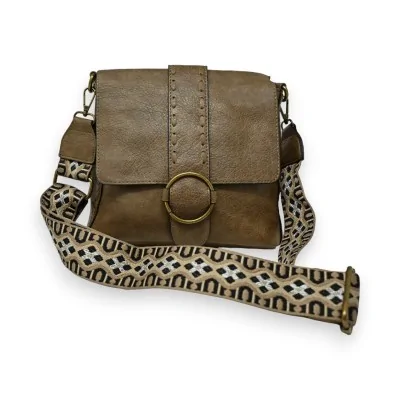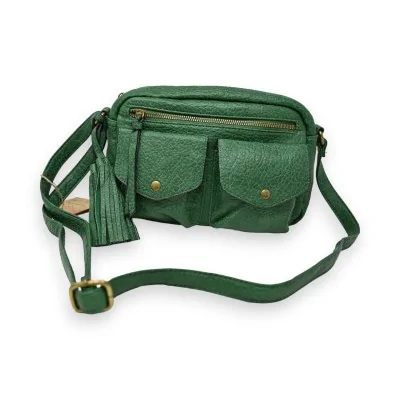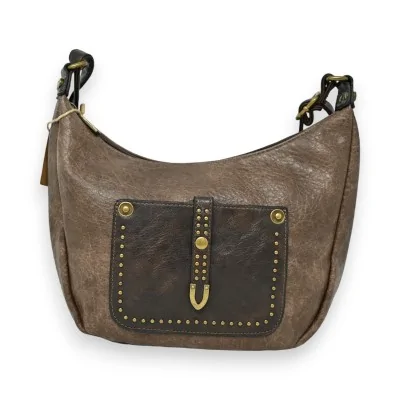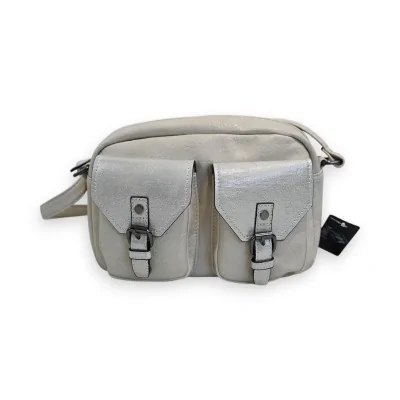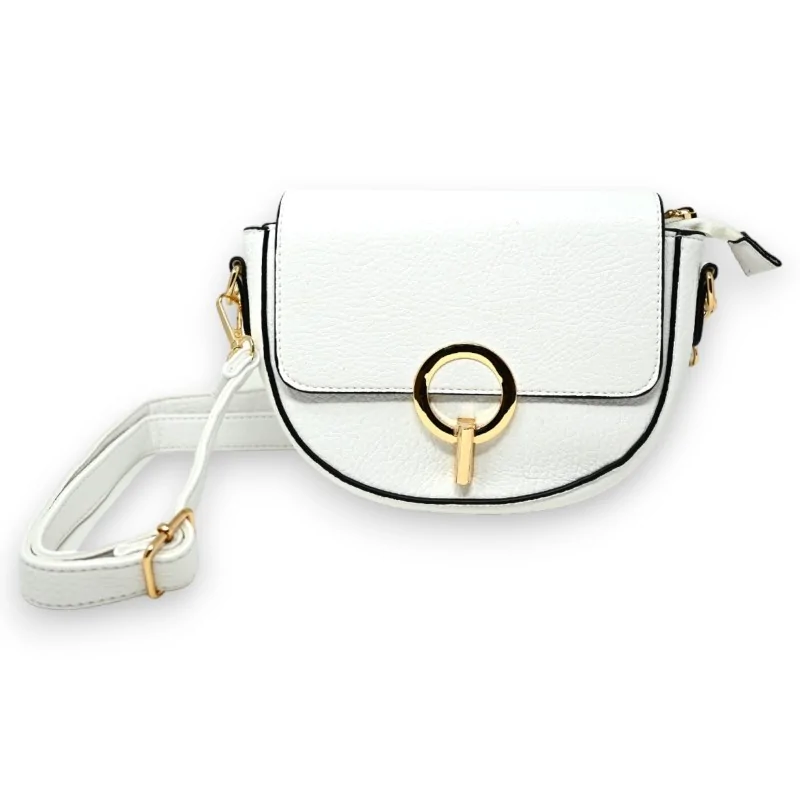
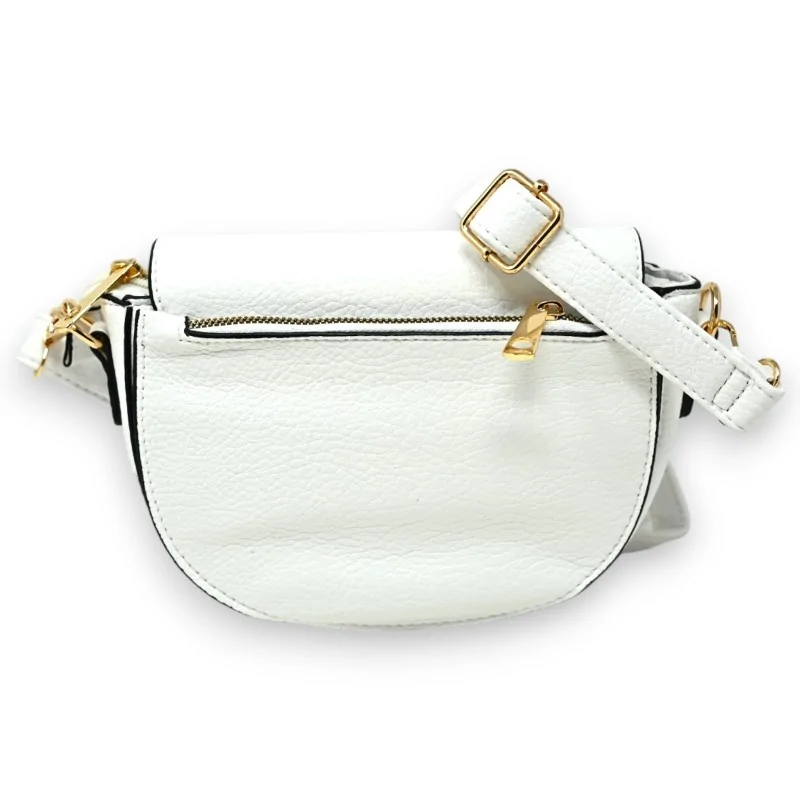
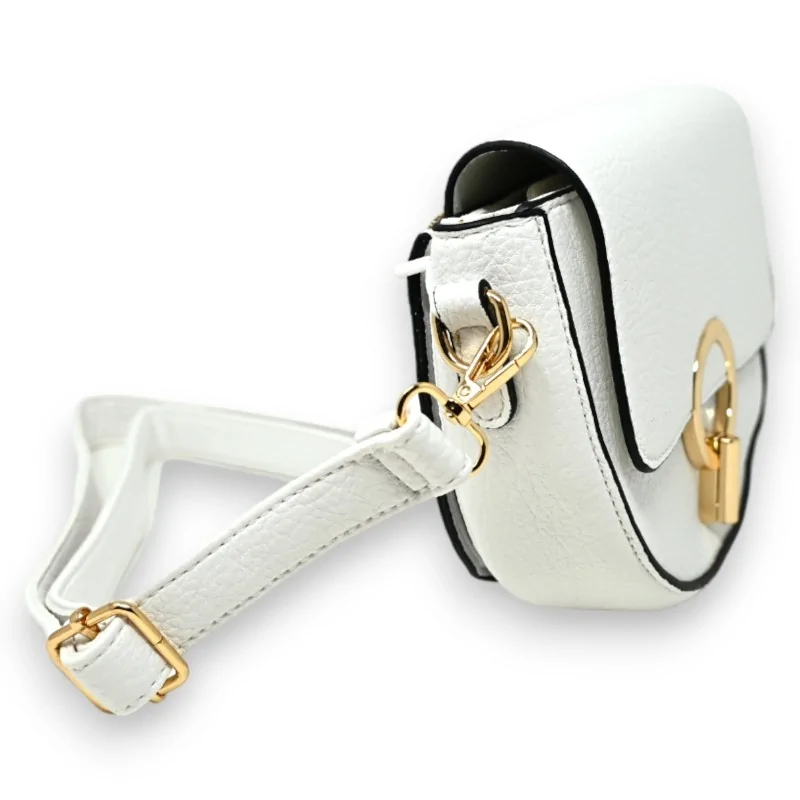



A small white shoulder bag cut in a half-moon shape, closed by a flap that hooks onto a gold ring crossed by a vertical bar. A line of black piping follows the flap, then the body, all the way round.
A gold zip runs across the back panel. The strap unclips at both ends and slides shorter or longer on a square gold buckle. Measurements: 20x5.5x14 cm.
Begin with the measurements, because on a bag this small they settle every other question. Twenty centimetres across, fourteen high, barely five and a half deep: a phone, a card holder and a set of keys will go in, and not a great deal beyond that. The table gathers what the three photographs actually show, nothing more.
| Measurements | 20x5.5x14 cm |
|---|---|
| Front | Flap held by a gold ring and a vertical bar |
| Back | Zipped pocket running the width of the panel |
| Strap | Unclips at both ends, slides to length |
| Trim | Black piping along the flap and the body |
Two gold snap hooks hold the strap to the rings on either side, so it comes away in a couple of seconds. A square gold buckle sits on the strap itself and takes up the slack. Because the detachable, adjustable shoulder strap is cut from the same grained white material as the bag, nothing jars when you put it back on.
Buckled up short, the bag rides close under the arm and stays out of the way on a crowded train. Let the strap out and it drops to the hip, where the shallow half-moon sits flat against you. With the strap off, the two gold side rings stay in place, small enough to read as part of the trim rather than as leftovers. To see the shape beside its neighbours, the satchel, clutch and straw styles filed next to it make the comparison easy.
Turn the bag over and a second opening appears: a zipped pocket set across the back panel, gold teeth and gold pull, stretching almost the full width. It is the only way into the bag that does not involve lifting the flap, which is the entire argument for putting a pocket there. The panel around it is plain, with no visible seam down the middle.
White shows every line, and this one is drawn deliberately. A band of continuous black piping edges the flap, carries on down the side and traces the curve to the base. It is a thin stroke rather than a border, and it marks exactly where the flap stops and the body starts, which on a single-colour bag is otherwise hard to read. The grain of the white surface is even and matt, so the dark line stays the only contrast.
The flap closes on a gold ring and bar clasp: the ring is fixed to the front, the bar drops through it, and that is the whole mechanism. It stays on show when the bag is shut, which is why the front still reads from a distance: a white curve, one gold point. If you want the same idea one size down, the smaller shapes that fasten at the waist sit in the next aisle along.

Data sheet