Availability: 4 In Stock

There is 1 product.
Four fingers, one pocket. That single design choice is the whole argument for a mitten. Inside a glove, every finger sits in its own sleeve, alone against the cold air; inside a mitten, the fingers sit together and warm one another. Less surface exposed, more heat kept where you want it.
The difference shows up fastest when your hands stop moving. Waiting on a platform, queueing outside a Christmas market stall, walking the dog on a still January morning: that is when a glove starts to feel thin and a mitten does not. Wind makes the gap wider still.
You can test it yourself. Put a lined glove on one hand and a mitten of similar thickness on the other, then stand outside without moving for ten minutes. The gloved fingers go first, starting at the tips, while the mittened hand stays comfortable well past the point you would expect. Nothing exotic is happening: less exposed surface, and four fingers sharing the same warm air.
Mittens ask something in return. Tapping a card reader, unlocking a phone, digging a key out of a coat pocket all mean pulling one off, and there is no clever way around it.
The usual answer is to own two pairs rather than hunt for one that does everything. Mittens for the cold walk, something lighter for the errands in between. If your day is mostly errands, be honest about it before you buy: the warmest pair in the world is useless if it lives in your bag.
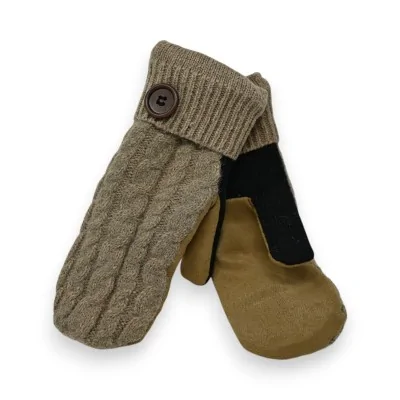
This is a small, deliberate selection rather than a wall of options. The pair here is knitted in a cable pattern across the back of the hand, with a suede-look palm for grip and a soft plush lining. The cuff turns back and fastens with a wooden button, so it lies flat under a coat sleeve instead of bunching.
Colours stay quiet: taupe through camel, with a darker panel at the wrist. Nothing that argues with a navy coat or a grey wool jacket. If a knitted hat for cold mornings is already part of your winter kit, you won't have to think about matching them.
For the exact fibre content and construction, read the product page. That is where the checked details are.
Buy a mitten with a little room in it. Measure round the palm at the knuckles, thumb excluded, then check that figure against the size guidance on the product page. A tight mitten is a cold mitten: it presses on the hand and squeezes out the layer of warm air that does the insulating.
The cuff deserves a second look. A short cuff tucks under a coat sleeve and suits town wear. A longer one laps over the sleeve and shuts out the draught at the wrist, which is where most of the cold gets in on a windy day. Check the ribbing too: too slack and it loses its shape within a season, too stiff and it leaves a mark.
Length matters as much as circumference. A mitten that runs long leaves an empty pocket of cold air beyond your fingertips, while one that stops short presses on them and squeezes out the warm air you are trying to keep. Spread your fingers inside the mitten once it is on: the lining should touch the ends without pushing back.
Knitwear and washing machines rarely mix. Wash by hand in cool water with a wool detergent, press the water out between two towels, then dry them flat, away from a radiator. Hang a wet mitten up and it stretches into a shape it will never recover.
The suede-look palm is a separate job: wait until the pair is bone dry, then lift the nap with a soft brush.
| Washing | By hand, cool water, wool detergent. No wringing, no machine cycle. |
|---|---|
| Drying | Flat, on a towel, away from direct heat. Never on a radiator or a hanger. |
| Storing | Flat and fully dry, in a breathable bag. A sealed plastic bag invites mildew. |
Store them somewhere you will actually find them in November. A drawer next to the winter scarves works better than the bottom of the wardrobe, and it saves you buying a second pair in a hurry because the first one has vanished.
Think about the day rather than the temperature. A day of standing still in the cold wants a mitten. A day of handling things wants fingers.
When the fingers need to stay free, our fingerless knitted gloves, the ones often sold as mitts, cover the palm and leave the fingertips free: enough for a phone, a ticket barrier or a coffee cup.
And when you want full use of your hands all day, our wider women's gloves section holds the full-finger models, from the smart and thin to the properly lined.
One last practical point: buy before the first cold snap rather than during it. Ordering early leaves time to try the fit at home, send a pair back if the palm is wrong, and still have warm hands the week the wind turns.