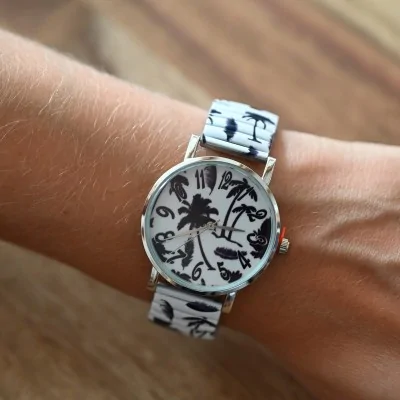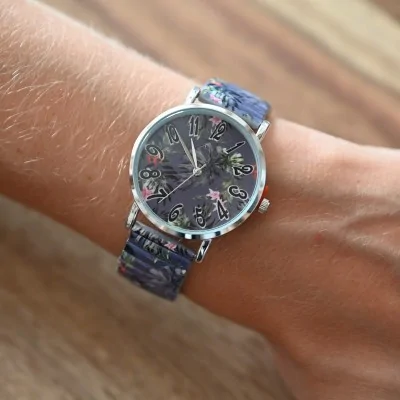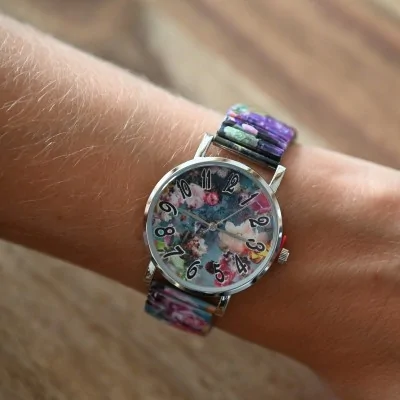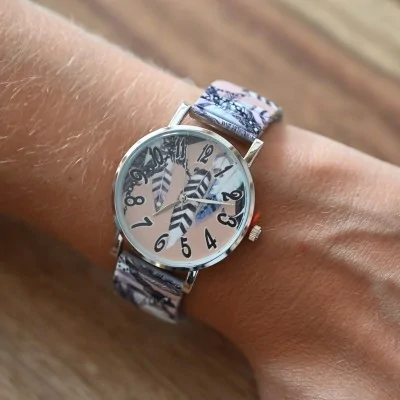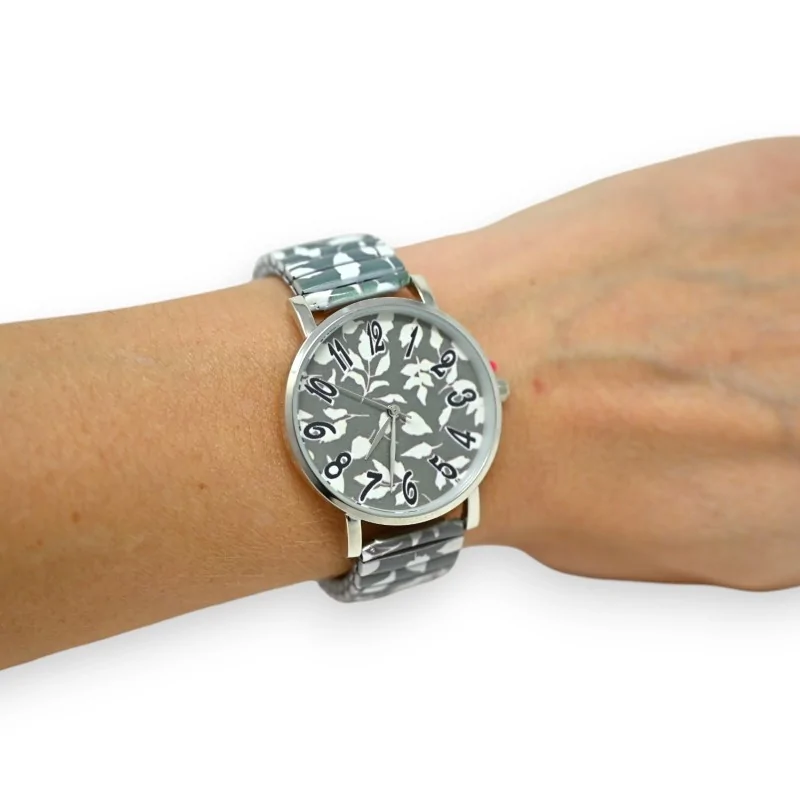
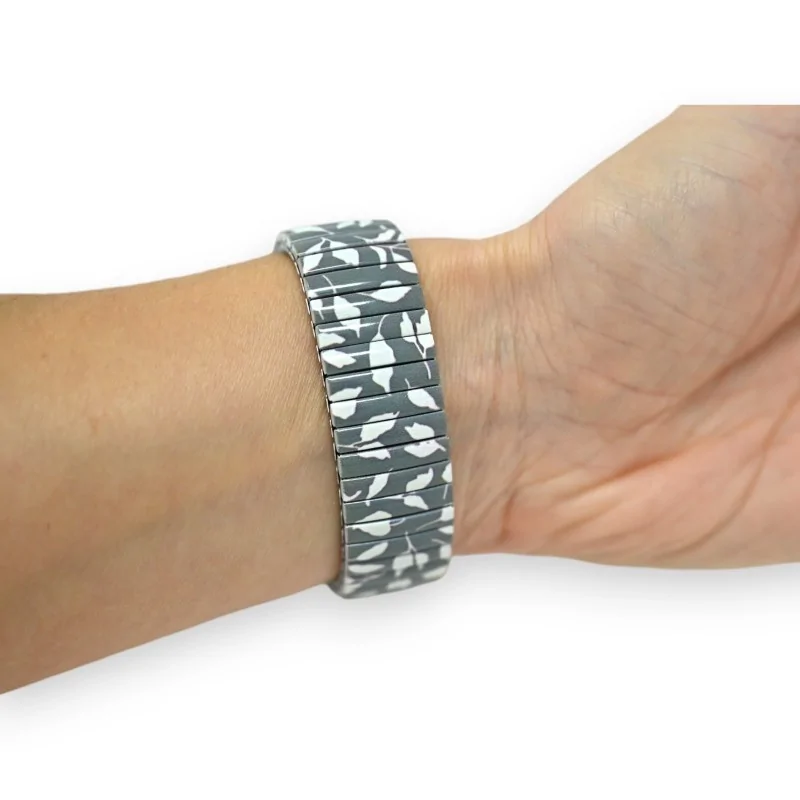



White foliage runs across a khaki ground, on the bracelet and on the dial alike. Nothing fastens: the bracelet stretches, your hand goes through, and it settles back around the wrist.
The black numerals stay wide enough to read straight away, even against the printed background.
This one is built on flat jointed links that pull apart and spring back, so there is nothing to fasten and nothing to adjust. You open it with two fingers, slide your hand through, and it grips the wrist on its own. Mornings are quicker that way. If that is the part you were looking for, you will find the rest of the dials built the same way among the watches that slide on instead of buckling.
The print does not stop at the bracelet. It carries on across the dial, where white leaves on khaki sketch a light spray of foliage. A round, silver-toned case frames it without competing with it. All twelve black Arabic numerals are drawn wide, so the time reads at a glance despite the busy background.
| Colours | Khaki and white |
|---|---|
| Print placement | Dial and bracelet, same foliage |
| Numerals | Twelve, black, wide |
| Bracelet | Flat jointed links, stretches, no clasp |
Khaki gets along with the quiet end of a wardrobe: raw denim, a cream knit, unbleached linen. The white in the foliage picks up a plain shirt and ties the watch to the rest of the outfit without effort. Over a dark winter sleeve it stands out; on a bare summer wrist it stays casual. It is an easy one to keep on at a desk, since the print reads as a texture from a distance rather than as a bold motif. For the other prints under the same label, look through the Ernest catalogue.
A dry, soft cloth lifts fingerprints off the links and brings the contrast of the foliage back. Then lay the watch flat in a drawer rather than leaving it stretched around anything wider than a wrist, and the bracelet keeps its spring for longer.

Data sheet