- Out-of-Stock
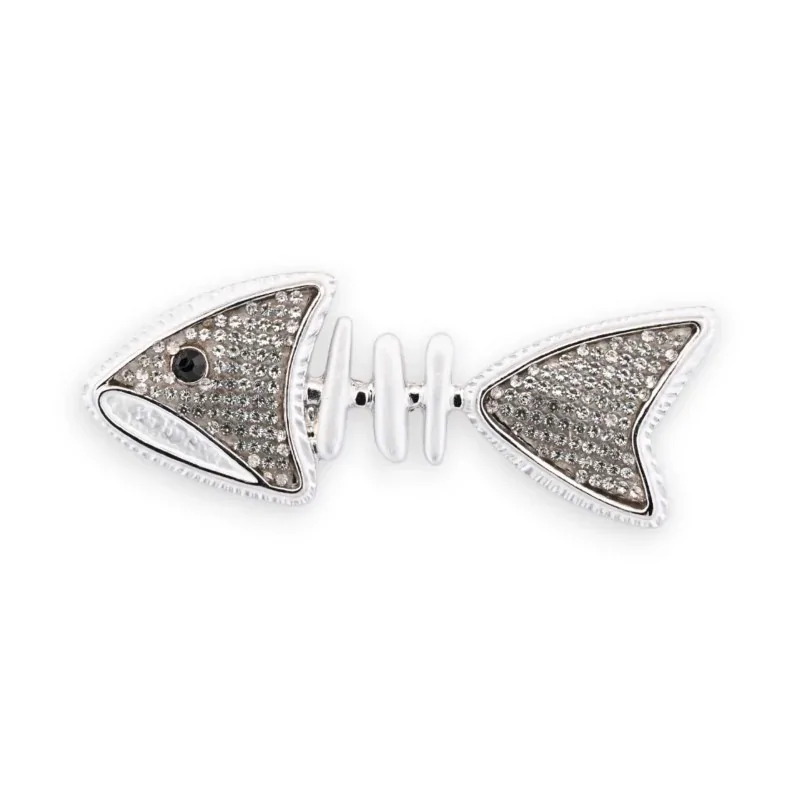



The fish brooch has been a quiet wardrobe signature ever since Georg Jensen and a generation of Scandinavian silversmiths put it on the map. This piece keeps the silhouette, swaps the pin for a discreet magnetic clasp and paves the head and tail in clear crystal rhinestones. Worn on a navy blazer lapel, a cashmere cardigan or the corner of a silk square, it reads as collected style rather than costume sparkle.
The fish brooch occupies a particular corner of jewellery history. Mid-century silversmiths like Georg Jensen and David Andersen turned it into a quietly recognisable signature; contemporary fashion labels such as ARKET still keep a silver-plated fish in their accessories edit. This 7.5 cm piece sits in that lineage: a stylised fishbone silhouette, head and tail paved with hand-set crystal rhinestones, a polished silver-tone spine in between, and a single black enamel eye for graphic punctuation. Nothing fussy, nothing literal, just a wearable sculpture.
The honest answer is: anywhere a blazer, a knit or a scarf needs an anchor. The piece is calibrated for visibility (7.5 cm is well above the modest 2-3 cm of antique brooches) without tipping into costume territory. On a tailored lapel it reads as wardrobe signature. On a chunky beige knit it warms up the look. Pinned at the corner of a folded silk square, it doubles as a scarf weight, which is precisely how a lot of customers actually use it. The magnetic system means you can move it from a wool coat to a silk blouse in seconds, without inspecting fabric afterwards for damage.
A few placements that work especially well: 1) blazer lapel, fish facing forward, head pointing upward toward the collar; 2) the high left side of a chunky knit cardigan, balancing a longer necklace on the right; 3) gathered into the corner of a silk square to hold a one-shoulder drape; 4) on the strap of a felt or canvas tote, where the magnetic clamp grips through both fabric layers. For more pieces with the same fabric-safe system, the full magnetic brooches selection sits alongside this one. For more aquatic motifs (enamelled goldfish, koi, starfish), the fish brooches sub-collection is the right rabbit hole.
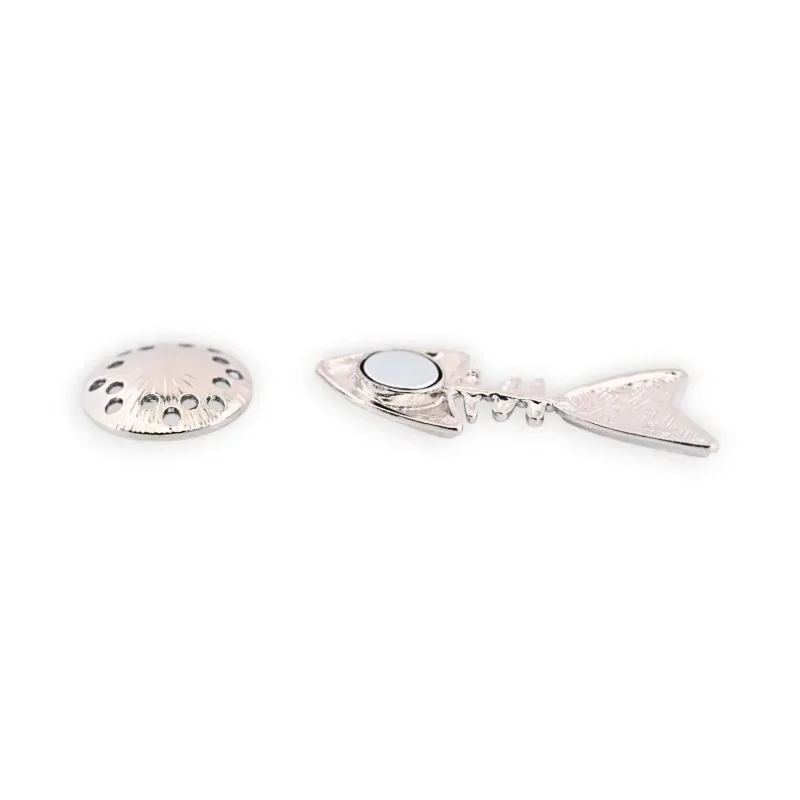
Yes, and the question is fair. The brooch is split in two: a front piece in silver-tone metal carrying all the visible design, and a smaller circular disc holding two rare-earth magnets. You feed the front through the fabric, position the disc on the inside, and the two pieces snap together with a positive click. The pull is calibrated for fabrics up to roughly 4 mm thick, which covers everything from silk crepe to a quilted jacket. Once snapped, the brooch doesn't shift through a brisk walk or a layered cardigan; the giveaway is a faint magnetic resistance when you slide a finger between front and back. The trade-off versus a traditional pin: zero damage to the textile, no piercing, no snagged threads on knitwear.
The body is cast in a zinc alloy with a rhodium-finish silver plating, the same combination most fashion-jewellery houses use when they want anti-tarnish behaviour without the cost of sterling. The pavé is set in individual cups and sealed, so the crystals stay flat rather than catching on knitwear, and dust ingress is minimal. To preserve the shine, store the piece flat in a soft pouch away from other metallic jewellery, wipe with a dry microfibre cloth when needed, and avoid contact with perfume, hairspray and chlorinated water. The magnets retain their strength indefinitely under normal wear.
| Length | 7.5 cm |
|---|---|
| Material | Zinc alloy, rhodium-finish silver plating |
| Stones | Pavé clear crystal rhinestones |
| Fastening | Two-part magnetic clasp, no pin |
| Suitable fabrics | Silk, knit, wool, denim, faux leather |
In jewellery culture the fish has been worn for symbolism (fertility, abundance, in some traditions Christian iconography) and for pure aesthetics (mid-century Scandinavian design, the surrealist eye of mid-century French houses). Today most customers wear it for the second reason: a recognisable shape that reads as quietly intentional, neither floral nor abstract, easy to repeat across seasons.
Through one layer of standard wool coat, yes. The magnets are calibrated for around 4 mm of fabric, which covers most coats, blazers and chunky knits. For very heavy boucle or felted layers, place the brooch on a single-fabric area such as the collar or lapel rather than over a seam or lining for the firmest grip.
As with any magnetic accessory, we advise customers with a pacemaker, implanted defibrillator or insulin pump to keep the brooch at least 15 cm away from the device and to check with their physician before regular use. Worn on a lapel or scarf, the distance is normally well above this threshold.

Data sheet
