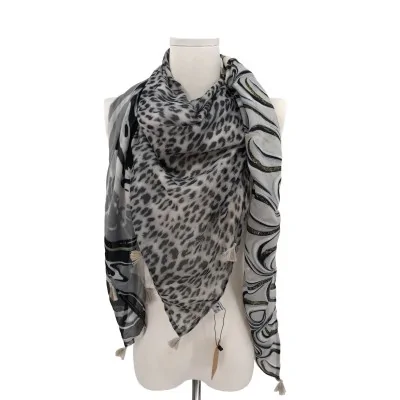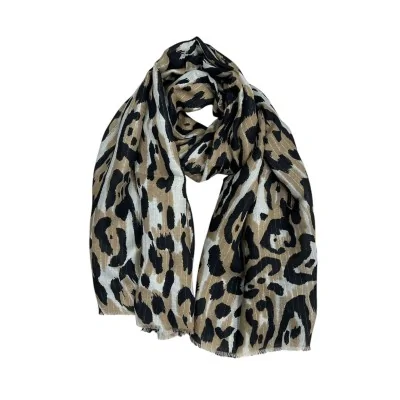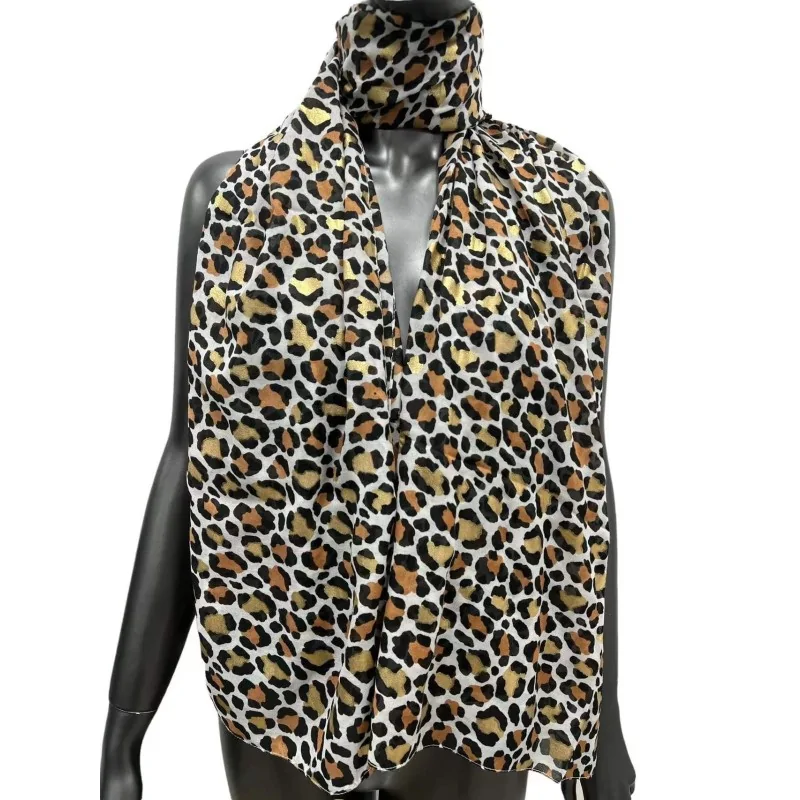


A leopard print on an off-white ground, where part of the spots have been printed in metallic gold rather than caramel. The rest of the pattern works on two tones only, solid black and matte caramel.
The piece is rectangular and worn lengthwise: one turn at the neck, two ends falling down the front. The cloth is thin and the edge is closed by a narrow rolled hem, with no fringe.
Start with the shape, because it decides everything else. This one is long and rectangular, so it needs no folding before you put it on: in the photograph it takes one turn at the neck and leaves both ends hanging to the bottom of the bust. A single turn, a loose knot or a straight throw over the shoulders all follow from that. If you would rather fold a piece into a triangle before knotting it, the square cuts have their own section.
Follow the border on the photograph and you will see a thin white roll running all the way round, stitched down. Nothing is left raw, and nothing is added either: no fringe, no beading, no contrast binding. It is as quiet as a finish gets, which on a print this busy leaves the spots to do the work.
The whole palette comes down to three: off-white, black and caramel, with the metallic standing in for the caramel here and there. Nothing else is added on top, which is why this one behaves like a light accessory rather than a statement piece. Knowing that in advance saves a lot of guessing in front of a wardrobe.
The table below runs in that same order, from the overall shape down to the way the cloth falls, so you can stop wherever your question is answered.
| Shape | Rectangle, worn lengthwise |
|---|---|
| Ground | Off-white, close to ivory |
| Spots | Solid black and matte caramel, in broken rings |
| Gold | Metallic, visibly grainy, on part of the spots |
| Edge | Narrow rolled hem, no fringe |
| Fall | Fine folds, loose ends |
Hold the cloth still and the metallic spots pass for a slightly deeper ochre. Move it, and a dozen of them light up at once while the ones that turn away go olive and almost bronze. That is the whole trick, and it depends on where you stand rather than on anything the scarf does: the surface is grainy enough to break the light into points instead of returning it flat.
Nothing in the way it falls suggests weight across the shoulders, and nothing stiffens where the metallic areas fall: the printed gold creases with the rest instead of sitting on top of it. The ends hang straight rather than buckling, and the folds at the neck stay short and tight rather than bulking into rolls. For a sense of how far the choice goes, there is the rest of the range, print by print.
Data sheet