Mode Tendance, Click here to understand delivery to the United States, Australia and United Kingdom
English GB
There are 2 products.
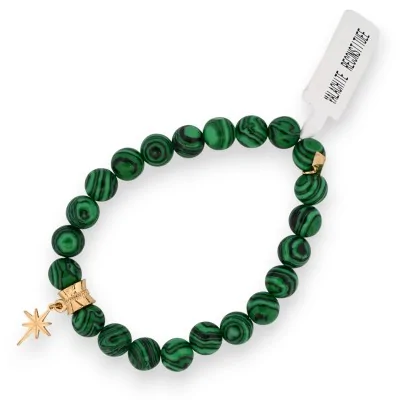
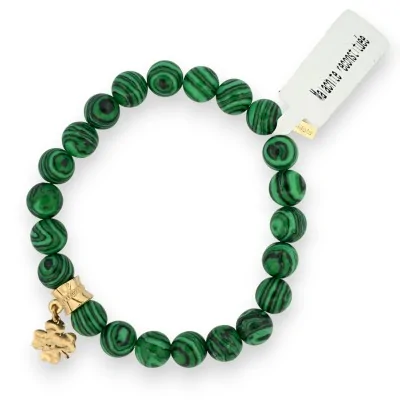
Our malachite bracelet selection brings together bracelets crafted from the green copper stone with its distinctive concentric banding, natural polished beads on stretch elastic for everyday comfort. Identified since Ancient Egypt (where pharaohs wore it as an amulet and ground it into cosmetic pigment for eye paint), malachite still attracts UK customers today thanks to its deep banded greens and its unique circular patterns (no two stones are identical, making each bracelet truly one-of-a-kind).
Malachite is a hydrated copper carbonate (Cu2CO3(OH)2) that forms in the oxidation zones of copper deposits, through slow alteration of chalcopyrite and azurite in carbonate-rich water. Historical deposits are found in the Democratic Republic of Congo (Katanga province), the Russian Urals (Mednorudyansk mine, source of the malachite columns at the Hermitage and Saint Isaac's Cathedral), Australia, Arizona, and notably the Cornish mining heritage (Cornwall malachite specimens are prized by mineral collectors). Its Mohs hardness (3.5 to 4) makes it a soft stone, which explains why polished bead bracelets require some care (avoid knocks and abrasion). Its intense green colour comes from copper ions, and its rosette patterns come from successive crystallisation layers. To browse the wider universe of energy stones, see our crystal healing bracelets section.
In the UK, malachite holds a distinctive place in the crystal healing renaissance that began in the 1970s-1980s alongside the wider New Age and wellbeing movement (Glastonbury crystal shops, Mind Body Spirit fairs, John Lewis crystal jewellery range). British practitioners have long associated malachite with personal transformation, drawing on the Cornish mining heritage that gave the country a real native source of copper minerals. The British market for crystal bracelets is mature and well-served by specialist retailers (Holistic Shop, Cwsellors, The Psychic Tree), with malachite consistently ranking in the top healing stones alongside amethyst, rose quartz and tiger's eye. Our selection fits this accessible tradition: natural polished beads, fair pricing, controlled sourcing. Wear it with everyday outfits or layer it with other crystal bracelets for a meaningful stack.
The malachite bracelet comes mainly in polished round beads (6 mm calibre for a discreet silhouette, 8 mm for stronger presence, 10 mm for a boho statement), threaded on stretch elastic (slip-on, adjustable to most wrists without a clasp). Our selection favours comfort calibres that suit most women's wrists. On finishes, glossy polished beads highlight the concentric patterns, while matte beads give a more natural earthy look. For lovers of other green lithotherapy stones, see also our aventurine section, a softer brighter green that pairs beautifully with malachite in a layered stack (the two greens balance each other: depth of malachite, gentleness of aventurine).
In traditional lithotherapy (note: symbolic and wellbeing approach, not medical advice), malachite is associated with the heart chakra (Anahata) and the solar plexus chakra (Manipura). It is considered a stone of transformation and emotional protection, helping to move past old fears and initiate life changes (job change, relocation, separation, grief work). Classic pairings recommend combining it with azurite (the two stones often occur together in deposits, as in azurite-malachite specimens) to amplify the introspective dimension, or with orange carnelian to balance malachite's slightly heavy quality with more vital, solar energy.
A common question among UK customers: should I wear malachite on the left or right wrist? Crystal healing tradition distinguishes two orientations: left wrist to receive the stone's energy (receptive side, linked to the heart), right wrist to project the stone's energy (active side, outward action). The choice depends on intention: for inner work and emotional softening, the left wrist is preferred; for projecting transformation into action (career change, public speaking, new beginnings), the right wrist suits better. Care: avoid water (malachite is soft and copper can oxidise), remove the bracelet for showers, swimming and sport. Recharge on an amethyst geode or under moonlight (never in direct sunshine which can dull the colour). For more discreet lithotherapy supports, see also our lithotherapy earrings.
Three concrete checks: weight (real malachite is dense, plastic feels too light), pattern texture (real rosettes are sharp and asymmetric, imitations show patterns that are too regular and repetitive), coolness to the touch (natural stone stays cool, plastic warms quickly in the hand). A bead lightly rubbed against a quartz bead will not scratch if plastic, but real malachite can be scratched (Mohs hardness 3.5-4). Our selection offers only natural beads.
Yes for a polished bead bracelet whose surface is sealed (copper is locked in the crystalline matrix). However, malachite dust (from sawing or shaping) is toxic by inhalation, which is why lapidaries always work it wet. For the end wearer, there is no risk to wearing the bracelet at the wrist, even for long periods. Just avoid putting it in the mouth (relevant for small children).
Absolutely. It is a symbolically rich stone, perfect for marking a turning point in a loved one's life (new career step, milestone birthday, retirement, support during a change). Choose a 6 or 8 mm calibre to stay discreet, and add a small card explaining the transformation symbolism. A meaningful present that combines British wellbeing tradition with real geological heritage.