Availability: 3 In Stock

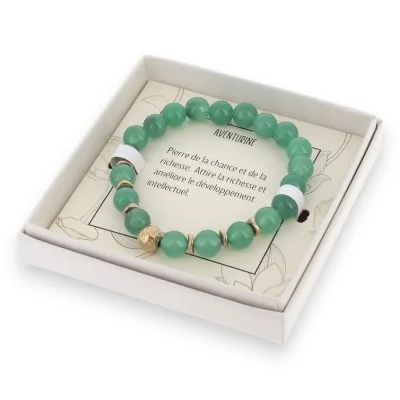
Our aventurine bracelets pair polished green beads with small gold-tone fittings. Green is the colour stated on every listing on this shelf, a clear green that runs from soft to deep from one bead to the next. The charm is what changes the character, a padlock with its key at one end of the range, a plain sphere at the other, and some pieces arrive boxed and ready to give.
There are 2 products.
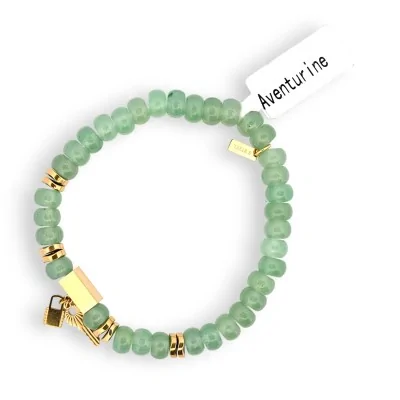
Every bracelet on this shelf is built the same way underneath: polished round beads threaded in a single row, with small gold-tone spacers breaking up the green. What changes from one to the next is the scale of the beads, the charm they carry and the way the bracelet closes. None of that is guesswork, it is written on each listing.
Aventurine beads turn up mostly at 6 mm, 8 mm and 10 mm. At 6 mm the row sits close and quiet, easy to wear next to a watch strap without the two arguing. At 8 mm, the diameter stated on the technical sheet on this shelf, it reads clearly across a desk without taking over the wrist. At 10 mm it is the piece you notice first. Bigger beads also give the light a longer run across the surface, so the green shifts more as you move.
A single row of green holds its own with nothing beside it. Stacked, it behaves differently: the gold-tone spacers pick up whatever metal you already wear, and a plain spherical charm slides between other bracelets without catching. A padlock-and-key pair is the opposite choice, a piece that wants to be seen and works better with a bare wrist beside it.
Aventurine is a green variety of quartz. Its name comes from the flecked glass made in Murano, whose glitter it echoes: here the flecks are mica inclusions rather than copper, and the soft glint they throw is called aventurescence. On a bracelet you never see it all at once. It arrives bead by bead as the row turns, which is also why no two beads read the same green, some soft and grassy, others much deeper.
| Something that stays under a cuff | The smallest beads, 6 mm, and no wide charm to snag on fabric. |
|---|---|
| A piece people comment on | 10 mm beads, or a padlock-and-key charm sitting at the front of the row. |
| A present you needn't wrap | A listing that states the bracelet arrives in its own gift box. |
| A partner for an existing stack | Smooth spacers and a plain spherical charm, nothing that hooks. |
| Something you can forget you're wearing | A Mohs 7 stone shrugs off a normal day; take it off before the shower. |
The stone itself asks for very little, a soft cloth brings the shine back. The metalwork is the fragile half of the equation: chlorine, hot water and perfume sprayed at close range all dull a gold-tone finish long before they touch the beads.
If it is the colour you are after but you would rather have something milkier, closer to sea glass, amazonite and its pale water greens sit on the next shelf along.
And to see every colour strung the same way, from rose quartz to tiger's eye, the full shelf of beaded stone bracelets gathers them together.