Mode Tendance, Click here to understand delivery to the United States, Australia and United Kingdom
English GB
There is 1 product.
Our obsidian bracelet selection brings together bracelets crafted from deep black volcanic glass, polished beads on stretch elastic for everyday wear. A natural glass formed by the rapid cooling of acidic lava (vitrified rhyolite), obsidian is one of humanity's oldest worked materials: Palaeolithic arrowheads, ritual Aztec mirrors of Tezcatlipoca, pre-Hispanic surgical blades sharper than modern steel. Its intense black palette, sometimes enriched with golden, silver or iridescent reflections (rainbow obsidian), makes it a visually striking stone particularly popular in British gothic and dark academia aesthetics.
Obsidian is technically a volcanic glass, an acidic magmatic rock (rhyolite, dacite) cooled so rapidly that crystals had no time to form. Its main composition is silica (SiO2 at 70-75%) with iron, magnesium and alkaline oxides. Its vitreous (not crystalline) nature gives it the characteristic sharp conchoidal fracture. The main deposits are in Mexico (Sierra de Pachuca, the historical Aztec source), the United States (Glass Mountain in California, Wyoming), Iceland (geothermal sources of Hekla), Italy (Lipari island, the historical Mediterranean source supplying the Roman Empire), Turkey (Cappadocia), Armenia and Russia. Its Mohs hardness (5 to 5.5) places it among moderately soft stones, and its conchoidal fracture demands careful handling of the beads (avoid knocks). To browse the wider universe of energy stones, see our crystal healing bracelets section.
In Britain, obsidian has carved a distinctive niche at the intersection of three cultural traditions: the Victorian mourning jewellery tradition (alongside jet from Whitby, obsidian was prized for sombre lockets and brooches during Queen Victoria's mourning period 1861-1901), the dark academia and gothic aesthetic that thrives in Cambridge, Oxford and Edinburgh university circles, and the British New Age dark protection tradition popularised by writers like Judy Hall (« The Crystal Bible »). The Whitby connection is particularly significant: although Whitby's signature mourning stone is jet (not obsidian), the two black materials are often grouped in British jewellery culture under the « dark protection » category. British retailers (The Psychic Tree, Samayla, Abiza, Holistic Shop, Thomas Sabo with their Glam & Soul black obsidian range) consistently feature obsidian among their best-selling « masculine » healing stones for men's bracelets, alongside black tourmaline and hematite. Our selection fits this accessible tradition: natural polished beads, fair pricing, controlled sourcing.
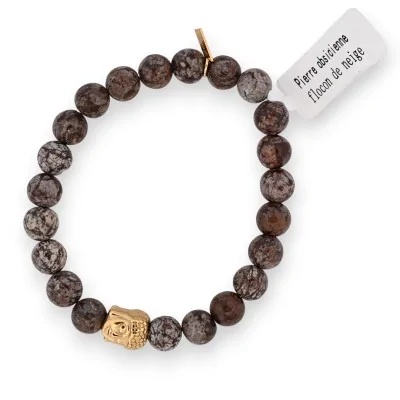
Obsidian comes in several visually distinct varieties: classic black obsidian (the most common), snowflake obsidian (with white cristobalite inclusions), golden obsidian (golden sheen under certain angles), silver obsidian (silver sheen), rainbow obsidian (multicoloured iridescences), mahogany obsidian (with reddish zones), snowflake obsidian (white cristobalite snowflakes). The bracelet comes mainly in polished round beads (6 mm calibre for a discreet silhouette, 8 mm for a balanced presence, 10 mm for a boho or masculine statement) threaded on stretch elastic. For contrasting chromatic pairings, black obsidian pairs naturally with green stones in strong contrast; see our aventurine section for the classic black obsidian + green aventurine combo balancing protection (black) and luck (green).
In traditional lithotherapy (note: symbolic wellbeing approach, not medical advice), black obsidian is associated with the root chakra (Muladhara). Considered the energy protection stone par excellence, it is traditionally worn to shield against negative energies, anchor in the present, and accompany periods of inner transformation (grief, separation, depression work). The obsidian mirror is used in some shamanic practices for « inner vision » and shadow work. Classic pairings recommend combining it with hematite (strengthen grounding), with black tourmaline (intensify protection), or with labradorite (balance the slightly heavy quality of obsidian with the luminous reflections of labradorite). Which zodiac? Scorpio, Capricorn and Sagittarius are traditionally associated.
A common UK question: which wrist? For obsidian, a stone of protection and grounding, the left wrist is traditionally preferred (receptive side, receive protection). A particular recommendation: crystal healing tradition advises not wearing obsidian continuously for more than a few days at a stretch (the stone « absorbs » negative energies and must be cleaned regularly). Care: clean weekly under cool clear water (obsidian does not fear water), recharge on an amethyst geode or briefly expose to moonlight. Avoid salt and aggressive cosmetics. The stone being naturally sharp (conchoidal fracture), inspect beads regularly for micro-fissures. For more discreet lithotherapy supports, see also our lithotherapy earrings.
Obsidian is an energetically very powerful stone, and crystal healing tradition recommends approaching it with discernment: it is not recommended for very anxious people, those experiencing severe depression, or the highly sensitive (the stone can amplify psychological work and destabilise those not ready to face their shadows). For children, prefer a softer snowflake obsidian. For pregnant women, some practitioners advise against intense black obsidian, although there is no scientific basis: case by case according to sensitivity.
Natural obsidian shows a conchoidal fracture visible with a magnifying glass (shell-shape pattern), a dense weight for the volume, coolness to the touch. Coloured glass imitations on the contrary show internal air bubbles (visible with a magnifying glass), lower weight, and warm quickly in the hand. Obsidian scratches with steel (Mohs 5-5.5) but resists the fingernail. For sky eye or rainbow obsidians, check that the patterns are well integrated in the matrix and not glued on the surface.
Yes, but with a clear intention: it is a gift suited to support a loved one through intense transformation (grief, separation, career change, introspective period), not a casual celebration gift. Obsidian is less « universal » than carnelian or aventurine, but it is very powerful for those who understand its meaning. Accompany with a card explaining the symbolism of protection and grounding.
