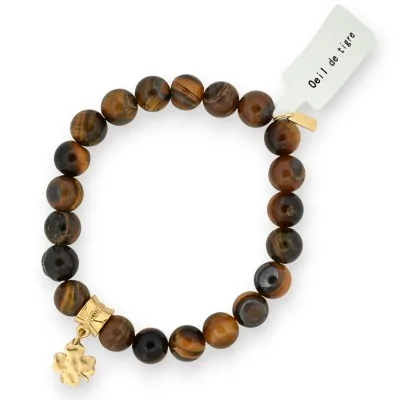
Availability: 1 In Stock

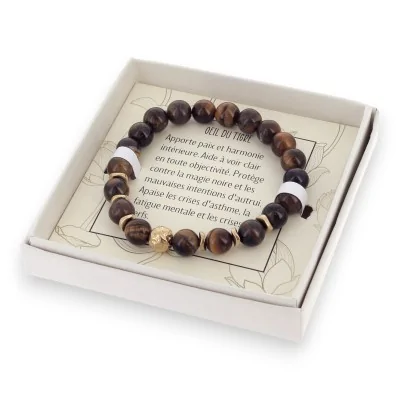
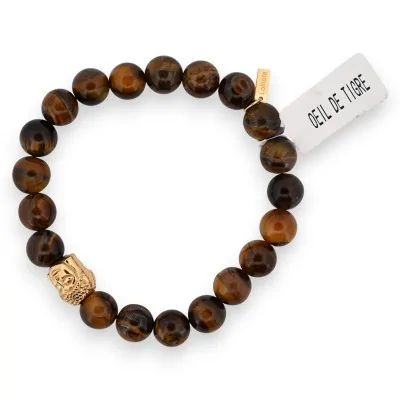
Every bracelet in this section is strung from polished natural tiger's eye beads in the 8 mm size, in the warm brown the stone is known for. What changes from one to the next is the gold detail: a clover, a Buddha, or a small round charm framed by gold-toned spacers. Tilt your wrist under a lamp and the band of light slides across the row; that is where the name comes from.
There are 3 products.
In Britain this is the question that comes up first, and the honest answer is that the stone has simply been marketed hard to men for the last decade. Nothing about it is inherently masculine. What is true is that brown and gold sit comfortably against a shirt cuff or a leather watch strap, which is why the stone turned up so often in men's beaded bracelets, and why a men's tiger's eye bracelet is now a category in its own right. Worn on a smaller wrist, the same 8 mm bead reads quite differently: warmer, closer to a tortoiseshell button than to a piece of kit. Our stock is unisex by design, and the gold detail does more to set the tone than the stone ever will.
The beads are the same across the range, so the choice comes down to fit, fastening and what arrives in the parcel.
| Clover charm | Gold-toned clover charm, colour listed as brown and gold, 8 mm beads. |
|---|---|
| Buddha charm | Strung on elastic cord, sized for a wrist of 6 to 7 inches, roughly 15 to 18 cm, colour listed as brown. |
| Round charm, spacers and Lolilota box | Gold-toned spacers set between the beads, supplied in a gift box, colour listed as brown. |
Sizing on beaded bracelets is less forgiving than on a chain, so measure before you order rather than after. Run a tape measure around the widest part of the wrist, just above the bone, and keep it snug without pressing in. Elastic gives you a little room either side of that figure. A knotted cord does not, so read the fastening on the piece you are looking at before you settle on a size.
Tiger's eye starts life as crocidolite, a fibrous mineral that is slowly replaced by quartz while the fibres stay lined up in the same direction. Iron in the original fibres oxidises to limonite along the way, and that is where the brown and gold comes from. Because the fibres remain parallel, they throw light back as a single narrow band that runs across them, and that band slides as the angle changes. Gemmologists call the effect chatoyancy; everyone else calls it the cat's eye. Two relatives share the structure but not the colour: hawk's eye, which stayed blue-grey because it never oxidised, and the redder bull's eye, which owes its shade to heat rather than to the ground it came from. At 7 on the Mohs scale, the stone is hard enough for daily wear, which is not true of every polished bead on the market.
Judging a beaded bracelet from a photograph is mostly a matter of looking at the whole row rather than one bead. On natural stone no two beads match exactly: the gold runs deeper on some, the band of light widens on one and narrows on the next, and a few will show a darker seam. A row where every bead carries an identical eye of identical width has usually been reconstituted or moulded in glass. The cut matters too, because the band only appears when the bead has been turned the right way against the fibres, so a poorly oriented bead looks flat and muddy next to its neighbours. One last point on colour: green tiger's eye is not a natural colour; it is dyed. The red shades come from heating, an old and accepted treatment that a seller should declare. What you see in this section is the brown and gold the stone carries on its own.
This is a bracelet you can forget about, within reason. Splashes and the odd shower do it no harm, but greasy soap will dull the polish over a few months. A dry cloth is all the upkeep it needs. The parallel fibres do create a line of weakness, so a hard knock against a door frame can split a bead along that line, which is worth remembering if you wear the bracelet while lifting or cycling. Store it flat rather than coiled, and an elastic cord will hold its tension longer. If you want a second piece in stone rather than metal, our earrings threaded with polished stone beads pick up the same warmth somewhere other than the wrist.
Tiger's eye turns up in the amulet traditions of the ancient world, and modern crystal healing has filed it under confidence and self-assertion. That is inherited symbolism, not a property of silica. The tradition earns its keep in pairings, because it keeps pushing brown up against a contrasting colour: haematite for a darker, heavier row, or a pale green stone for the version that reads best in daylight, as our bracelets of green aventurine beads show.
Tiger's eye is one stone among many here, alongside amethyst, labradorite, malachite, rose quartz and agate, each with its own section. If you are shopping by colour rather than by mineral name, working down from the wider family of stone bead bracelets lets you put the shades side by side first and narrow down afterwards.