Availability: 2 In Stock

There are 2 products.
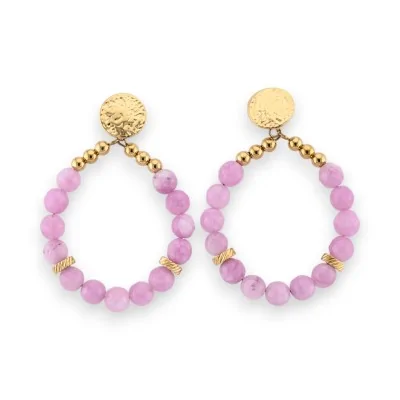
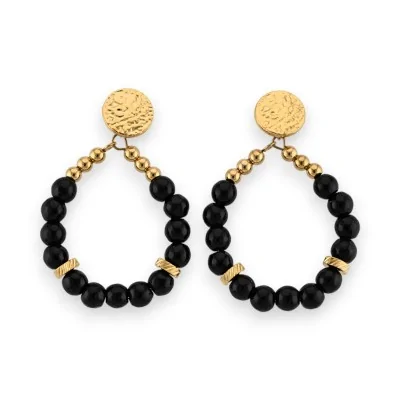
Hoops are the format people reach for when they want the stone without the announcement. A beaded bracelet sits in your eyeline all day, knocks against a desk, catches on a sleeve. A hoop goes on before the kettle boils and stays forgotten until you take it out. That is the whole argument for this section, and it holds up whether you wear stones for the look or for what they mean to you.
Before you pick a colour, pick a size. Some hoops in this section reach five centimetres across, with a textured disc at the top that catches the light as you move. At that width the earring becomes the main piece: a heavy necklace alongside it will fight for attention and both will lose. Smaller hoops that sit close to the lobe do the opposite job, slotting in beside whatever you already wear without asking for space. Neither is better. But getting this wrong is the most common reason a pair ends up back in the box, so the diameter on the product page deserves a proper look.
The metal is settled, so the stone is the only real decision left. Amethyst gives you purple, deeper on some beads than others, and it sits comfortably against a gold tone because neither colour shouts over the other. Black agate does the opposite: hard contrast, almost graphic, more visible from across a room while still reading as restrained. Your own colouring matters too. Purple tends to disappear against fair hair and comes forward against dark; black behaves the other way round.
| Stone | What you actually see | Reads best with | Worth knowing |
|---|---|---|---|
| Amethyst | Purple, varying in depth from bead to bead | Warm tones, dark hair, pale knitwear | Shade shifts between batches |
| Black agate | Deep, even black | Strong gold, darker or sharper outfits | The black comes from colour treatment |
Worth being straight about this. The deep black on agate beads sold across the jewellery trade is very largely the result of colour treatment, and we are not going to present that shade as something that came out of the ground looking like this. What we describe is the colour you will receive, which is the part that matters when you are choosing. Amethyst is a different story: the purple varies from batch to batch, as it does on any stone cut into beads, and the product photographs show that variation rather than hiding it. Anyone who has bought stone beads before will recognise both situations.
The steel ring handles daily wear without complaint. The bead is the part that needs a little thought. Take the hoops out before showering, swimming and going in the sea, because chlorine and salt work on a stone surface far faster than on metal, and a treated bead can dull. Hairspray and perfume deserve the same treatment: spray first, put the earrings in afterwards, never the reverse. Beyond that a soft cloth now and then is enough, with no product and no rubbing at the stone itself. Stored flat rather than tipped into a dish with everything else, hoops keep their round shape instead of slowly going oval.
Most people arrive here already owning a bracelet, which makes the decision easy: repeat the stone and the two pieces read as a deliberate pair rather than two things bought separately. It works in the other direction too, and starting with the ears is arguably the smarter route when you are unsure about a colour, because a stone you cannot see on yourself all day is one you adjust to faster. The same minerals worn on the wrist are gathered in a section considerably larger than this one.
If the colour is settled and only the format is still open, there is a quicker route. One section pulls together everything set with purple stone beads, wrist and ears in the same place, which saves working through the range twice.
The darker option is organised the same way: the agate pieces gathered together, with whatever variation in depth the stone allows from one batch to the next. One stone repeated across two pieces stays the simplest set to wear and the easiest to add to later, which is why it is worth deciding the stone before the shape.
Roughly the length of the ear itself on most people, which is why a hoop that size behaves as the main piece rather than an accent. Hold a ruler against your lobe before ordering if wide hoops are new to you. It is a surprisingly effective test and it takes ten seconds.
We would rather not promise what the product page does not state. These listings declare colour, not plating thickness or the process used, so we cannot tell you how many years the finish will hold. What we can say is that keeping the hoops away from perfume, chlorine and abrasive cloths is what makes the difference on any gold-tone piece.
They are matched at assembly, but beads cut from stone never come out exactly alike. Expect a small difference in depth or veining between left and right. That is the material behaving normally, and it is the clearest way to tell a stone bead from a coloured glass one at arm's length.