Availability: 6 In Stock

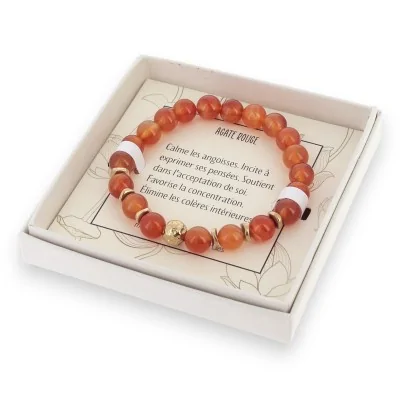
Two shades of agate sit in this section: Indian agate, where green and grey drift across every bead, and a deeper red agate that reads as one solid colour. Beads are round, polished and 8 mm throughout. What changes from one bracelet to the next is the gold detail, whether that is a star charm, a flat round medal, or a small sphere set between spacers. A few arrive boxed, which makes the gift decision easy.
There are 4 products.
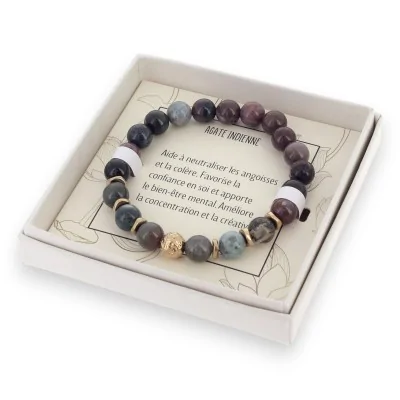
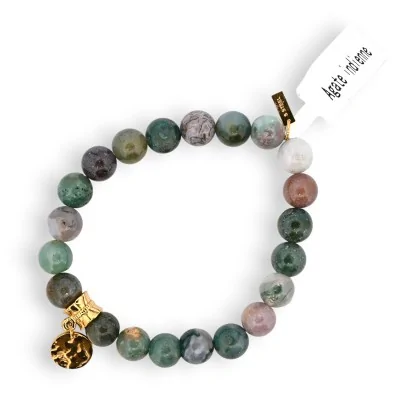
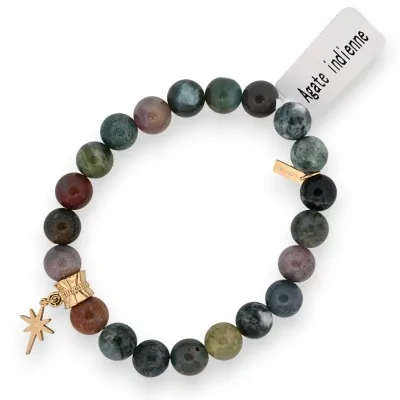
Because every bracelet here uses the same 8 mm bead, the decision comes down to the metalwork sitting among the stones. That is unusual for a stone section, and it makes shopping quicker. A star charm keeps things light and slightly graphic, the sort of piece that holds its own on a bare wrist. A round medal does the opposite: it gives a flat, reflective surface that steadies the mottled beads beside it. The spherical charm with spacers spreads small points of gold along the whole strand, which photographs well and dresses up a plain sleeve.
| Finish | Effect on the wrist | Works well when |
|---|---|---|
| Star charm | One small accent, otherwise all stone | You want the beads to do the talking |
| Round medal | A flat gold surface catching the light | You like a focal point, worn on its own |
| Sphere with spacers | Gold repeated at intervals along the strand | You stack bracelets and want them to tie together |
Indian agate is the quieter of the two. Its beads shift between green, grey and brown, and no two sit exactly alike, so the strand looks lived in rather than manufactured. Red agate is the statement: warm, even, and easy to pair with gold. One thing is worth saying plainly. We describe the colour as it is supplied and make no claim about how it was obtained, because strong reds in this part of the market are commonly the result of colour treatment and nothing on our product pages proves otherwise. If you would rather compare stones before deciding, the wider stone selection sets them out one by one.
An 8 mm strand is the middle ground of bead jewellery. It has enough presence to be seen under a cuff, yet it does not swallow a slim wrist the way a chunky bead can. Worn alone it looks deliberate. Worn with a thin chain or a soft watch strap it becomes the textured element that stops a stack from looking flat. Most people settle it on the less active hand, simply to spare it the rub of a desk edge or a keyboard. Sizing is the one thing to check before ordering, as the fastening is not the same on every piece and the wrist measurement is given on each product page. For other stones assembled the same way, see what else is strung on this format.
Agate belongs to the chalcedony family, a microcrystalline silica that sits near 7 on the Mohs scale. In practice the beads resist scratching far better than soft stones such as turquoise or howlite, and they tolerate daily handling without fuss. Two simple habits protect the polish and the colour. Keep the strand away from perfume, hairspray and household cleaners, which dull a polished surface over time, and wipe the beads with a dry, soft cloth instead of rinsing them. Where colour has been introduced by treatment, long spells in direct sun will eventually fade it, so storing the bracelet in a pouch or in the box supplied with some pieces is worth the small effort.
Crystal healing is a symbolic practice, not medicine, and nothing here replaces professional advice. With that said, agate has an unusually long history in the tradition. It is classed among the grounding stones, associated with steadiness rather than momentum, and often chosen for periods when life is in flux. The red variety leans towards drive and activity in that reading, while the mottled stone is linked with patience. In Britain agate also carries a decorative history of its own, from banded pebble jewellery to Victorian brooches, which is part of why the stone still feels familiar rather than exotic. Plenty of buyers pick a stone for the intention as much as the colour, and the two usually point the same way.
No. Both are agate, a banded form of chalcedony. The trade name Indian agate covers stones with mixed natural tones, mostly greens, greys and browns, while red agate refers to a single even shade. What you see on the wrist is a colour difference, not a mineral one.
An occasional splash does no harm, since agate is a hard silica and not porous in the way a soft stone is. Repeated showers are a different matter, mostly because soap film settles between the beads and takes the shine off. Take the bracelet off first and you will not have to think about it again.
It is one of the easier stones to give. There is no special care routine to explain, the colour suits most wardrobes, and a bead strand is forgiving about sizing. Some pieces come boxed already. If earrings are more the person's habit, the same stones turn up in that shape too.