Availability: 2 In Stock

There are 2 products.
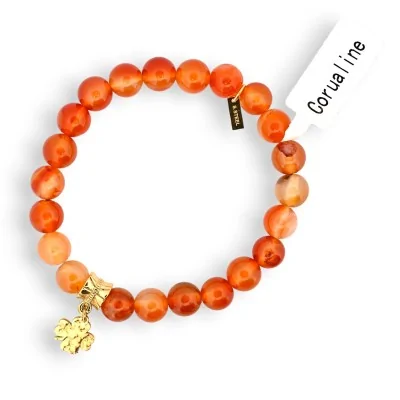
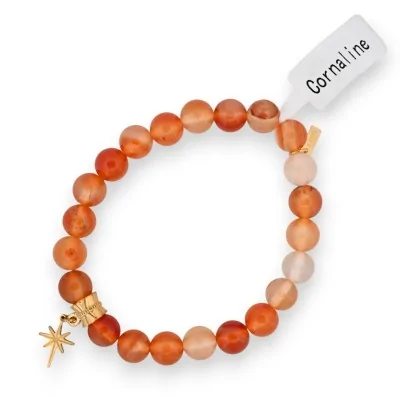
One charm hangs from each strand, clipped to a small gold-tone bail that sits among the beads: a fine-pointed star on one bracelet, a four-leaf clover on the other. A stainless steel tag sits alongside the charm. Nothing else interrupts the row.
Gold behaves differently here from the way it does against a cool stone. It sits inside the same warm range as the orange instead of cutting across it, so the charm reads as part of the bracelet rather than a contrast to it. Silver would fight the stone; gold lets it carry on.
Orange is the only colour declared on these bracelets, which undersells what turns up on the wrist. Some beads are dense and near-red, opaque all the way through. Others hold a pale, almost beige core with a faint band running across it at an angle. A few are translucent enough to glow when the light comes from behind.
That unevenness is worth knowing before you order. No two strands come out the same, so the bracelet you receive will never be the twin of the photograph. Read it as the ordinary spread of the material rather than a flaw in the batch.
Warm stones are easier to place than they look. Carnelian sits well with raw denim, cream, camel and any brown, and it looks awkward next to a strong pink or a bright blue, which competes for the same eye. If you like the warm end of the range, Indian and red agate sit on the neighbouring page.
Two strands are plenty in a stack. Pair the carnelian with something plain: grey, off-white or black, and let the gold do the talking. One charm to a wrist stops the motifs arguing. The rest of the beaded strands, warm stones and cool ones alike, sit together on one page.
The stone itself is hard and takes daily wear without complaint. It is the gold finish that goes first, well before the beads, and chlorine and perfume dull it faster than any amount of knocking about. Take the bracelet off before the pool, the shower and the gym, and roll it over your hand rather than forcing the row open.
| Colour | Orange, brick red through to pale apricot, uneven along a single strand. |
|---|---|
| Bead size | 8 mm, as stated on each product page in this category. |
| Strand | Continuous row of beads with no clasp visible in the photographs; the detail is given on each product page. |
| Charm | One only, gold-tone, star or clover. |
| Care | Soft, barely damp cloth, dry fully, store flat. |
It is a chalcedony, a member of the quartz family, coloured by iron oxides and cut and polished since antiquity for seals and signet stones. Most carnelian sold as beads has been heated or dyed somewhere along the way, so we describe the shade supplied rather than promise an untreated stone. Colour and bead size are the only figures the product pages declare.
It does. At 8 mm the beads sit mid-range, neither delicate nor chunky, and the row slips over the hand with no clasp to work. On a wider wrist a single strand looks better than a stack.
The banding is the tell: agate shows sharp, well-defined stripes, while carnelian is generally even in colour or only faintly zoned, in an orange that runs from red to pale apricot. The two come from the same family of stone, so on a strung bracelet the fastest check is how regular the banding stays from one bead to the next.