
Availability: 2 In Stock

Every brooch in this section shows a stylised elephant and fastens with a magnet, so nothing has to go through the fabric. That is the one feature they all share. Colour, decoration and size change from one design to the next, and each product page spells them out. In practice you will choose by colour first, then by the garment you have in mind, since the same brooch reads very differently on a silk scarf and on a wool coat.
There are 3 products.
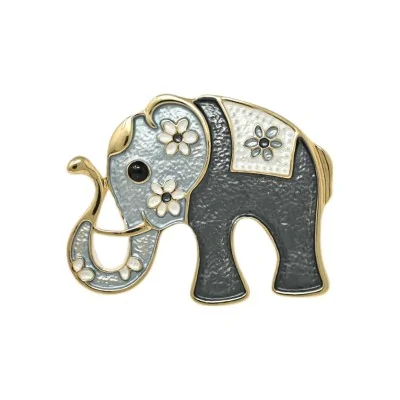
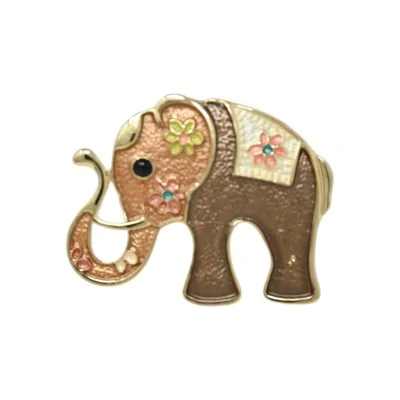
The magnet works through the fabric, so the thinner the fabric, the firmer the grip. That single rule explains almost every case, and it is worth knowing before you attach anything to a winter coat. The table below sets out what to expect from the fabrics most of us actually wear.
| Blouses, silk scarves, light knits | The firmest hold of all. The two halves sit close together and the brooch stays put through a full day. |
|---|---|
| Shirt collars, viscose dresses, shawls | Reliable. Place it near a seam or a folded edge and it will not wander. |
| Jacket lapels, blazers | Good, provided you use the lapel itself rather than the padded body of the jacket. |
| Heavy wool, quilted coats, padded jackets | Less certain. Look for a spot where the fabric is a single layer, such as a lapel or a pocket flap. |
The grey design is the quiet one. A marbled body, a black glittery trunk, a pearly ear: it plays with light rather than colour, and it reads well against charcoal or navy. The brown and salmon design goes the other way, with small pink and green flowers, gold detailing and a black cabochon for the eye, all of which warm up camel, beige and rust. Between the two sits the grey and white piece, edged with gold and decorated with a floral pattern, bold enough to be noticed across a room on a plain jacket. If you are unsure, the colour listed on the product page is the reference to trust.
These are not statement brooches that take over a coat. Where the measurement is given, the pieces run from 4.7 to 5 cm, which is roughly the width of two fingers. That size sits comfortably on a narrow lapel without dragging it out of shape, and it also means you can wear two of them, one on a collar point and one on a bag strap, without the effect becoming heavy. Anything smaller would disappear on a coat; anything much larger would need a sturdier backing than a magnet.
A traditional pin pushes a shaft through the weave and leaves a visible mark on fine knitwear. Here the motif sits on the front, the magnetic backing goes behind, and the two hold each other. You can move the brooch at lunchtime from a lapel to a bag strap and back again, as often as you like, without worrying about damage. On a loosely knitted collar, where a pin would eventually snag a thread, that difference is the whole point. It also makes the brooches easy to lend, borrow and pass on, since nothing about them is fitted to one particular garment. And when you take one off in the evening, the fabric underneath looks exactly as it did in the morning, with no puncture mark to smooth out and no loose thread to trim.
Take the brooch off by sliding the two halves apart rather than pulling them straight off, so the fabric is never tugged. Store each piece flat, in its own small pouch: left loose in a bag, it will rub against keys, coins and hairgrips, and the painted areas chip when metal knocks against them. A dry, soft cloth is enough to bring the gold detailing back to life. Keep water, household cleaners and perfume sprayed at close range away from painted decoration, which dulls sooner than plated metal does.
Elephants are one motif among many here. The full range of animal designs uses the same magnetic fastening across very different silhouettes, from lifelike to almost graphic.
If you would rather widen the search altogether, the brooches section also brings together floral, geometric and costume pieces, with or without a magnet depending on the design.