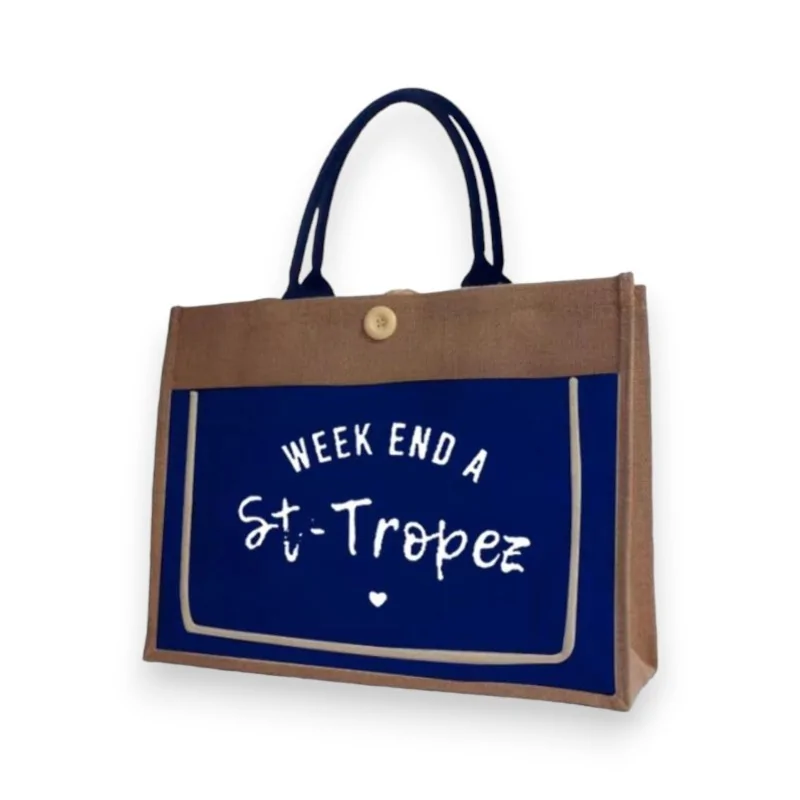


One navy panel across the front, framed by a thin ecru line, with Week end a St-Tropez printed in white and a small heart underneath. Behind it sits an open-woven beige cloth that runs over the top band, down the gussets and under the bag.
There is no zip. The top edge stays open from one side to the other, the base is flat and the sides are gusseted, so the bag holds its shape once it is set down. Two rounded navy handles carry it by hand or over a shoulder, and a light wooden-look button marks the middle of the upper band.
The whole of the front is given over to a single navy rectangle, laid on the beige weave and framed by a thin ecru line that follows its rounded corners. Inside it sits the print: WEEK END A in plain capitals, then St-Tropez underneath in a loose handwritten script, with a small white heart closing the group. Nothing is embroidered or raised here; it is flat white print on navy, which is why it still reads from the other side of a room. That one panel is the whole decoration of the bag, and nothing else has been added around it.
A round, light wood-toned button with four holes sits in the middle of the upper band, and the two handles are stitched either side of it. They are rounded rather than flat, and long enough to go over a shoulder as readily as into a hand. They also clear the top edge by a fair margin, so the bag can hang from a forearm while both hands are busy. Both handles repeat the navy of the panel, which keeps the fittings in line with the front rather than introducing a third colour of their own.
The listed colour is navy blue and beige, and that is exactly what the bag gives you. The beige comes from an open, visibly woven natural cloth that runs across the top band, down both gussets and under the base. Seen at an angle, the weave is open enough to pick out the individual threads, and the band along the top is cut from the same cloth as the sides. The navy shows up in two places only: the front panel and the pair of handles. There is no secondary pattern, no metal plate and no contrast stitching competing for attention, which is what keeps the bag wearable well past the end of August.
There is no zip and no flap. The top edge runs straight across and stays open, so a swimsuit or a notebook goes in without any rummaging at the bottom. A flat base and gusseted sides are what make the bag stand up on its own once you set it down, instead of folding in on itself. It is noticeably wider than it is tall, nearer to a box than to the soft totes you fold away in a drawer between outings, and it will sit upright in a boot or a hallway. You can compare it with the totes that keep their shape in the same section.
The width and the open top point it first at the beach, the market and a Saturday run around town: a towel, a hat and a water bottle all lie flat across the base. In town the natural weave sits easily with denim or a summer dress, and the navy panel stops it reading as a plain carrier bag. Because the decoration is a single line of print, it moves from a seaside afternoon to a commute without looking like fancy dress. If you like the idea in a plaited fibre instead, see what the straw side of the range looks like.
Data sheet