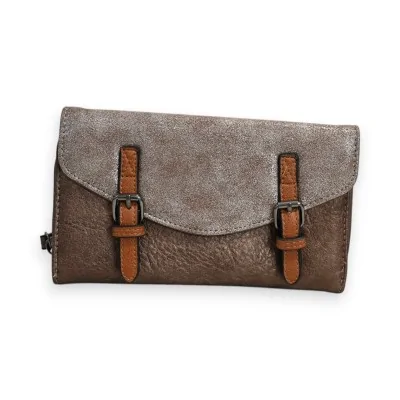
A long wallet cut from printed cork, fastened by a shaped flap that clicks shut on a single press-stud. No zip to run round three sides, no buckle to thread.
The chevron print covers both outer faces, though not with the same drawing on each. Inside, a taupe lining, gussets for notes and papers, a zipped pocket for coins, and card slots cut from plain cork. Size 20x10.50cm.
Open this wallet and nothing has to be unwound. A rounded tongue of printed cork reaches over from the back, crosses the side and snaps down on one gold-toned press-stud. That matters at a till: you can work the flap with the hand holding the wallet, while the other one is busy with a card or a basket. A zip-around model wants both hands, and ideally a flat surface.
Most printed accessories repeat the same motif front and back. Here the pattern shifts. One face is given over to green and blue chevrons, ranked in mirrored bands over the pale grain of the cork; turn the wallet over and red and orange shapes take the lead, with the blue-green zigzags pushed out to the edges. Which face you show is a decision you make when you put it down on a table.
The inside drops the noise completely. A matt taupe fabric lines the whole opening, and soft gussets fold out to separate notes from folded papers. Coins go in a zipped pocket with a gold-toned slider, closed off from everything else, so nothing rattles loose into the note section. A row of card slots is cut from plain, unprinted cork and sits along the top edge once the wallet lies open.
| Material | Printed cork, card slots in plain cork |
|---|---|
| Size | 20x10.50cm |
| Fastening | Side flap with gold-toned press-stud |
| Lining | Matt taupe fabric with fold-out gussets |
| Coins | Zipped pocket, gold-toned slider |
At that length, notes stay flat and the wallet stands upright against the lining of a handbag rather than sliding under everything else. It will not disappear into a jacket pocket, which is the trade-off. If a shorter shape suits your pockets better, wallets grouped by size and fastening make that comparison quick.
Harvested as bark that the cork oak replaces by itself, the material is light in the hand and keeps a faint ridging you can feel under the thumb. Printed cork minds standing water and solvents far more than it minds daily handling, so blot a spill instead of letting it dry in. Scuffs vanish into that grain more readily than they would on a smooth finish.
A print this loud asks for quiet around it: a navy trench, grey flannel, a plain white shirt. Put it beside a second pattern and the two argue. What else sits on the small leather goods shelf follows the same reasoning, pouches and coin purses included.

Data sheet