Availability: 2 In Stock

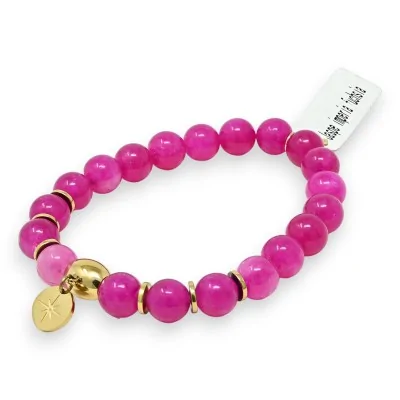
Two jaspers sit on this shelf, and they pull in opposite directions. One is speckled cream with a four-leaf clover; the other is hot pink with a star medallion. Both are strung on stretch elastic, so there is no clasp to fiddle with. No two beads carry quite the same marking.
There are 2 products.
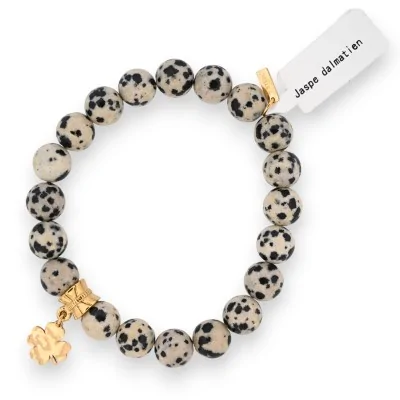
Ask yourself what the bracelet has to sit next to. The dalmatian disappears happily into linen, denim and anything oatmeal. The fuchsia does not disappear anywhere, which is rather the point of it.
| Dalmatian jasper | Matt beads, cream ground flecked with irregular black spots | Neutrals, gold-tone jewellery, stacked with plainer bands |
|---|---|---|
| Fuchsia imperial jasper | Glossy beads, deep pink shot through with paler veining | Worn alone, against black or cream rather than another strong colour |
Stretch elastic forgives a wrist you have guessed at, which is why it beats a clasped chain as a present. Roll it over the knuckles rather than yanking the thread: a sharp pull is what eventually kills the cord. Bead diameters on the market cluster at 6, 8 and 10 mm; the dalmatian here is strung at 8 mm, big enough to read across a room without weighing down the wrist. If you like a stack, pair one pale stone with one dark rather than two mid tones. Other stones that work the same way on the wrist are just next door.
Under the one name sit dozens of opaque microcrystalline silicas, each taking its colour from whatever minerals happened to be present. That is why the brick red of one variety, the green and brown of ocean jasper and the horizon-like markings of landscape jasper look nothing like one another. Those varieties are not all strung into bracelets here; the grid above shows what is actually on offer. On hardness, jasper sits between 6.5 and 7 on the Mohs scale, which puts it near the tough end of the ornamental stones.
British crystal healing files jasper under grounding stones, tied to the root chakra and to the idea of staying steady. Each variety then picks up its own shade of meaning: play and lightness for the dalmatian, drive and nerve for the red. It is a symbolic vocabulary passed down from practitioner to practitioner, and plenty of customers still reach for it when choosing one stone over another.
Better not. Keep it clear of long soaks, perfume and household cleaners, for the sake of the cord as much as the gold-tone parts. A soft cloth is all the cleaning it needs. For stone beads at the ears, look at the hoop version in gold-tone steel.
The dalmatian, nine times out of ten. It is the safer bet for someone whose jewellery you have never really studied, and it reads as a first stone. Save the fuchsia for a person who already wears gold tones and is not shy about colour.