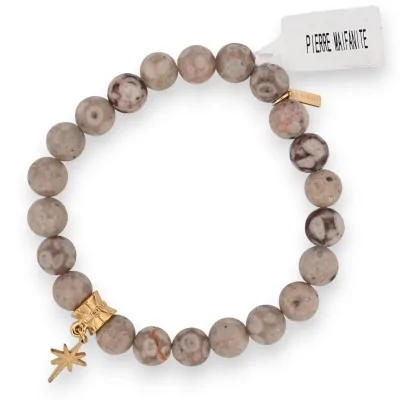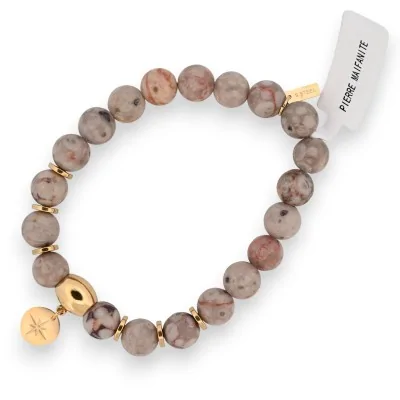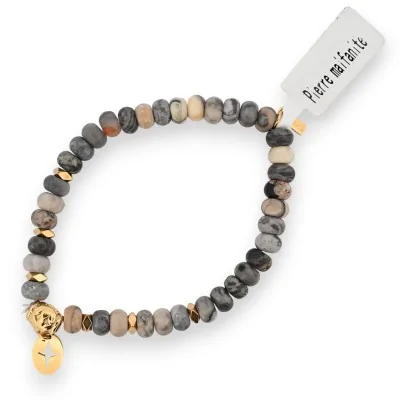
Our maifanite bracelet selection brings together bracelets in the grey medicinal stone of Traditional Chinese Medicine, polished beads on stretch elastic for everyday wear. A volcanic rock from China (Inner Mongolia, Yunnan) used in TCM for over 2000 years, maifanite (麦饭石, maifanshi) is traditionally associated with detoxification, water mineralisation and digestive wellbeing. A niche stone in the UK still little-known but growing among practitioners of acupuncture and TCM in London and Manchester.

Our maifanite bracelet selection brings together bracelets in a niche stone of crystal healing from Chinese origin, polished beads on stretch elastic for everyday wear. A microporous volcanic rock rich in silica, alumina, calcium, potassium, magnesium and trace elements (over 30 different minerals identified), maifanite (Chinese 麦饭石, pronounced maifanshi) has been used in Traditional Chinese Medicine (TCM) since the Tang dynasty (618-907) for its water mineralisation and digestive support properties. It remains a rare niche stone in the UK, little-known but growing among practitioners of acupuncture and TCM in London, Manchester and Edinburgh.

Geological identity of maifanite

Maifanite is a microporous volcanic rock of altered rhyolite type, rich in silica (SiO2 about 65%), alumina (Al2O3), calcium, potassium, magnesium and trace elements. Its exceptional microporous structure (millions of micro-cavities per cm³) gives it a large specific contact surface and explains its historic capacity to mineralise water (slow release of trace elements). Its grey palette nuanced with beige and light brown is not visually spectacular but remains recognisable by its slightly grainy texture even after polishing. Its Mohs hardness (5-6) makes it a moderately soft stone, to be protected from shocks. Main deposits are in Inner Mongolia (China, historic source), Yunnan, Shandong and Hubei, with very controlled production by the Chinese government (maifanite is classified as a mineral stone of medical use in China). To browse the wider universe of energy stones, see our crystal healing bracelets section.

Maifanite in the British TCM and acupuncture wellness movement

In Britain, maifanite has begun appearing in crystal healing bracelets since 2018, carried by two converging movements: the British enthusiasm for Traditional Chinese Medicine (TCM clinics across London, Manchester and Edinburgh, registered acupuncturists through the British Acupuncture Council, Chinese medicine practitioners at the Asante Academy in London), and the seek-the-different trend among crystal collectors who already own all the classics (amethyst, rose quartz, tiger's eye, obsidian, black tourmaline). Maifanite occupies a niche position in the UK market: few specialised retailers know it, which makes it an original gift for informed enthusiasts. Its relative commercial rarity also makes it interesting for collectors wishing to complete their rare stones collection. The Chinese expat community in Britain (particularly in London's Chinatown and Manchester's Northern Quarter) maintains traditional knowledge of maifanite's TCM uses. Our selection fits this approach of widening the traditional palette: natural polished beads, fair pricing, controlled sourcing.

Formats and finishes of the maifanite bracelet

Maifanite comes mainly in polished round beads (6 mm calibre for a discreet silhouette, 8 mm for a balanced presence, 10 mm for a boho statement) threaded on stretch elastic. The colour remains fairly uniform in the grey-beige range: light grey maifanite (most widespread), grey-brown maifanite (with visible inclusions), classic Chinese maifanite (uniform grey with grainy micro-texture). For chromatic pairings, grey maifanite pairs naturally with more colourful stones that bring visual contrast; see our aventurine section for a balanced maifanite + aventurine combination where the neutral grey lets the green express its vivacity, particularly suited to people wanting a sober functional combination.

Traditional properties and stone pairings

In traditional Chinese lithotherapy (TCM, note: symbolic and energetic approach, not Western medical advice), maifanite is associated with the spleen-pancreas meridian and the stomach meridian, linked to digestion, the transformation of food into vital energy (Qi), and the balance of body fluids. TCM tradition classes it among the gentle « yang » stones (moderate warm energy) that complement more soothing « yin » stones like fluorite or sodalite. Classic pairings recommend combining it with tiger's eye (strengthen grounding and digestion), with clear quartz (amplify the general effect), or with blue sodalite (balance yang and yin).

How to wear your maifanite bracelet day to day

A common UK question: which wrist? For maifanite, a stone of transformation and digestive balance, the left wrist is traditionally preferred in TCM (yin side, inner integration). Tradition recommends wearing maifanite close to the spleen-pancreas meridian (left forearm). Care: maifanite is microporous and must be protected from contamination (perfumes, cosmetics, chlorinated water). Clean gently with pure spring water (which will itself be mineralised by the stone) then dry with a clean cloth. Recharge on an amethyst geode or in plain earth. Avoid shocks (Mohs 5-6, softer than quartz). For more discreet lithotherapy supports, see also our lithotherapy earrings.

Frequently asked questions about maifanite bracelets

Does maifanite really mineralise water?

This property is the subject of studies in China (Inner Mongolia University and Peking University) which have confirmed slow release of calcium, magnesium and trace elements into water in prolonged contact with raw maifanite. However, the polished bead bracelet whose surface is smooth does not have this effect (the micro-pores are only active in the raw unpolished state). For water mineralisation use, use raw maifanite stones sold separately, not the bracelet.

How can I tell real maifanite from an imitation?

Natural maifanite shows a grainy texture visible even after polishing (different from the smooth grey of howlite or grey agate), modest weight for the volume (slightly lighter than quartz), and a natural grey-beige colour without saturation. Coloured ceramic or reconstituted stone paste imitations are too uniform and too hard. Our selection guarantees the authentic Chinese origin of maifanite.

Is maifanite a good gift?

An excellent original gift for someone interested in Chinese medicine, holistic nutrition, yoga or Asian wellness practices. Particularly suited to people who already own the classic stones and seek originality. 8 mm calibre for a visible presence. Add a short explanation of the TCM tradition (the stone is still little-known, the explanation strengthens the perceived value of the gift).