Availability: 1 In Stock

This range brings together bracelets strung from polished rose quartz beads, in a pale pink that lets light through without ever turning clear. Every strand carries a piece of gold-toned metal: a star medallion, a clover charm, or gold accents framing a central sphere. The colour shifts from one bead to the next, deeper here, almost white there. Bead size and the way each strand is built are given on the product page.
There are 3 products.
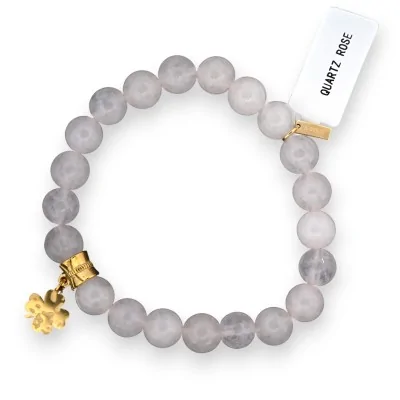
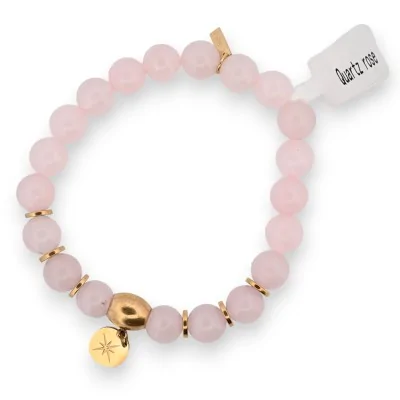
All three strands share the same base: round polished beads, pale pink. What separates them is the gold, and where it sits.
| Gold detail | How the strand is built |
|---|---|
| Star medallion | Engraved medallion hanging from the strand, with fine gold rings set between the 8 mm beads. |
| Clover charm | Small gold clover on a strand strung on stretch elastic. |
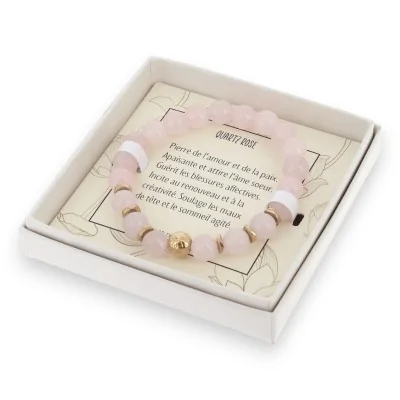
| Central sphere | 8 mm beads with gold accents spread along the strand; the bracelet arrives in its own gift box. |
A medallion pulls the eye to one point and still registers across a room. The clover only shows itself when the hand moves. Accents set along the strand do the opposite of both: they spread the gold out and let the stone lead. Wrist size and the fastening vary from one piece to the next, so the product page is the one to check.
Rose quartz is a massive variety of quartz. Its colour comes from very fine fibrous inclusions dispersed through the crystal, far too small to see, yet numerous enough to scatter light. That is why the stone stays translucent rather than fully transparent, with the milky veil that makes it recognisable. Those same fibres sometimes throw a faint star across a bead turned towards direct light. Look closely at any strand and you will see the colour is never quite even: one bead leans white, its neighbour holds a deeper pink, and pale frosting runs through others.
Pale pink layers easily, because it competes with almost nothing. Against a black sleeve or raw denim the strand looks lighter than it really is, while on cream or camel it settles back and needs the gold to stand out. If you want a second strand rather than a contrast, purple is the natural neighbour: same quartz family, no change of material, just a deeper tone. You will find exactly that in the purple strands of amethyst.
The build is worth comparing too. Beads on a cord and rigid bangles do not sit on the wrist in the same way, and the full range of stone strands and bangles puts the two side by side.
The rose quartz on the market is mined mainly in Brazil, Madagascar, Namibia, India and South Africa. It reaches a Mohs hardness of 7, which is why it takes daily wear better than softer stones: a watch case or a clasp will not scratch it in ordinary use. Two things do shorten its life. Long, repeated exposure to sunlight slowly drains the pink, so a drawer suits it better than a windowsill. And perfume, hand cream and rich soap build up between the beads and slacken the cord. A dry, soft cloth at the end of the day keeps the polish, and storing the bracelet flat holds the strand in shape.
Rose quartz has long been filed under tenderness and attachment, and modern crystal lore has made it the stone of love in all its forms. That is an inherited symbolic use, handed down from one tradition to the next, not a property of the mineral: silica acts on neither mood nor health. That symbolism does explain why these bracelets are bought as gifts so often, for a birthday, a new baby or a friendship that has lasted.