Availability: 2 In Stock

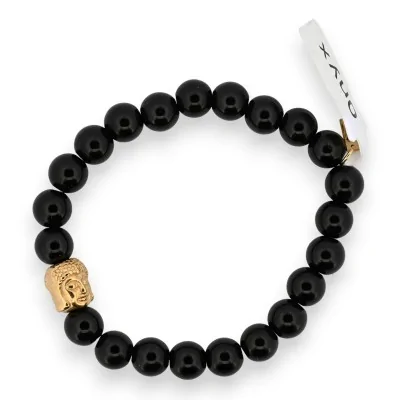
Our onyx page brings together the black bead bracelet from the Mode Tendance selection, strung on elastic cord with a single gold-plated Buddha head among the beads. Onyx is the black variety of chalcedony, dense and glossy once polished, and crystal healing tradition treats it as a grounding stone. It is the quiet piece you reach for on a Monday and forget to take off by Friday, worn on its own or pushed up against a watch strap.
There is 1 product.
Black has never needed an argument in jewellery. It sits under a rolled shirt sleeve, it survives every change of season, and it flatters skin tones that fussier colours fight with. An onyx bracelet takes that reasoning and gives it weight, quite literally: polished stone has a density you register the moment the strand settles on your wrist.
This one is built plainly, and that restraint is rather the point. Round onyx beads of 8 mm run the full circumference, evenly polished, with no pale banding across them. A single gold-plated Buddha head sits among them as the only interruption, worn to the side of the wrist rather than dead centre. There is no clasp: the beads are strung on elastic cord, so it goes on one-handed and there is no tiny catch to fumble with in a hurry.
| Stone | Onyx, the black variety of chalcedony |
|---|---|
| Declared colour | Black |
| Bead diameter | 8 mm |
| Construction | Elastic cord, no clasp |
| Accent | Gold-plated Buddha head |
Britain has an unusually deep relationship with black jewellery, and it started with grief rather than fashion. After 1861 the court went into prolonged mourning, and jet from the Whitby cliffs became the material of the moment because etiquette permitted almost nothing else. Onyx followed close behind, as demand outran what the Yorkshire coast could supply. What began as a rule of dress ended up as a habit of taste: by the Edwardian years black stones had shed the mourning association entirely and were simply worn because the contrast against pearl, jet-black against cream, looked superb. That habit never really left British jewellery boxes.
Onyx belongs to the chalcedony family, a form of silica whose crystals are far too small to pick out by eye. That tight structure is what allows the polished surface to come up almost lacquered, without the visible inclusions you would find in quartz. On the Mohs scale it measures roughly 6.5 to 7, which puts it among the hard stones and means a bracelet takes the ordinary knocks of a desk, a steering wheel and a coat sleeve without scuffing. If you want to see how the same bead work looks in other minerals, the full range sits on our page for stones strung as wrist beads.
A caveat first, because it matters: crystal healing is a symbolic wellbeing practice, not medicine, and nothing here replaces professional advice. Within that tradition, onyx is filed under the grounding stones and linked to the root chakra. The words that come up again and again are steadiness and the ability to hold your nerve through a stretch that is asking a lot of you, whether that is a demanding quarter at work, a bereavement or a spell of genuine uncertainty. Plenty of people describe something more practical than mystical: rolling the beads under the thumb is a small, repeatable gesture that pulls attention back when it wanders.
Close up you see individual beads, the gold head, the tiny gaps where the cord shows. From three metres away all of that collapses into a single dark band, and that is the view most people actually get of your wrist. It changes what is worth pairing. A difference of finish, gloss beside matte, disappears entirely at that distance and only rewards the person wearing it. A difference of colour survives: a warm orange tone next to the black still registers as two things rather than one, which is why a strand of warm carnelian is the pairing that photographs well and the subtle one is a pleasure reserved for the wearer.
Nobody takes a bracelet off twenty times a day, so the honest question is what happens when you forget. Handwashing is the usual culprit. The stone itself shrugs off water, but soap dries into the gaps between beads and leaves a dull film, and repeated soaking gradually softens the tension in the elastic cord until the strand hangs loose. Sliding it up the forearm before you reach the tap takes a second and spares you both problems. If it does get a soaking, lay it flat on a towel and let it dry properly rather than putting it straight back on damp. Prefer something smaller in the same material? Our stone beads worn at the ear work on exactly the same principle.
Both, and 8 mm is the reason it travels so well. It reads clearly on a slim wrist without becoming a cuff, and it still holds its own next to a watch on a broader one. The gold-plated Buddha head is the only note of warmth in the piece and pushes it towards spiritual jewellery rather than anything gendered.
Two habits cover it. Put hand cream and perfume on before the bracelet goes on, not after, and give the beads an occasional wipe with a dry soft cloth. Most of the time a bracelet that looks tired is simply carrying a film of cosmetics on the polish rather than any change in the stone itself.
It is a forgiving gift, which is exactly what you want when you are buying for someone whose taste you only half know. The elastic removes any sizing guesswork and black slots into whatever they already own. It lands particularly well as a marker for something: a new role, a qualification finished, a difficult year seen off.