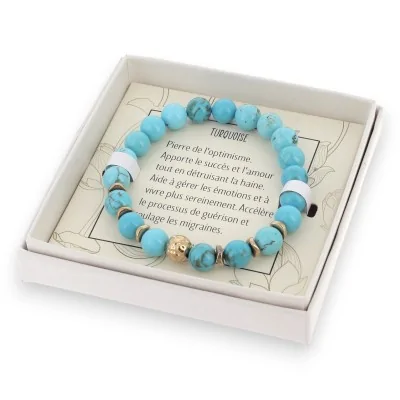
Availability: 4 In Stock

There is 1 product.
Copper pulls turquoise towards blue, iron pushes it towards green. That single fact explains why two beads cut from the same seam can look like different stones, one a clean robin's egg blue, the other closer to a pale sea green. On a beaded bracelet you see the whole spread at once, and that unevenness is the stone behaving normally rather than a fault in the making.
Then there is the pattern. Many beads are crossed by matrix, the darker veining of the host rock, sometimes as a fine web, sometimes as broad brown patches. Others come up plain. Veined beads have more depth and sit well with leather, linen and other rough textures. Plain beads read as tidier, which is usually the easier choice for the office.
This is where most of the confusion sits, and it is worth a minute of your time. Raw turquoise is a hydrated copper aluminium phosphate, soft and porous, sitting at 5 to 6 on the Mohs scale. It scratches more readily than quartz, and it drinks in whatever it meets. Almost every treatment on the market exists to work around those two weaknesses.
Natural turquoise is cut and polished with nothing added, so the colour and the veining shift from bead to bead. Stabilised turquoise is genuine stone impregnated with resin, which hardens it and locks the shade in place; it wears far better day to day and makes up a large share of what is sold worldwide. Reconstituted turquoise takes real turquoise powder and fragments, binds them and reforms them into beads, which is why the colour looks so even and the veining so graphic. Dyed howlite and dyed magnesite are a separate matter altogether: those are different minerals coloured blue, with no turquoise in them at all.
Two things you can check with the bracelet in your hand. Stone of any grade stays cool for a few seconds when you pick it up, while a resin bead warms almost immediately. And if the veining runs on logically from one bead to the next, you are looking at a reformed material cut from a single block. Neither test replaces the description on the product page, but both help you understand what is on your wrist.
A stretch bracelet has no clasp, so the fit is decided before you buy. Take a tape measure or a strip of paper around the widest part of your wrist, then add roughly a centimetre for a bracelet that turns freely without sliding over the hand. Larger beads eat into that allowance, so a 10 mm bead on a small wrist needs a touch more room than an 8 mm one.
Bead size also changes the look. A 6 mm bead reads as delicate and stacks well. 8 mm is the everyday size, visible on its own without shouting. Anything above that becomes a statement piece and wants a plain sleeve and a bare wrist. If you like the stacked look, banded agate beads sit comfortably alongside turquoise without competing for attention.
Porous stone absorbs what you put on it, and the change is one way: once the blue has drifted towards grey-green it does not come back. Perfume, hand cream and chlorine dull the colour faster than anything else, so the sensible habit is to put the bracelet on last, after everything else has been sprayed and rubbed in.
| Shower, bath or pool | Take it off first. Prolonged water is what shifts the colour, and chlorine speeds it up. |
|---|---|
| Perfume and cosmetics | Apply everything, wait a moment, then put the bracelet on. |
| Strong sunlight | Fine for an afternoon, but do not store it on a sunny windowsill; steady light fades the blue. |
| Cleaning | A dry soft cloth over the beads. No rinsing, no ultrasonic cleaner. |
| Putting it on | Open your hand and roll it over. Pulling on the cord is what breaks a stretch bracelet. |
The same handling suits the wider stone bracelet range, since the mountings are built the same way.
Turquoise is one of the traditional December birthstones, which is why it turns up so often as a winter gift. Its history runs much further back. Egyptian burial jewellery used it, Persian workshops made it the blue of domes and court pieces, and silversmiths in the American South West have set it for centuries. It appears in Tibetan mala beads too.
That long run explains its place in modern crystal lore, where turquoise is linked to the throat and to speaking plainly, and carried as a traveller's stone. Taken as symbolism rather than as any kind of remedy, it makes a thoughtful gift before a move or a long trip.
Untreated stone can, and often does. Skin oils, cosmetics and sunlight gradually pull it towards green. Stabilised and reconstituted beads hold their shade far better, which is exactly why those grades exist.
Silver keeps the coolness of the stone and gives a crisp, graphic result, which is the classic South Western pairing. Gold tones warm the blue up and soften it. Neither is more correct; it depends on the rest of your jewellery.
It works well for a departure, a move abroad or a new job, thanks to the travelling stone association. An 8 mm bead in a mixed blue-green is the safest choice when you do not know the person's taste in detail.