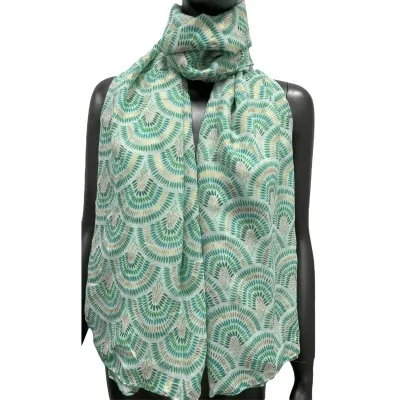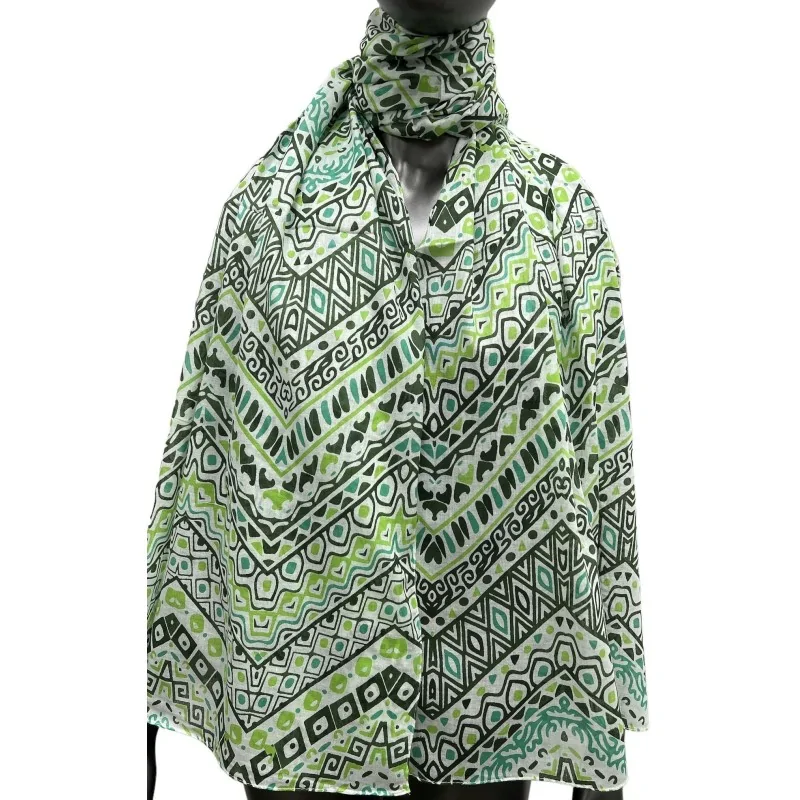


This long cotton scarf measures 80 x 180 cm, enough to take one turn at the neck and still let both ends fall down the front. Opened out, it sits across the shoulders like a light stole, with no folding first.
The print runs edge to edge: bands of chevrons, diamonds and hooked spirals follow one another in three greens, from a near-black fir to a bright anise, over an off-white ground.
The length is the first thing you notice. At 80 x 180 cm this is a long model rather than a square, so a single loop holds it in place and the two ends still reach well below the collar. Worn open, it covers the top of the back without adding any weight. The cotton falls in soft vertical folds, which keeps the pattern readable rather than crumpling it. If you are weighing one shape against another, the rest of the range sets the formats side by side.
Nothing on the cloth is left plain. Bands run the whole length, separated by rows of chevrons that draw V shapes down the scarf. Inside them the motifs change from one band to the next: diamonds with a dot at the centre, small triangles, squares in a row, short dashes, and hooked spirals that keep coming back like a signature. From a distance it reads as one green print; close up the drawing breaks into these separate rows.
The near-black fir green draws the outlines and holds the whole thing together. The bright anise green fills the shapes and is what the eye catches first. A softer water green sits between the two and stops the contrast turning hard. The off-white ground between the bands does the quiet work, keeping a dense pattern from weighing an outfit down.
| Composition | 100% cotton |
|---|---|
| Dimensions | 80 x 180 cm |
| Shape | Long model, to knot or to drape |
| Pattern | Ethnic bands: chevrons, diamonds, triangles and spirals |
| Colours | Fir green, anise green, water green and off-white |
The two formats are not worn the same way. A long model like this one goes straight round the neck and is adjusted afterwards, whereas a square has to be folded into a triangle before it is tied, which changes how much of the drawing shows. A square puts one part of the pattern on display; here the bands run the full drop, so you follow the sequence rather than a single panel. For anyone who already owns squares, the long shape is the one that changes the silhouette rather than the detail.
Data sheet