A clear guide to carrying medication in hand luggage: UK rules, the 100 ml exemption, doctor's letters and controlled...


A clear guide to carrying medication in hand luggage: UK rules, the 100 ml exemption, doctor's letters and controlled...

UK rules, clinical age guidance, choosing a safe piercer, first studs and the full healing timeline for a child's ear...

Sizing in inches and centimetres, teeth spacing, spring strain and materials: how to pick a claw clip that actually...

What pin-up style is, how it differs from rockabilly, and how to build the silhouette from clothes you already own.
UK airports no longer share one liquids rule. Where the 2 litre allowance applies, where 100ml still stands, and how...

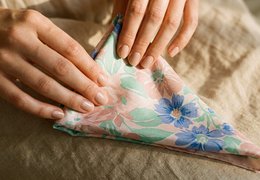




The silk square scarf is probably the most versatile accessory in the wardrobe: a single piece gives ten different looks depending on how you fold and place it. The challenge is not owning one, it is knowing how to tie it without looking costumed. Here are eight essential knots sorted by use (neck, head, accessory), preceded by the three base folds that anchor everything else.
Every knot starts with a fold. Master them once and you save time on every new technique. The difference between a Paris runway stylist and a beginner sits in the regularity of these first moves.
Fold the scarf in half along the diagonal. The point of the triangle sits at the front or back depending on the knot. The base for head ties (Bardot, modern head wrap) and the cowboy knot. Also the base of the scarf tucked into the collar of a coat.
Fold into a triangle first, then roll the point towards the opposite edge in 3 to 4 centimetre tucks. You end up with a regular strip 5 to 8 centimetres wide depending on the scarf size. This strip serves the ascot, the Parisian knot, the hair band and the belt.
The scarf stays almost open, folded only into a diamond from its corners. Used for the modern head wrap and for shoulder shawls. The fold that best showcases Liberty prints and paisley cashmere patterns.

The neck remains the scarf's most common home: it is where it shows, where it completes the outfit, and where it stays without fuss. Four knots cover 90% of occasions.
The most universal. Fold into a narrow strip, pass it behind the neck, cross the two ends at the front and pull one tip under the loop for a loose knot at collarbone height. With a V-neck or a round-neck jumper, this is the detail that structures the silhouette without overloading it. Ideal format: 70x70 cm scarf.
Folded into a narrow strip, the scarf is half-knotted above the sternum, then the tips tuck under the collar of a white shirt or under a turtleneck. The look references 1970s editorials. Stick to fine silk or satin; pleated fabric kills the movement.
Fold into a triangle, place the point at the front of the throat, cross the ends behind the nape and bring them forward for a flat knot to the side. The knot that best forgives large formats (90x90 cm), which would suffocate in tighter knots.
The Hermès editorial signature. Fold into a strip, tie a single knot in the middle, spread the two tips into a generous loop behind the nape, then cross and knot a second time at the front. The result is a soft crown around the neck, particularly elegant on paisley or ethnic prints.
The scarf on the head has returned to the front line since the Bardot revival of 2024-2026 across British and American editorials. Two techniques cover the essentials.
Fold into a triangle, place the point on the forehead and tie the two ends behind the head, then tuck the point under the knot for a flat headband finish. Hair pulled back or in a high ponytail. A leopard or Liberty Flora scarf carries the entire look on its own.
The Audrey Hepburn 60s style reread for 2026. Fold into an open diamond, place on the crown, cross the two tips under the chin and knot behind the nape. The hanging tip frames the face. Choose larger prints (paisley, pleated geometric) that read well over a wide surface.
When the neck and head are already taken, the scarf becomes a colour accent elsewhere. Two ways to relocate it.
Fold into a narrow strip, loop simply around the bag handle at the leather junction. The scarf hangs in two tips or doubles into a tight charm knot. The colour becomes a signature detail that revives a basic black or tan tote.
Fold into a 3 cm strip, slide through the belt loops of a skirt or trousers, knot at the side or front in a loose double knot. For trousers with no loops, simply wrap around the waist in a double front knot. Prefer scarves with strong prints, which survive the twist.

The format determines which knots work. Three sizes cover most of the market.
The small 55x55 cm scarf (sometimes 45 cm), often sold as a neckerchief, suits tight neck knots (Parisian, ascot) and the headband. It disappears under a coat and never works as a shawl. The medium 70x70 cm scarf, the historic Hermès format, is the most versatile: it covers the eight knots shown here. The large 90x90 cm (or 110 cm on heavier silk pieces) excels at head knots, gypsy loop, shoulder shawl and hip wrap. Too bulky for tight neck knots, it overwhelms a fine shirt.
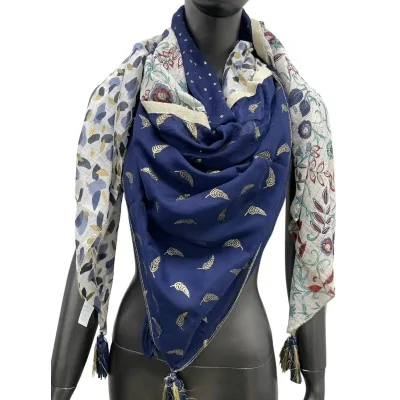
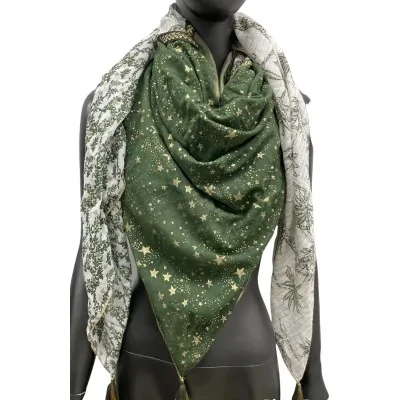
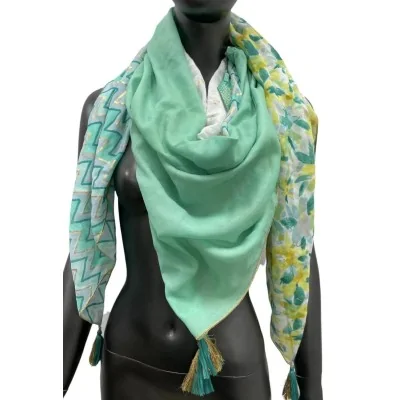
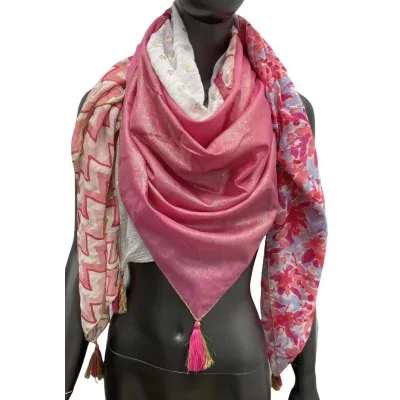
At Mode Tendance we curate a silk square selection from Liberty florals to navy paisley cashmere, passing through black and white pleated geometric, in an editorial spirit without the Hermès price tag. Our silk square scarf collection covers the 70x70 and large formats, and our four-sided scarf range offers the trapeze alternative for those who prefer the more structured drape of an open collar.
Pick a zone (neck, head or accessory) and a knot adapted to the format. At the neck, the Parisian knot works on every 70x70 cm scarf. On the head, the Bardot headband and the modern wrap suit leopard, paisley or Liberty patterns. As an accessory, the bag handle or belt accept strong prints that survive the twist.
French style relies on the Parisian knot or the loose gypsy loop, never on tight or complicated knots. Choose a 70x70 cm scarf in silk or fine satin, fold it into a narrow strip, pass it behind the neck and knot it loosely above the collarbone. Single accessory rule: scarf or necklace, not both.
Reserve the 90 or 110 cm format for the cowboy knot, the gypsy loop, the shoulder shawl or the hip wrap. Avoid tight neck knots, which suffocate the volume. On a 90 cm scarf, the cowboy knot is the safest first choice: it falls naturally across the chest without bulging at the nape.
The 90 or 110 cm format is needed. Fold into an open diamond, drape across both shoulders with the diamond points falling front and back, secure with a discreet brooch or a small knot at chest height. Works particularly well on an open evening coat or a plain dress.
The 70x70 cm format is the most versatile and the one that appears most in editorials. It suits six of the eight knots shown here. Keep the small 55 cm neckerchief for ascots and headbands, and the large 90x90 cm for head knots and shoulder shawls.
 How to wash a silk scarf without ruining it
 How to keep a scarf from slipping off your head and hair
 Chemo headscarf: how to wear one so it stays put How to tie a headscarf: 6 styles from Bardot to turban