A clear guide to carrying medication in hand luggage: UK rules, the 100 ml exemption, doctor's letters and controlled...


A clear guide to carrying medication in hand luggage: UK rules, the 100 ml exemption, doctor's letters and controlled...

UK rules, clinical age guidance, choosing a safe piercer, first studs and the full healing timeline for a child's ear...

Sizing in inches and centimetres, teeth spacing, spring strain and materials: how to pick a claw clip that actually...

What pin-up style is, how it differs from rockabilly, and how to build the silhouette from clothes you already own.

UK airports no longer share one liquids rule. Where the 2 litre allowance applies, where 100ml still stands, and how...






Spot a yellow butterfly on a country walk, a red admiral in the garden or a rare blue flickering over a meadow, and folklore has something to say about it. Butterfly colours have been read as omens and messages for centuries, from Irish cottage tales to Japanese court poetry. This guide decodes what each shade is said to mean, which butterfly is considered the luckiest, and how British folklore reads these winged visitors.
Each of the main butterfly colours carries its own traditional meaning: white stands for peace and departed souls, yellow for joy, blue for luck, black for endings that lead to new beginnings. These readings come from folklore rather than science, but they have stayed remarkably consistent across cultures. Here is the colour by colour breakdown.
Blue is the rarest of the butterfly colours in the wild, which is why nearly every tradition treats it as a wish granted or luck on its way. A blue butterfly is widely read as good fortune, from the Amazonian morpho to Britain's own Adonis blue.
White butterflies are linked to peace, purity and the gentle presence of someone who has passed away. In Irish folklore, harming one was once forbidden, as it might carry a soul.
Yellow speaks of sunshine, optimism and creative energy. A yellow butterfly crossing your path is traditionally read as a sign of good news or a bright season ahead.
Orange combines warmth and boldness: sociability, passion for a project, renewed enthusiasm. The monarch's orange wings have made it a symbol of returning souls in Mexican tradition.
Red is the colour of passion and powerful spirits. Some Native American traditions regarded a red butterfly with deep respect, while European folklore reads it as strong emotion arriving in your life.
Green ties the butterfly to growth, nature and prosperity. It is often read as encouragement for a project or investment that needs patience.
Purple, historically the rarest dye, stands for spirituality, intuition and inner transformation. Crossing one is read as an invitation to trust your instincts.
Brown butterflies speak of grounding, home and practical news. In several traditions a brown visitor announces matters of the household resolving themselves.
Black is not the bad omen it is often assumed to be: most traditions read it as the close of one chapter before a rebirth, the deepest form of the butterfly's transformation symbolism.

True blue is the rarest butterfly colour, because almost no butterfly produces a blue pigment: the shade comes from microscopic wing scales that scatter light, a structural colour documented by natural history museums. That physical rarity feeds the folklore: what the eye rarely sees, tradition calls precious. Purple and green are nearly as scarce, while whites, yellows and browns dominate most meadows. Collectors and photographers prize the morpho and Britain's Adonis blue precisely for this optical effect.
British and Irish folklore gave butterflies a serious role: they were souls in transit. In Ireland it was long considered wrong to harm a white butterfly, as it might carry the soul of a child; a 1600s decree is often cited in folklore collections. In parts of England, the first butterfly of the year predicted the season: catch sight of a white one and the year would be gentle, a dark one and you should brace yourself. Folklore treats butterflies as souls in transit, which explains why their colours were watched so closely.
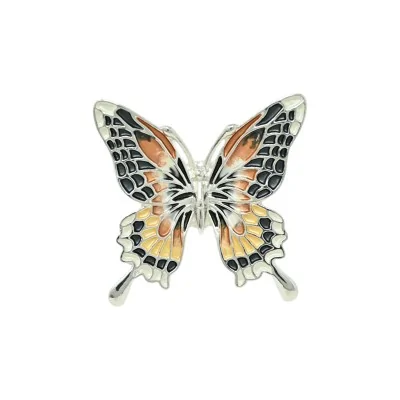
Many butterflies wear two shades, and tradition reads both together, dominant colour first. Orange and black, the monarch's livery, pairs energy with passage: in Mexico it marks the souls returning for the Day of the Dead. Yellow and black, worn by the swallowtail, joins joy to the close of a cycle: good news arriving after a transition. Black and white, seen on the marbled white of European meadows, balances peace with change. Brown wings dotted with orange, common on British commas and fritillaries, speak of grounded, practical progress with a spark of momentum. Read the base shade first, then let the second colour fine-tune the message.
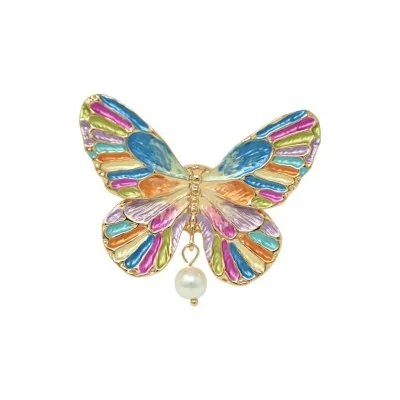
Wearing the butterfly colours you connect with is the easiest way to keep their meaning close: an enamel blue for luck, a golden one for light, a rainbow piece for joy. Gifting a colourful butterfly carries a precise wish, which makes it a thoughtful present for fresh starts, exams or recoveries. Our story on the butterfly in jewellery and its meaning explores the symbolism further, and our butterfly collection spans enamel blues, golden crystals and rainbow pearls.

The blue butterfly is considered the luckiest in most traditions, because true blue is the rarest colour found on butterfly wings. White butterflies hold that role in Irish folklore, and yellow ones in parts of Asia. Spotting a vivid blue is widely read as a wish about to come true.
Purple and white are the colours most associated with spirituality: purple stands for intuition and inner transformation, while white is linked to souls, peace and protection. Black butterflies also carry deep spiritual weight as symbols of profound change rather than misfortune.
A visiting butterfly is traditionally read as a message of change, comfort or remembrance, with the colour refining the meaning: white for peace, blue for luck, black for a chapter closing. Naturalists note the simpler truth that butterflies are drawn to warmth, bright clothing and the salts on our skin.
Yes, the same colour can carry opposite readings: white means peace in Europe but mourning in parts of Asia, and black, feared in some places, is honoured in Mexico as the messenger of ancestors. Context matters, so consider the recipient's culture before gifting a butterfly symbol.
Mode Tendance, jewellery and accessories editorial team. Published 12 June 2026. Sources: Apuleius, Metamorphoses (the myth of Psyche); natural history museum research on structural wing colour; documented folklore collections from Ireland, England, Mexico and Japan.
 Hoop Earring Trends 2026: 8 Looks to Wear Now
 Autumn/Winter 2026 jewellery trends: 7 pieces to adopt
 Bee in the House: Meaning, Symbolism and Superstition
 Labradorite vs moonstone: how to tell them apart
 What it means when a butterfly comes into your house
 How to cleanse and charge crystals: the complete guide
 Which side to wear a brooch: the rule explained
 Bee symbolism: meaning, the Manchester worker bee and spiritual sense