A clear guide to carrying medication in hand luggage: UK rules, the 100 ml exemption, doctor's letters and controlled...


A clear guide to carrying medication in hand luggage: UK rules, the 100 ml exemption, doctor's letters and controlled...

UK rules, clinical age guidance, choosing a safe piercer, first studs and the full healing timeline for a child's ear...

Sizing in inches and centimetres, teeth spacing, spring strain and materials: how to pick a claw clip that actually...

What pin-up style is, how it differs from rockabilly, and how to build the silhouette from clothes you already own.
UK airports no longer share one liquids rule. Where the 2 litre allowance applies, where 100ml still stands, and how...






Getting a child's ears pierced sits somewhere between family tradition, healthcare and, increasingly, a question of consent. In the UK the picture surprises many parents: there is no statutory minimum age for ear piercing in England and Wales, while Scotland treats under-16s differently. What fills the legal gap is a patchwork of studio policies, clinic protocols and healthcare guidance. This guide sets out the actual rules across the UK, the age markers clinicians use, how to tell a safe piercer from a risky one, and what the first eight weeks really look like.
There is no blanket legal minimum age for ear piercing in England and Wales, and no statutory requirement for parental permission. Scotland is the exception: children under 16 need parental consent. That absence of a national age rule is why two studios on the same high street can give parents completely different answers.
Because the law leaves the question open, reputable premises set their own policies, and those policies are stricter than the law. Many will not pierce below a set age at all, commonly somewhere between eight and sixteen depending on the site and the technique. Almost all require a parent or legal guardian to attend in person rather than send written permission, and they will ask for identification proving that relationship. An older sibling, an aunt or a friend's parent cannot give consent on your behalf.
Local authorities register and inspect piercing premises, which is the practical safeguard parents should lean on. Ask to see the premises registration before booking, because a registered business has been inspected against hygiene standards that no amount of online reviews can replace.
Clinical guidance on ear piercing avoids naming a single age and names a capability instead. The American Academy of Pediatrics, whose position is widely echoed by UK clinics, recommends postponing piercing until a child is mature enough to look after the pierced site herself. Around seven or eight, most children can describe discomfort accurately, clean their lobes under supervision and resist tugging at a stud.
Where families choose ear piercing in infancy, clinics generally advise waiting until after the first routine immunisations and never piercing a baby who is unwell. The practical objection is that an infant sleeps on her side, brings her hands to her ears and cannot report pain, so the entire aftercare burden falls on the parents for the full healing period.
Waiting until a child requests the ear piercing herself solves the consent question and improves aftercare compliance in one move. It also lets her take part in choosing the studs, which measurably increases how carefully she treats them.

For ear piercing, the venue matters more than the price. Three routes exist in the UK and they differ in method, setting and follow-up rather than in legality.
Medical and nurse-led clinics have grown quickly for infant and toddler ear piercing. They work in a clinical room, often use a hand-pressurised single-use system or a needle, and offer a follow-up appointment. Dedicated body piercing studios almost always use a hollow needle and hold the strongest technical training, though many decline very young children on principle. High street jewellers and pharmacies typically use a cartridge system and are the fastest and cheapest route, with the least follow-up.
Whichever you choose, four checks apply everywhere: sterile single-use equipment opened in front of you, gloves changed between steps, written aftercare instructions handed over, and a straight answer about the metal of the first studs. A piercer who cannot tell you the alloy is not the piercer for a child. Sterility matters more than method, because hygiene prevents far more complications than the choice between needle and cartridge.

Metal decides how well the lobe tolerates an ear piercing, and the useful standard is nickel release rather than marketing language. The European standard EN 1811 sets the limit for nickel released from items in prolonged skin contact, and asking whether the studs comply is far more meaningful than the word hypoallergenic, which carries no regulatory definition. Implant grade titanium is the safest default, with well-documented surgical steel and 18 carat gold as alternatives.
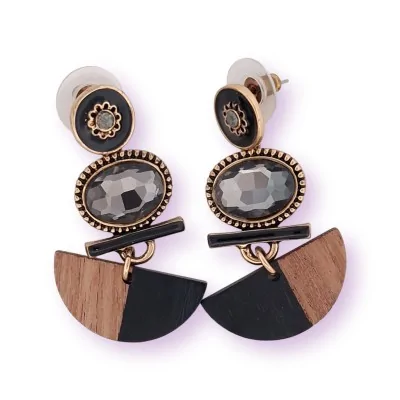
Shape matters just as much for a child. Choose a small, flat, low profile stud without protruding stones, on a post long enough to accommodate the slight swelling of the first days. Flat backs do not catch on hair, which removes the single most common cause of a stud being pulled out. Once healing is complete, a wider choice opens up among our styles for pierced ears.
Expect six to eight weeks for an ear piercing on the lobe to heal and keep the original studs in for that entire period. Mild redness, warmth and tenderness in the first days are normal, as is a clear fluid that dries into a small crust. Clean with sterile saline twice a day, dry gently, and avoid twisting the stud. Never twist a healing stud, an instruction handed down for decades that in fact reopens the forming channel every time it is followed.
Three signs justify medical attention rather than watchful waiting: pain that increases after day three instead of settling, yellow or green discharge, and redness spreading beyond the lobe. A fever alongside any of these needs same-day advice. Our dedicated guides cover how to clean an ear piercing while it heals and how to recognise and treat an infected piercing. When your child is older and starts asking about a helix or a tragus, our guide to ear piercing types explains how healing times differ by site.
One last practical point: a new lobe closes quickly. If a stud falls out during the first months, it needs replacing promptly, and never by forcing it back through.
Keep the piercing out of swimming pools, lakes and the sea for the first three to four weeks, since standing water carries bacteria straight into an open channel. Showering is fine from day one provided the lobes are patted dry afterwards.
School sport policies often require jewellery to be removed or taped over, which conflicts with keeping first studs in for six to eight weeks. Raise it with the school before the appointment: taping the lobe is the accepted compromise. Tie long hair back for the first few days, and take extra care when pulling jumpers over a child's head, which is when most studs are caught.
A new lobe can close within hours during the first weeks, so a stud that comes out needs replacing promptly, though never by force. If it will not pass through without resistance, go back to the piercer rather than push. Wash your hands, clean the stud with sterile saline first, and keep spare butterfly backs at home, since the backs are lost far more often than the studs themselves.
There is no legal minimum age for ear piercing in England and Wales, so the decision rests with parents and with the individual studio's policy. Clinics that pierce infants generally advise waiting until after the first routine immunisations. Scotland requires parental consent for under-16s, and most reputable premises set their own minimum age well above the legal floor.
Written consent alone is rarely accepted: reputable premises require a parent or legal guardian to attend in person with identification proving the relationship. In Scotland parental permission is a legal requirement for under-16s, and elsewhere it is a studio policy applied almost universally to children.
Cartridge systems are legal and widely used on earlobes in the UK, while dedicated studios prefer a hollow needle because it removes tissue rather than forcing it apart. For a lobe, the more decisive factors are genuine single-use sterility, the operator's experience with young children and the quality of the first studs.
Keep the original studs in place for six to eight weeks without removing them, so the channel can form completely. Taking them out early risks rapid closure and irritation on reinsertion. Ideally the first change is done by the person who carried out the piercing.
An infected lobe shows increasing pain after the third day, yellow or green discharge, spreading redness and sometimes heat or swelling of the whole lobe. Clear fluid and mild crusting are normal healing. Any fever, or redness extending down the neck, needs same-day medical advice.
Mode Tendance, jewellery and accessories editorial team. Published 21 July 2026. This article provides general information and does not replace advice from a healthcare professional.
Sources: UK local authority registration requirements for piercing premises; Scottish parental consent rules for under-16s; American Academy of Pediatrics guidance on postponing piercing until the child can care for the site; European standard EN 1811 on nickel release from items in prolonged skin contact; Johns Hopkins Medicine publications on the risks of infant ear piercing.
 Medication in hand luggage: prescriptions, exceptions and security checks How to wear pin-up style in 2026 without looking like a costume Liquids in hand luggage: UK airport rules and limits 2026
 How to change a watch battery yourself: a step-by-step guide
 Hoop Earring Trends 2026: 8 Looks to Wear Now
 Nickel allergy and jewellery: symptoms and safe metals to choose
 What to give a woman who has everything: the anti-duplicate method
 How to change a watch strap: steps and mistakes to avoid