A clear guide to carrying medication in hand luggage: UK rules, the 100 ml exemption, doctor's letters and controlled...
€5.50


A clear guide to carrying medication in hand luggage: UK rules, the 100 ml exemption, doctor's letters and controlled...

UK rules, clinical age guidance, choosing a safe piercer, first studs and the full healing timeline for a child's ear...

Sizing in inches and centimetres, teeth spacing, spring strain and materials: how to pick a claw clip that actually...

What pin-up style is, how it differs from rockabilly, and how to build the silhouette from clothes you already own.

UK airports no longer share one liquids rule. Where the 2 litre allowance applies, where 100ml still stands, and how...






Pin-up style keeps resurfacing on the high street, and the current revival owes as much to social media as to any runway. Pin-up style is easy to recognise and surprisingly easy to get wrong: copy every detail at once and you end up in fancy dress. This guide separates pin-up style from rockabilly, explains who can wear it, and shows how to build the silhouette from clothes you already own.
Pin-up style is a way of building a silhouette rather than a fixed uniform, which is why pin-up style survives changes of decade. It cinches the waist, keeps the shoulder line clean and lets volume sit either above or below that cinch. The prints most associated with it, polka dots, small florals and gingham, are secondary; remove the waist emphasis and the reference disappears entirely.
The imagery comes from mid-century American advertising illustration, particularly the work of Gil Elvgren and Alberto Vargas, and from the return of the marked waist in post-war fashion after the 1947 New Look. Pin-up styling starts at the waistline, which is why a plain belt often does more work than an expensive vintage dress.
The two overlap but are not interchangeable. Pin-up describes a polished, feminine silhouette drawn from illustration and cinema, while rockabilly describes a music subculture with a harder, more casual wardrobe. Confusing them with each other is the most common reason a look reads as costume rather than style.
Pin-up favours the fitted bodice with a full or pencil skirt and a clearly marked waist. Rockabilly keeps the waist but leans towards rolled-up jeans, capri trousers and looser shapes. Rockabilly leans harder on denim and leather, where pin-up stays with cotton, crepe and rayon.
Pin-up sits with polka dots, cherries, small florals and saturated primaries. Rockabilly adds tartan, leopard, western piping and skull or dice motifs. The palettes overlap on red and black but diverge quickly beyond that.
Pin-up hair is set and structured, worn with a low heel or a strappy shoe. Rockabilly hair ranges from a quiff to a loose ponytail, worn with brogues, boots or plimsolls. The finish is the fastest way to read which of the two a person is wearing.

Yes, because pin-up style is a set of proportions rather than a body type. The waist is marked wherever the torso is narrowest, and the volume below is chosen to balance the hips. A straight frame gains a visual waist from a wide belt; a fuller frame gains definition from a fitted bodice and a skirt that releases immediately below it.
The one adjustment worth making is skirt length. A hem that finishes at the narrowest part of the calf flatters most people, while a hem cutting across the widest point shortens the leg regardless of size. Fabric with some body holds the shape better than a thin jersey.
The 3-3-3 rule asks you to build outfits from three tops, three bottoms and three pairs of shoes, producing a small capsule that still generates dozens of combinations. Applied to pin-up style, it stops the wardrobe from filling up with single-use novelty pieces that only work once a year.
A workable set: a fitted white shirt, a plain black knot-front top and a short cardigan; a pencil skirt, a circle skirt and high waisted trousers; low court shoes, flat mary janes and white trainers. Everything in that list combines with everything else, and only two items read as explicitly vintage.
Start with what changes the silhouette rather than what changes the theme. A wide belt over an existing dress, a shirt tucked and knotted at the waist, or trousers worn at the natural waist instead of the hip will shift the whole outline before a single vintage item is bought.
Only then add one dated element. One vintage piece per outfit is enough for the reference to register. Two competing references, a polka dot dress with a headscarf and seamed stockings, tip the balance towards reenactment.

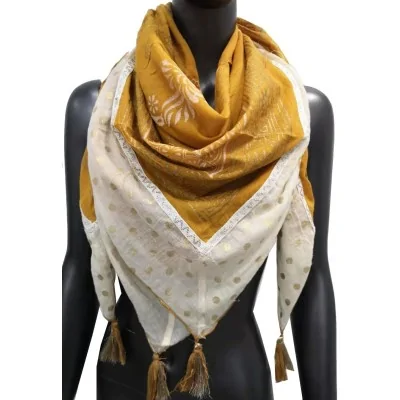
Three accessories carry most of pin-up style on their own: a square scarf, a wide belt and a pair of upswept sunglasses. They signal the reference without committing an entire outfit to it, which makes them the cheapest and most reversible entry point into the style.
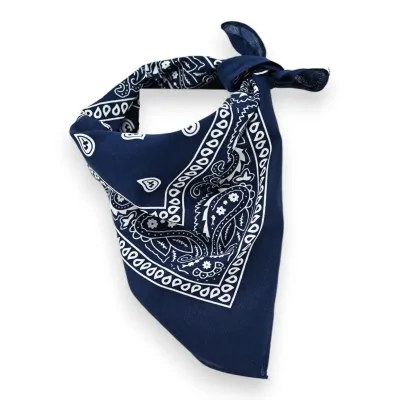
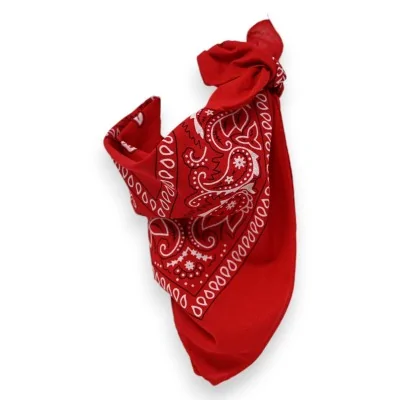
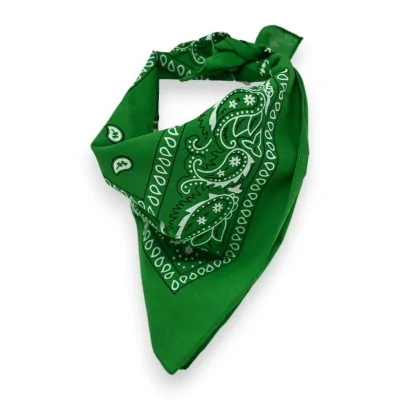
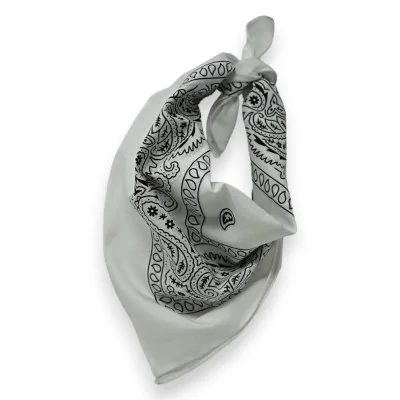
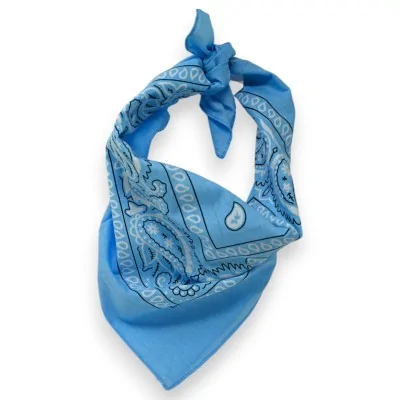
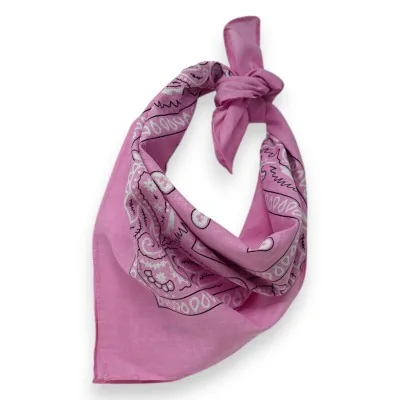
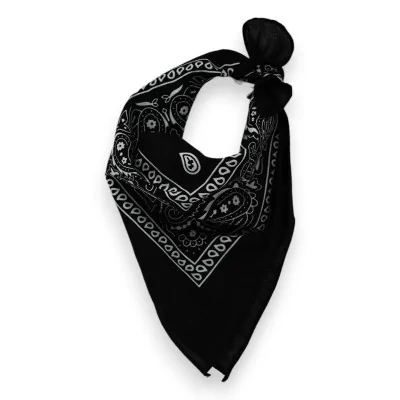
Accessories carry the reference without the costume. A folded scarf tied at the crown of the head, or worn as a band over pinned-back hair, is enough to redirect a neutral outfit. Our bandanas in plain cotton hold a tight knot well, while our square scarves in fluid fabric drape more softly at the neck. For the tying techniques themselves, see our guide to tying a headscarf.
Keep jewellery simple and readable: mid-sized hoop earrings, a short row of pearls, or a single brooch on a collar. In cold weather the outline starts with outerwear, and our guide to styling a winter coat covers how to keep a defined waist under a long piece.
The term behind pin-up style describes an image meant to be pinned to a wall, and it entered common use through American calendars and magazines in the 1940s. The pictures were painted advertising illustrations rather than photographs, which matters: the proportions shown were stylised by the artist, not recorded from a model.
Gil Elvgren produced several hundred of these paintings for calendar publishers, while Alberto Vargas worked for magazines under the name Varga. Their images travelled with wartime aircraft nose art and were widely reproduced afterwards. The clothing shown was not yet a coherent fashion movement; that came after 1947, when the marked waist returned to European tailoring.
Bettie Page, Rita Hayworth and Jane Russell later attached faces to the drawings. Their short fringes and set waves remain the fastest visual shorthand for the whole style, which is why hair often does more identifying work than clothing.
The three mistakes that spoil pin-up style are all fit problems rather than taste problems. First, buying a reproduction dress and leaving the waist seam where the factory placed it: if that seam sits below your natural waist, the silhouette collapses and no accessory recovers it.
The waist seam decides the whole outfit, and moving it by two centimetres usually costs less than a scarf. Second, choosing a hem that cuts the widest part of the calf, which shortens the leg on any body. Third, stacking references: a print, set hair, seamed stockings and a red lip all at once reads as a themed party rather than a wardrobe.
A fourth, less obvious mistake concerns fabric. Vintage rayon becomes brittle along fold lines and does not survive machine washing, while the heavy cottons of the same decades remain robust. Check the underarm seams and the zip line first, since those give way before anything else.
Pin-up style is a mid-century inspired look built on a tightly marked waist, a fitted bodice and either a full circle skirt or a pencil skirt. It draws on 1940s and 1950s American illustration and cinema, and uses polka dots, small florals and saturated colours. Accessories such as square scarves and wide belts complete it.
There is no single body type, despite the hourglass shape shown in vintage illustration. The style is a set of proportions that can be recreated on any frame by marking the narrowest point of the torso and choosing the skirt volume to balance the hips. Illustrated proportions were stylised, not photographic.
Yes, provided the fit is adjusted rather than copied. The most common mistake is buying a reproduction dress in a standard size and leaving the waist seam where the manufacturer put it. Having the waist seam moved to your own narrowest point costs little and changes the result completely.
Limit yourself to one dated element per outfit and keep everything else current. A polka dot dress with modern flat shoes reads as style; the same dress with seamed stockings, gloves and set hair reads as costume. Hair and make-up count as dated elements in that total.
Low court shoes, mary janes and round-toed loafers sit most naturally with the silhouette because they lengthen the leg without demanding a high heel. Flat white trainers also work and instantly modernise a circle skirt or a fitted dress. Avoid a very pointed toe, which belongs to a later decade.
Mode Tendance, fashion and accessories editorial team. Published on 19 July 2026. Sources consulted: Victoria and Albert Museum fashion collections on 1950s dress; Musée des Arts décoratifs documentation on the 1947 New Look; illustrated archives of Gil Elvgren and Alberto Vargas.
 Medication in hand luggage: prescriptions, exceptions and security checks Ear piercing for a child: what age, uk rules and safety Liquids in hand luggage: UK airport rules and limits 2026
 How to change a watch battery yourself: a step-by-step guide
 How to style a winter coat: what to wear under each type
 Nickel allergy and jewellery: symptoms and safe metals to choose
 What to give a woman who has everything: the anti-duplicate method
 How to change a watch strap: steps and mistakes to avoid