A clear guide to carrying medication in hand luggage: UK rules, the 100 ml exemption, doctor's letters and controlled...
Mode Tendance, Click here to understand delivery to the United States, Australia and United Kingdom
English GB

A clear guide to carrying medication in hand luggage: UK rules, the 100 ml exemption, doctor's letters and controlled...

UK rules, clinical age guidance, choosing a safe piercer, first studs and the full healing timeline for a child's ear...

Sizing in inches and centimetres, teeth spacing, spring strain and materials: how to pick a claw clip that actually...

What pin-up style is, how it differs from rockabilly, and how to build the silhouette from clothes you already own.
UK airports no longer share one liquids rule. Where the 2 litre allowance applies, where 100ml still stands, and how...






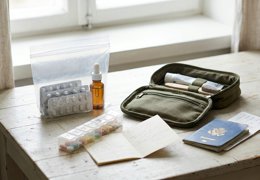
Packing a regular treatment for a flight raises the same questions every time: how much can you carry, do you need a doctor's note, and what happens at UK security when a tablet strip or a bottle of liquid medicine goes through the scanner? This guide sets out what UK airports actually allow, so your medication in hand luggage causes no last-minute stress. Carrying medication in hand luggage follows a few simple rules once you know them.
Yes, you can carry all the medication you need for your trip in your hand luggage, in any form: tablets, capsules, creams, sprays and injectables. There is no fixed maximum as long as the quantity matches personal use for the journey. As a rule, keep essential medicines in your cabin bag, never in the hold, where a case can be delayed, lost or exposed to freezing temperatures. Leave medicines in their original packaging with the information leaflet, which makes them easy to identify at security and abroad.

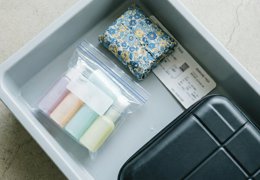
Liquid medicines are exempt from the usual 100 ml limit that applies to cosmetics and toiletries. You can carry larger volumes of essential liquid medication, including insulin and liquid feeds, through UK security. In short, essential liquid medicines are exempt from the 100 ml rule, provided you declare them and can show they are needed. Take them out of your bag, tell the security officer, and expect them to be screened separately. Our companion guide to the 100 ml liquids rule in hand luggage explains the standard framework these exceptions sit within.
A prescription or a letter from your doctor is strongly recommended whenever you fly with essential or liquid medication. It is not always demanded for a domestic flight, but it removes any doubt at security and on arrival. A doctor's letter clears most questions at security, especially for injectables and controlled medicines. Ask for the letter to state the medicine's generic name, the dose and the condition treated, and keep a copy in English if you travel outside the United Kingdom.
Some medicines are classed as controlled drugs, such as strong painkillers, certain sleep or anxiety treatments and stimulants. For these, you may need a personal licence from the Home Office if you carry them above a set threshold, and you should always travel with your prescription. Controlled drugs need proof and advance checks before you leave. Just as important, verify the destination country's rules through its embassy, because a medicine sold freely in the UK can be banned elsewhere.

Keeping your medication in hand luggage means every dose you might need during the flight, plus a safety margin, travels in the bag you carry with you. Split your supply between two bags if you travel with someone, so a single lost bag never leaves you without treatment. A small compact toiletry bag keeps tablets, prescription and injection kit together in a format that stays within reach. Store insulin and other temperature-sensitive medicines in an insulated pouch, away from the aircraft window. Order the boxes by time of day so the right dose is easy to find mid-flight, and keep the prescription in the same pouch rather than in a separate bag. For long trips, take more than the itinerary requires, since delays and cancellations can stretch a journey well beyond the plan.
You can bring as much as you need for the trip, with a sensible margin for delays. There is no fixed cap on personal medication in hand luggage. Airport staff only expect the quantity to look consistent with personal use, so a two-week holiday should not carry a year's supply without a clear reason and supporting paperwork.
Keeping pills in their original packaging with the leaflet is strongly advised, though not always legally required in the UK. Original boxes let security and foreign authorities identify each medicine instantly and match it to your prescription. Loose pills in a daily organiser are fine for the journey, but carry the original boxes too when you cross a border.
You can put spare medication in checked luggage, but never your essential treatment. The hold is not temperature-controlled and the bag may be delayed or lost. Always keep the doses you need for the flight and the first days of your trip as medication in hand luggage, with any documents that prove they are prescribed to you.
A current prescription in your name covers most trips. Add a doctor's letter, ideally in English, for regular treatments, injectables and travel outside the UK. Controlled drugs may also require a Home Office licence. Keep all of this with the medicines themselves, not buried in your suitcase, so you can show it at a moment's notice.
Carry insulin in an insulated pouch or a cool bag inside your hand luggage, never in the hold where it may freeze. Gel packs approved for medical use are allowed through security when declared. Keep the insulin away from the aircraft window and direct sunlight, and take more than the trip requires in case of delays.
Mode Tendance, accessories and travel desk. Published on 22 July 2026. Sources: GOV.UK hand luggage restrictions (essential medicines and medical equipment), UK Civil Aviation Authority, NHS guidance on travelling with medicines, Home Office guidance on controlled drugs. This article offers practical guidance and does not replace advice from your doctor or pharmacist.
Ear piercing for a child: what age, uk rules and safety How to wear pin-up style in 2026 without looking like a costume Liquids in hand luggage: UK airport rules and limits 2026 How to change a watch battery yourself: a step-by-step guide
 Nickel allergy and jewellery: symptoms and safe metals to choose
 What to give a woman who has everything: the anti-duplicate method
 How to change a watch strap: steps and mistakes to avoid
 Infected ear piercing: how to spot it and what to do