A clear guide to carrying medication in hand luggage: UK rules, the 100 ml exemption, doctor's letters and controlled...
Mode Tendance, Click here to understand delivery to the United States, Australia and United Kingdom
English GB


A clear guide to carrying medication in hand luggage: UK rules, the 100 ml exemption, doctor's letters and controlled...

UK rules, clinical age guidance, choosing a safe piercer, first studs and the full healing timeline for a child's ear...

Sizing in inches and centimetres, teeth spacing, spring strain and materials: how to pick a claw clip that actually...

What pin-up style is, how it differs from rockabilly, and how to build the silhouette from clothes you already own.
UK airports no longer share one liquids rule. Where the 2 litre allowance applies, where 100ml still stands, and how...





Most people buy a claw clip by looking at the colour. The three things that actually decide whether it holds are the width of the bite, the strength of the spring and the finish of the inner surface. Get those wrong and the same hairstyle that lasted a full day yesterday slides out in ten minutes today. This guide matches texture, density and length to the format that works, using the sizing logic UK and US accessory brands publish in inches.
Match the internal volume of the clip to the mass of hair you need to hold, not to how long your hair is. A clip that is too large stays half empty, pivots on the section and works its way down. A clip that is too small has to be forced shut, which puts the spring under permanent strain. As a working rule, fine or shoulder-length hair sits around 2.5 to 3.5 inches (6 to 9 cm), medium density around 3.5 to 4 inches, and very thick or long hair needs 4.5 inches and above.
Four mechanisms cover almost everything on the market. Snap clips use a sprung metal blade and suit flat, fine sections. Alligator clips pivot on a central spring and grip a vertical section. Claw clips interlock their teeth around a full twist. French barrettes close a bar onto a base and spread the load across several centimetres. An oversized clip always slips, because it has nothing to close on.
If a single twist keeps escaping, split the hair into two stacked sections and clip them together rather than separately. The lower section gives the teeth something textured to bite into, and the upper one hides the join. This is the standard fix stylists use on freshly washed, very straight hair, and it works better than buying a stronger spring.
Fine hair holds through contact points, not pressure. A fine strand measures under 0.05 mm across, so squeezing harder flattens it without gripping it. Choose a smaller claw clip with narrow, closely spaced teeth and a lightly ridged or silicone-lined interior, and skip anything heavy with large stones. Weight is what makes an accessory rotate and travel down the section.
Closely spaced teeth grip fine hair far more reliably than a stiff spring does. One more detail worth knowing: freshly washed hair is too soft and too slippery to hold anything. Clipping on second-day hair is not a compromise, it is the correct condition for grip.
On dense hair the limiting factor is internal volume. Look for long, widely spaced teeth and a deep body that can wrap a whole twist without being forced. Jumbo is not automatically better: an oversized clip on a moderate amount of hair is just as unstable as an undersized one, and the hinge is the first thing to fail when the clip is permanently strained.
Curly and coily textures need geometry that does not crush the pattern. Widely spaced teeth leave the curl spring intact, where a flat blade compresses it and leaves a visible dent when you take it out. Clip loosely, leave a few centimetres of slack at the root, and if your hair is both long and thick use two medium clips rather than one very large one. Size to density, not to length.
The material of a claw clip decides durability and breakage risk. Cellulose acetate, made from wood pulp, polishes to a smooth edge and is the best everyday compromise. Resin is lighter and suits fine hair but tolerates repeated twisting badly. Plated metal gives the strongest mechanical hold, provided the inner face is genuinely smooth rather than stamped.
For any metal accessory in prolonged contact with skin, nickel release is restricted under Annex XVII of the REACH regulation, measured to the EN 1811 standard. It matters here because the area behind the ear reacts quickly in sensitised wearers. Polished acetate reduces mechanical breakage compared with raw injection-moulded plastic, where the mould line forms a ridge that catches the fibre. Run a fingernail along the inside before you buy: if you can feel a seam, your hair will find it too.
Breakage usually comes from the removal, not from the claw clip itself. Pulling a clip downwards tears out whatever is caught in the spring. Open the clip before removing it, every time. Reference work on hair fibre mechanics, notably Clarence Robbins on the physical behaviour of human hair, is consistent on the point that the fibre tolerates repeated stress at a single location poorly.
Two more habits are expensive: clipping at the same height every day, which creates a weak band at mid-length, and sleeping in a rigid accessory, which holds the fibre bent for hours. Vary the height, and take hard accessories out at night. For dressier occasions where the accessory has to survive a full day and sit under a veil or hat, our guide to wedding placements covers the five positions that hold best, and the same friction logic applies to fabric, as explained in our piece on accessories that slide off the head.
Our hair accessories range covers everything from mini snap formats to occasion pieces, in the materials described above.

| Hair type | Size | Mechanism | Material |
|---|---|---|---|
| Fine, straight | 2.5 to 3 in | Snap or small claw | Acetate, light resin |
| Fine, wavy | 3 to 3.5 in | Ridged alligator | Acetate |
| Thick, straight | 4 in | Long-toothed claw | Acetate or metal |
| Curly or coily | 4.5 in and up | Wide-spaced claw | Polished acetate |
| Short bob | 1.5 to 2 in | Snap | Smooth metal |

Fine or shoulder-length hair needs roughly 2.5 to 3.5 inches, average density 3.5 to 4 inches, and very thick or long hair 4.5 inches and above. Size to the mass of hair you are holding rather than its length. A clip that has to be forced shut strains its spring and the hinge fails within weeks.
In most cases the clip is too large for the amount of hair it holds, so it stays half empty and pivots. The other common causes are a perfectly smooth inner face with no grip, a spring that has softened after months of use, and freshly washed hair that is simply too slippery to hold anything.
They are not damaging in themselves, but sharp edges and rough removal are. A raised mould line, a stamped inner face or pulling the clip downwards will cut fibres each time. A polished accessory, opened before removal and positioned at a different height each day, causes no meaningful breakage.
A claw clip has interlocking teeth on both jaws and wraps around a full twist of hair, which is why it suits updos. An alligator clip has a single hinge and a flatter bite, gripping a vertical section, which makes it the better choice for sectioning while styling or for holding a smaller half-up.
Take rigid accessories out before sleeping. Held bent for hours under the weight of your head, the fibre is under sustained stress at one point, which encourages mid-length breakage. If you need to secure your hair overnight, use a soft fastening with no hard parts.
Mode Tendance, accessories and jewellery editorial team. Published on 20 July 2026.
Sources: REACH regulation (EC) No 1907/2006, Annex XVII, entry 27, and standard EN 1811 on nickel release from articles in prolonged contact with the skin; Clarence R. Robbins, Chemical and Physical Behavior of Human Hair, Springer, on the mechanical behaviour of the hair fibre; Mode Tendance product and category pages.
 Scarf for short hair: 5 ways to wear it
 Wedding guest hairstyles: easy ideas you can do yourself
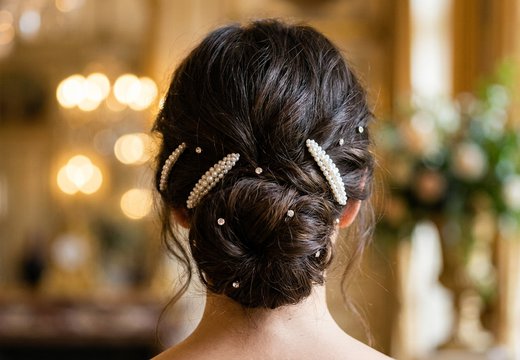 How to wear hair clips at a wedding: 5 placements that work