A clear guide to carrying medication in hand luggage: UK rules, the 100 ml exemption, doctor's letters and controlled...


A clear guide to carrying medication in hand luggage: UK rules, the 100 ml exemption, doctor's letters and controlled...

UK rules, clinical age guidance, choosing a safe piercer, first studs and the full healing timeline for a child's ear...

Sizing in inches and centimetres, teeth spacing, spring strain and materials: how to pick a claw clip that actually...

What pin-up style is, how it differs from rockabilly, and how to build the silhouette from clothes you already own.
UK airports no longer share one liquids rule. Where the 2 litre allowance applies, where 100ml still stands, and how...

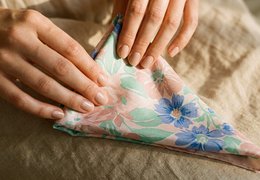




A head scarf is the rare accessory that solves a problem and elevates an outfit at the same time. Tied over the crown, it shields hair from sun, wind and salt, rescues a bad hair day in under a minute, and adds instant polish to the plainest jeans and shirt combination. From the under-chin knot of the sixties to the structured turban and the forties factory-girl twist, this guide walks through six ways to tie a head scarf, with exact folds, the right scarf sizes, and the tricks that keep everything in place from breakfast to last train home.
The right head scarf measures at least 65 cm on each side and has a touch of grip to it: a 90 cm square is the most versatile size, big enough for a turban yet foldable into a slim headband. Anything smaller than 65 cm will not reach around the crown with enough length left to knot.
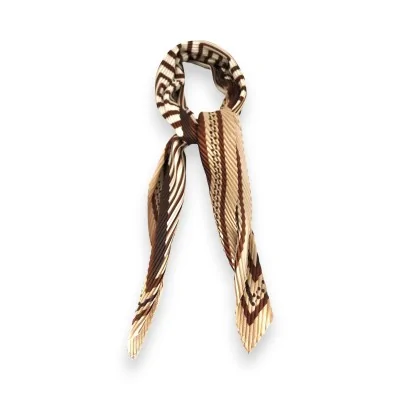
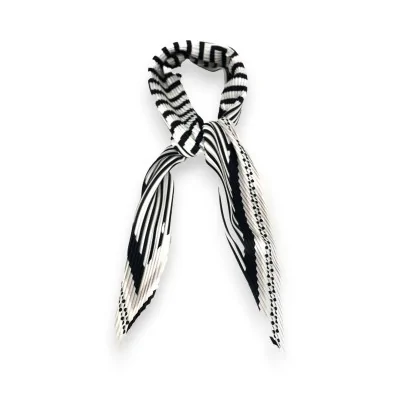
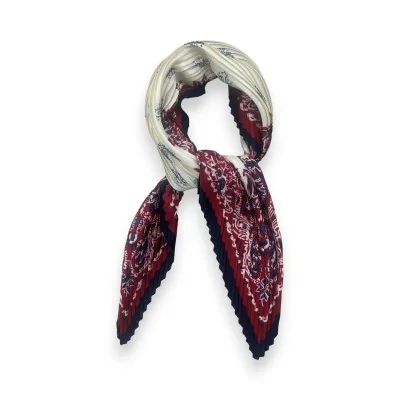
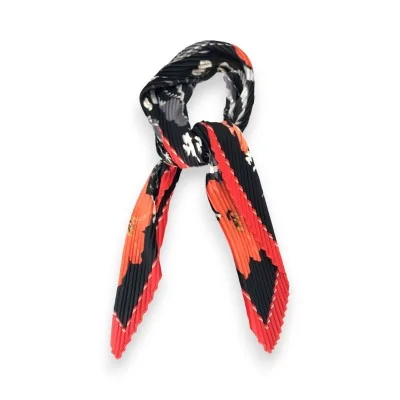
Fabric decides both hold and hair health. Silky finishes are kindest to the hair fibre, reducing frizz and breakage, but they slide more; cotton grips well yet can leave creases in the lengths. A fluid weave with a satin finish is the practical middle ground. You will find suitable prints, from paisley to leopard, in our square scarf collection, where the 90 cm formats are the ones to pick for head styling.
Six techniques cover almost every situation: the Bardot knot for retro glamour, the forties turban for vintage workwear charm, the boho head wrap for festivals, the headband twist for everyday polish, the pony wrap for speed, and the full coverage wrap for maximum protection. Each one starts from a simple triangle or band fold and takes less than a minute.
Fold the square into a triangle, lay the long edge along your hairline, bring both side points under your chin and tie a double knot, leaving the back point loose over the nape. Add oversized sunglasses and the Riviera reference is complete. This is also the most protective style for the whole head of hair.
Fold into a triangle, place the long edge at the nape with the point towards your forehead, bring both ends up above the brow, twist them around each other twice, then coil the twist and tuck the ends under the fabric. This is the style worn by British factory workers in the forties, revived today as a vintage statement that holds all day without a single pin.

Roll the square into a wide band, centre it on the nape, knot it twice above the forehead and let the tails hang or tuck them in. On textured or second-day hair it stays put naturally and frames the face without flattening volume.
Roll a narrow band, place it under the hair at the nape and tie on top of the head, slightly off centre, with the tails hidden under the band. It reads as a polished accessory rather than a cover, ideal for the office where a full wrap might feel like too much.
Tie your hair in a low ponytail, fold the scarf into a narrow ribbon and knot it around the elastic, letting the tails float in the lengths. Ten seconds, no mirror needed. A small clip above the knot secures it; our hair clips pair naturally with this style.
Place the triangle fold on your forehead, cross the points under the nape, bring them back up and knot at the crown or side. Every strand is covered, which makes it the best option against sun, dust or wind, and a modest, elegant everyday solution.
Three levers keep a head scarf in place: friction, technique and anchoring. Give the fabric something to hold by skipping the post-wash blow-dry or misting roots with texturising spray; cross the points twice before knotting, because a double cross doubles the friction; and anchor the knot with two flat bobby pins pushed through it, or a small clip at each temple.

The worst combination is a very smooth scarf over freshly washed, straightened hair: that is the setup that slides within the hour. If nothing works, switch to a self-locking style like the turban twist, which relies on the structure of the coil rather than on grip.
For the full method, from grippy fabrics to hidden pins, see our dedicated guide on how to keep a scarf from slipping.
Wrapping hair in a silky scarf at night reduces friction against the cotton pillowcase, which is the main cause of overnight frizz, tangling and breakage, and it extends the life of blow-dries, braids and curl definitions by a day or two. Silk wrapping preserves curls overnight, which is why the technique is a staple of textured hair routines.
The method: fold a large square into a triangle, place the long edge at the nape, bring the points to the forehead, cross them, return them to the nape and knot loosely, then tuck the back point under. Choose a knot position that does not press into the skull when you lie down, and a scarf you reserve for night use so day products do not transfer onto it.
A head scarf earns its place in four everyday scenarios: at the beach, where it protects the scalp and parting from sunburn and the lengths from salt; on bad hair days, where the turban or full wrap hides everything in ninety seconds; on the commute, where the Bardot knot beats any hood against wind; and at events, where a silk band lifts a simple bun into an outfit detail. For event styling, the eight base techniques in our essential scarf knots guide cover the neck and bag versions that match a head style.
One styling rule keeps things chic: one statement accessory per outfit. If the scarf print is loud, keep earrings small and the neckline plain; if your outfit already carries pattern, choose a plain or tone-on-tone scarf instead.
For chemotherapy or hair loss, the most comfortable head scarf is a large square, 90 to 110 cm, in a soft satin-finish weave, tied with no pressure points: a full coverage wrap knotted low at the nape, or a loose turban twist, never a tight headband. On a sensitive or bare scalp, seams and rough cotton can chafe, so smoothness matters more than grip.
Practical details make the difference day to day. A thin cotton band worn underneath absorbs perspiration and stops the scarf wandering; dense, busy prints keep their opacity even when stretched; and carrying a second scarf means an instant change or extra volume layered under the first. Charities that run headwear workshops also suggest practising each knot once at home before a day out, so the gesture becomes automatic. These are comfort and style pointers, not medical guidance: for anything concerning the scalp or treatment, your care team remains the reference.
A 90 cm square works for every head style in this guide, from headband to turban. A 65 to 70 cm square is enough for headbands and pony wraps only, while 110 cm formats suit voluminous turbans and very thick or long hair. Below 65 cm the points become too short to knot securely.
It is usually called the turban twist or victory roll wrap, popularised by women working in wartime factories who needed hair safely covered, and by the Rosie the Riveter imagery that followed. The scarf is twisted above the forehead and coiled, leaving the knot as a decorative front feature.
Yes, if the scarf has a silky finish and the knot sits loosely at the nape. Night wrapping cuts friction against the pillowcase, preserves curls and blow-dries, and reduces breakage. Avoid tight knots on the forehead, which mark the skin and create tension on the hairline over time.
Roll the scarf into a wide band of eight to ten centimetres and wear it as a deep headband covering the hairline, or go for the full turban, whose volume replaces the volume of hair. Both styles hold on a pixie or short bob without needing pins in the lengths.
Mode Tendance, fashion and accessories desk. Published 7 June 2026.
Sources: Victoria and Albert Museum archives on 1940s utility fashion; American Cancer Society, How to tie a head scarf; Mode Tendance product sheets, 90 cm square formats.
 How to wash a silk scarf without ruining it
 How to keep a scarf from slipping off your head and hair
 Chemo headscarf: how to wear one so it stays put
 Scarf for short hair: 5 ways to wear it How to tie a square scarf : 8 essential knots