A clear guide to carrying medication in hand luggage: UK rules, the 100 ml exemption, doctor's letters and controlled...
Mode Tendance, Click here to understand delivery to the United States, Australia and United Kingdom
English GB


A clear guide to carrying medication in hand luggage: UK rules, the 100 ml exemption, doctor's letters and controlled...

UK rules, clinical age guidance, choosing a safe piercer, first studs and the full healing timeline for a child's ear...

Sizing in inches and centimetres, teeth spacing, spring strain and materials: how to pick a claw clip that actually...

What pin-up style is, how it differs from rockabilly, and how to build the silhouette from clothes you already own.
UK airports no longer share one liquids rule. Where the 2 litre allowance applies, where 100ml still stands, and how...


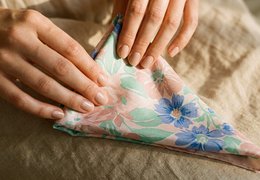



A scarf that slides off your head, slips through your hair or creeps down your shoulders is one of fashion's small daily frustrations. The fix is rarely a tighter knot: it is a smarter combination of fabric, base and technique. This guide explains how to keep a scarf from slipping wherever you wear it, on the head, in the hair, around the neck or over the shoulders, with the grip bases, hidden fixings and knots that professional stylists rely on.
Scarves slip because two smooth surfaces, fabric and hair, generate almost no friction against each other. The shinier the weave and the cleaner the hair, the faster the scarf travels. A satin weave lets its threads float on the surface, which is exactly what makes it glossy and exactly what makes it slide; freshly washed hair behaves the same way from the other side.
Movement does the rest: every nod or turn of the head shifts a knot that has only one anchor point. The solution therefore works on three layers at once. Prepare the hair so its surface grips, choose a weave with micro-texture, and tie knots that spread tension across several points. As a rule of thumb, grip comes from texture, not tightness: a tighter knot on a slippery base only digs in for an hour before it gives up.
The fabrics that stay put share one feature: a slightly irregular surface. Cotton and cotton gauze grip best, followed by silk twill, whose fine diagonal ribs catch the hair; chiffon, fluid viscose and polyester satin slide the most. Check the composition label, which is mandatory on textiles sold in the EU and the UK, before you buy.
Weave matters as much as fibre: the same silk yarn produces a grippy twill or a slippery satin depending on how it is woven. For headwear, pick a 65 to 90 cm square in twill or cotton; keep glossy satins for neck and bag styling, where gravity works with you instead of against you. The material of each model in our scarf collection is listed on its product page, so you can choose twill for the head and satin for the neck deliberately.

An undercap or liner creates the friction layer that smooth hair cannot provide. A thin cotton or bamboo undercap, a velvet headband worn under the scarf, or a non-slip mesh liner all give the fabric something to hold on to, and all disappear once the scarf is tied. They are standard practice in hijab styling and headwear for hair loss, and they work just as well for a fashion bandana.
If you do not own a liner, build the base from the hair itself: a spritz of dry shampoo at the roots, a light backcomb at the crown, or simply tying the scarf on second-day hair instead of freshly washed lengths. On fine or very smooth hair, a velvet band under the scarf remains the single most reliable trick: velvet pile grips both the hair below and the silk above.
Liners come in three families, each with its use case. Cotton and bamboo undercaps cover the whole head and suit full wraps and turbans; they absorb perspiration and protect the fabric as well as the skin. Mesh and tulle bands stay invisible under light summer styles and add grip without warmth. Silicone-dotted strips, sewn or ironed inside the hem, are the discreet option for a scarf you wear the same way every day: the dots grip the hair directly and need no separate accessory.
The surest way to keep a scarf from slipping off your head is to combine three moves: tie on a textured base, use a knot with at least two anchor points, and lock the folds with flat pins. Fold the square into a triangle, cross the ends low on the nape, bring them back to the front and tie flat: this double-wrap spreads tension so no single point takes the strain.
Then secure the weak spots. Slide one flat pin through the back fold and into the hair, and cross a second pin over it in an X so the fabric cannot pivot. Place a small flat clip under the nape knot if your hair is short. For the styling side of head wraps, from the Bardot knot to the modern turban, see our guide on how to tie a headscarf, and if you wear a crop or pixie cut, the dedicated guide to scarves for short hair adapts every placement.

Keep a neck scarf in place by anchoring it to itself rather than to your neck: fold the square into a flat band, wrap once, then pass the ends through the loop in opposite directions before tying. This self-locking wrap cannot rotate, unlike a single knot that spins around the neck as you move. Worn under a collar, the collar itself becomes an extra anchor.
For silky squares, two more options work well: a small scarf ring that pinches the layers together, or a flat double knot tied slightly off-centre so it sits in the hollow of the collarbone instead of sliding to the side. If you prefer step-by-step knots, our guide to eight essential scarf knots covers the neck, the bag and the wrist.
A shawl or oversized scarf stays on the shoulders when its weight hangs in front of the shoulder line, not behind it. Drape the scarf so both ends fall forward, then anchor one layer: a discreet brooch or magnetic pin at the shoulder, a loose single knot at sternum height, or one end thrown over the opposite shoulder to create a counterweight.
Fabric choice helps here too: a matte weave drapes and grips, while a satin-finish wrap slides off at the first gesture. In the evening, a fine belt worn over the scarf at the waist turns it into a secured layer that cannot fall, a styling trick that also defines the silhouette.
After chemotherapy, choose soft, breathable fabrics such as cotton or bamboo, tie the scarf over a thin undercap to protect sensitive skin, and prefer flat knots on the nape rather than tight wraps. Without hair, the liner provides the grip the scalp cannot, and it prevents the friction that bare skin finds uncomfortable.
Volume matters for comfort and confidence: a padded undercap or a pre-tied volumiser restores the silhouette of hair under the fabric. We cover gentle materials, step-by-step wraps and all-day comfort in our dedicated guide to wearing a headscarf during chemo. This advice concerns comfort and style only and does not replace guidance from your medical team.
Five mistakes explain most slipping scarves: tying on freshly washed hair, choosing satin for headwear, relying on one tight knot, skipping pins out of fear of damaging the silk, and using a square that is too small for the style. Each has a quick fix listed above; the small-square problem is solved by sizing up, because a 90 cm square anchors better than a 55 cm bandana for any full head wrap.
One last habit to break: pulling the scarf back into place by its visible edge. Repositioning by the edge loosens the anchor folds a little more every time. Instead, re-seat the back fold first, then smooth the front, and the wrap returns to position without losing its grip.
Size determines how many anchor points a wrap can have, so it decides half the battle before you tie a single knot. A 90 cm square allows a full double wrap with a nape cross, which is why it is the standard for head coverage. A 65 to 70 cm square works for headbands and half wraps with pin support, while a 55 cm bandana only holds as a band, never as a full cover.
Shape matters too: an oblong scarf, roughly 30 by 180 cm, wraps a turban with three full turns and locks itself by torsion, which square formats cannot match. Triangular pre-folded scarves save a step but lose the adjustability of the fold; on slippery hair, the freedom to widen the band at the nape is precisely what you want to keep. As a rule, pick the format for the style first and the fabric for the grip second.
The tricks that keep a scarf from slipping also rescue one that has already moved. When a scarf starts sliding mid-day, resist the instinct to pull it back by the visible edge; that loosens the anchor folds further. Instead, find the back fold, re-seat it lower on the nape, then smooth the front into place. The wrap recovers its original tension in about ten seconds, without retying anything.
Keep a two-item rescue kit in your bag: one flat pin and one small claw clip. The pin re-anchors the back fold, the clip locks a headband above the ear. If neither is at hand, a trick borrowed from stylists works anywhere: twist the two front ends once around each other before tucking them, the torsion adds friction that survives several hours of movement.
To keep a scarf from slipping, combine a textured base, a grippy fabric and a multi-point knot: tie the scarf on second-day or dry-shampooed hair, choose cotton or silk twill rather than satin, wrap the ends twice so tension spreads across several anchor points, and lock the back fold with two crossed flat pins.
Cotton and cotton gauze slip the least, followed by silk twill, whose diagonal ribs create micro-grip. Polyester satin, fluid viscose and chiffon slip the most. The weave matters as much as the fibre: the same silk holds in twill and slides in satin, so check both the label and the finish.
Flat pins with smooth coated tips do not damage silk when placed through a fold rather than through stretched fabric. The fold spreads the pressure and hides the pin. Avoid serrated clips directly on silk twill, as the teeth can pull a thread; clip onto the hair or the liner instead.
A rotating headscarf means the wrap has a single anchor point on a smooth base, so the whole tube of fabric pivots with each head movement. Switch to a double-wrap knot crossed at the nape and add one flat pin above each ear: the rotation stops immediately because the fabric is fixed on three points.
Yes, silicone-dotted strips sewn or ironed inside the hem grip hair directly and hold a daily wrap without pins or liners. They suit scarves you tie the same way every day, since the strip must sit where the fabric meets the hairline. On delicate silk twill, sew rather than iron, and test on a corner first.
Yes, wrapping hair in a smooth scarf at night reduces friction against the pillow, which limits frizz and breakage. Tie it loosely on the nape with a flat knot, never tight across the forehead. Smooth, gentle fibres are preferable for this use, precisely because the low friction that makes them slip in the day protects lengths at night.
Mode Tendance, fashion and accessories editorial team. Published on 10 June 2026.
Sources: Regulation (EU) No 1007/2011 on textile fibre names and composition labelling; OEKO-TEX Standard 100; Mode Tendance product sheets.
 How to wash a silk scarf without ruining it
 Chemo headscarf: how to wear one so it stays put
 Scarf for short hair: 5 ways to wear it How to tie a headscarf: 6 styles from Bardot to turban How to tie a square scarf : 8 essential knots