A clear guide to carrying medication in hand luggage: UK rules, the 100 ml exemption, doctor's letters and controlled...
€9.90


A clear guide to carrying medication in hand luggage: UK rules, the 100 ml exemption, doctor's letters and controlled...

UK rules, clinical age guidance, choosing a safe piercer, first studs and the full healing timeline for a child's ear...

Sizing in inches and centimetres, teeth spacing, spring strain and materials: how to pick a claw clip that actually...

What pin-up style is, how it differs from rockabilly, and how to build the silhouette from clothes you already own.

UK airports no longer share one liquids rule. Where the 2 litre allowance applies, where 100ml still stands, and how...






When American Secretary of State Madeleine Albright (1937-2022) wore a butterfly design to her first meeting with Vladimir Putin in 2000, she did it deliberately. The butterfly stood for hope, transformation, a new chapter in US-Russia relations. Her brooch language, documented in the Smithsonian travelling exhibition Read My Pins, became the most public lesson in jewellery diplomacy of the modern era, and it left a permanent mark on how a butterfly piece is read on the British market today. This article walks through that legacy, the broader meaning of the butterfly in jewellery, and five ways to wear one in 2026 without slipping into kitsch.
Madeleine Albright collected more than two hundred political brooches during her career as US Ambassador to the United Nations (1993-1997) and Secretary of State (1997-2001). She wore a snake when meeting Saddam Hussein after the Iraqi press called her « an unparalleled serpent ». She wore a dove on the day of any peace negotiation. And she wore the butterfly at moments of hoped-for transformation : NATO expansion, the opening of the Korean dialogue, the Russia detente of the late 1990s.
The Smithsonian's Read My Pins exhibition has been touring American and British museums since 2009 and is still on the road in 2026. It reframes the brooch as a political object, not a decorative one, and that reframing reached the British high street : Liberty London and John Lewis both report a sustained interest in « meaningful brooches » since the exhibition's London leg at the V&A in 2014. Wearing a butterfly today, in the UK as in the US, often carries that subtext of intentional signal.
Albright did not choose the butterfly randomly. The symbol carries three converging layers across European and American traditions. The ancient Greek layer : psukhê (ψυχή) meant both « soul » and « butterfly », and the soul was said to leave the body in butterfly form. The Christian layer : medieval iconography read the butterfly as a symbol of resurrection (caterpillar entombed in chrysalis, butterfly emerging). The modern psychological layer : Jungian readings frame the butterfly as the archetype of personal transformation after a passage.
The British wearer in 2026 reaches for the butterfly typically at one of these moments : the end of a difficult chapter, a recovery from illness, the loss of a loved one (the Victorian black-enamel butterfly tradition revived in Goth jewellery circles), or simply the desire to mark a season of personal growth. The Italo Jewelry and La Telita catalogues, both London-distributed, sell butterfly pieces almost entirely on this transformational narrative.

Meaning matters, but placement determines whether the brooch reads as a statement or as a vintage relic. Five placements work in the UK 2026 wardrobe.
The default British placement, faithful to the Albright signature. A 4 to 6 cm butterfly on the left lapel of a navy or charcoal blazer at breast pocket height. The rule borrowed from the Secretary of State : one statement brooch at a time, no competing necklace.
Our companion article how to tie a square scarf in 8 styles covers the knots that work best. A discreet butterfly placed on a gypsy loop or an ascot transforms a Liberty silk square into a personal piece. Pick a 3 cm format to avoid crushing the fabric.
The editorial placement borrowed from Schiaparelli's AW 2024 show. A butterfly at the left shoulder, at collarbone height, on a plain evening dress or a basic white shirt. The asymmetry creates a focal point that lifts the silhouette. Avoid on patterned fabrics.
The 2026 evolution of brooch wearing : abandon the solo butterfly for a cluster of two or three in different sizes, arranged in a diagonal line on the lapel of an open wool overcoat. The effect recalls a photographic mid-flight sequence. Cap at three pieces, beyond which the lapel becomes a display case.
For those new to brooches : a magnetic butterfly clipped to the handle of a Mulberry or a Cambridge Satchel transforms a plain leather bag without piercing the leather. The brooch can be louder (6 cm, rhinestones) here because it does not interact with the silhouette.

The colour layer adds a second message on top of the universal transformation reading. Six colours dominate the UK butterfly design market.
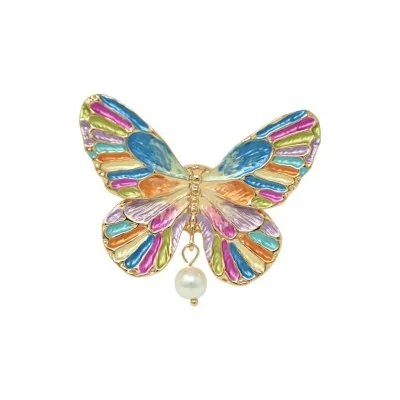
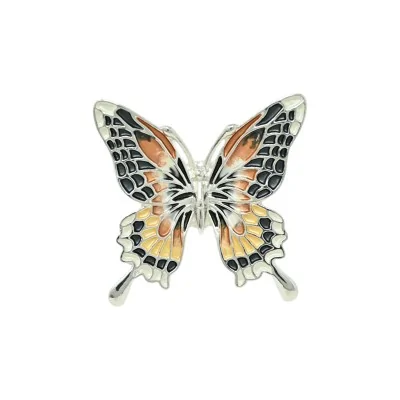
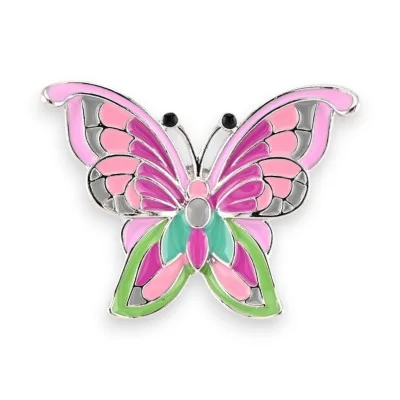
The blue butterfly (best seller in the UK) : serenity, recovery, spiritual clarity. Often worn after a period of stress or illness. The yellow butterfly : optimism, sunshine, sometimes associated with the return of a loved one in Mediterranean tradition. The black butterfly : memory, elegant mourning, revived from Victorian widows' jewellery. The white butterfly : new chapter, often given at a wedding or christening. The pink butterfly : feminine tenderness, recently associated with breast cancer awareness in UK campaigns. The multicoloured butterfly : exuberance, creative freedom, the most contemporary reading.
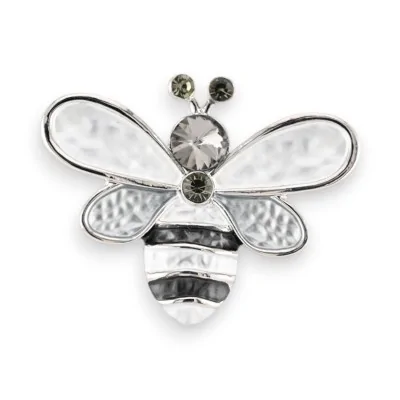
At Mode Tendance we have assembled a butterfly design selection centred on magnetic models that protect silk and cashmere, and classic pin models for structured tailoring. Our butterfly design collection covers the six colours documented above, and our insect brooch range extends the bestiary to bees, dragonflies and ladybirds for collectors of the wider menagerie.
The dominant meaning is transformation and rebirth, inherited from the Greek equivalence between the soul (psukhê) and the butterfly, reinforced by Christian iconography of resurrection. A butterfly design is traditionally worn at a moment of personal passage (a fresh start, a recovery, a wedding, the memory of a loved one). The colour adds a second layer of meaning : blue for serenity, white for new beginnings, black for memory.
Five reliable placements in 2026 : left lapel of a tailored blazer (the Madeleine Albright default), on the knot of a silk scarf, at the shoulder of a plain dress, clustered in twos or threes on an open coat, or on a handbag handle for those new to brooches. One placement at a time, on plain fabric rather than print, format from 3 to 6 cm depending on the location.
In several Mediterranean and East Asian traditions, yes. The butterfly is a recognised lucky charm in southern Italy, Greece and Japan, where two mirrored butterflies symbolise long-lasting marriage. British tradition is less codified, but the butterfly piece is frequently given as a gift to mark a happy occasion or to celebrate a recovery.
Madeleine Albright assigned political meanings to each animal in her brooch collection. The butterfly stood for transformation, hope and new beginnings, which made it her chosen piece for diplomatic openings : NATO enlargement, the Russian detente of the late 1990s, the opening of dialogue with North Korea. The full story is documented in the Smithsonian's touring exhibition Read My Pins and in her 2009 book of the same title.
Blue is the safest default : universally positive, no funereal connotation. White suits a wedding or a christening. Yellow or multicoloured suit a birthday or a celebration of good news. Avoid black unless you know the recipient associates it with a recent loss they want to commemorate. Pink has become tied to breast cancer awareness in the UK, which can be a meaningful choice or an unwelcome reminder depending on the recipient.
 Hoop Earring Trends 2026: 8 Looks to Wear Now
 Autumn/Winter 2026 jewellery trends: 7 pieces to adopt
 Bee in the House: Meaning, Symbolism and Superstition
 Labradorite vs moonstone: how to tell them apart
 What it means when a butterfly comes into your house
 How to cleanse and charge crystals: the complete guide
 Which side to wear a brooch: the rule explained
 Bee symbolism: meaning, the Manchester worker bee and spiritual sense