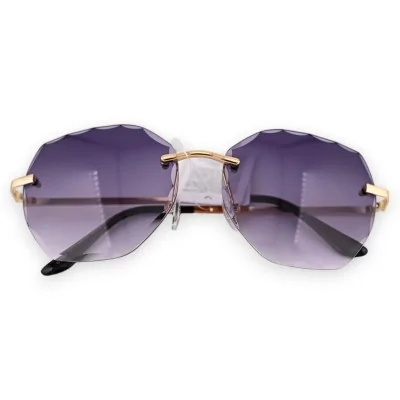

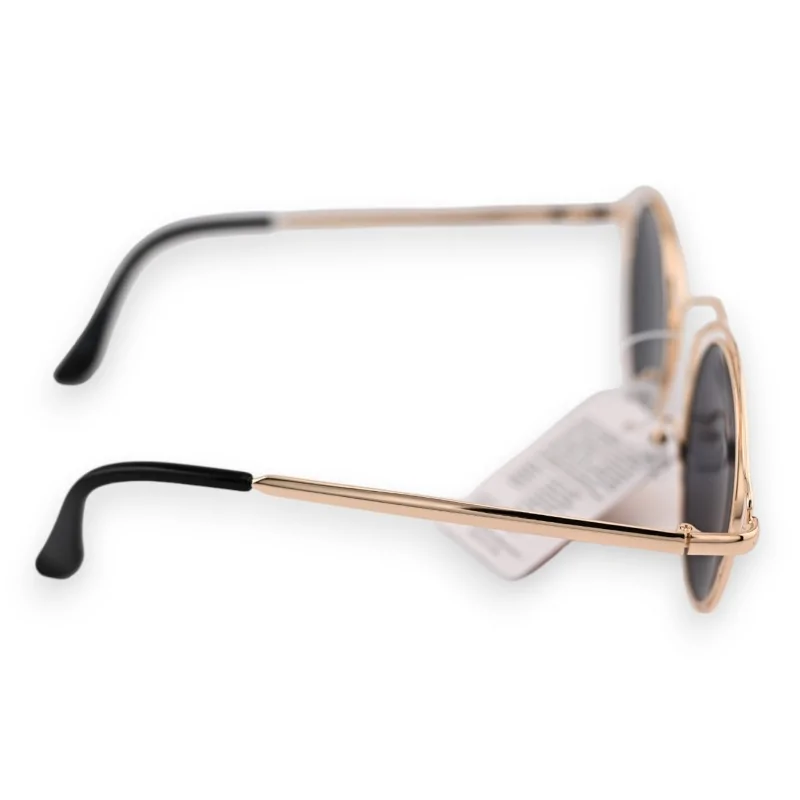




A round frame in gold-coloured metal, with a second wire running outside each rim. Both temples are thin and straight, and each one finishes in a short black end. Under the bridge, two translucent pads are each held in place by their own screw, and the lenses keep one depth of tint right across the surface.
Picked up off a table, the pair folds almost flat, and what the thumb finds first is not gold. Each temple finishes in a short black piece, smooth and a shade wider than the metal it caps. Those two ends are the only places on the whole frame where the colour changes.
A frame wears where it touches. The points of contact are behind the ears, and that is precisely where the gold stops: the black pieces cover the last stretch of each temple, the part that rests on the skin all day. Everything forward of the hinge keeps a single colour, because none of it is in permanent contact with the wearer.
The temples close across the back of the lenses rather than on top of one another, so the closed pair is barely deeper than the rims themselves. The hinge is small enough to disappear into the corner of the rim, and from there a thin gold wire runs straight to the black end without a single step or joint on the way.
| Metal | Thin gold-coloured wire |
|---|---|
| Shape | Round, with a second wire outside each rim |
| Temples | Straight, gold, finishing in black |
| Nose pads | Translucent, each held by a screw |
| Lenses | Dark, with no lightening towards the edges |
Round frames sit differently on different faces, and one catalogue photograph settles very little. Next to squarer fronts the difference reads in a second, which is the argument for looking at the round and the angular shapes on one page rather than one model at a time.
A round frame pushed up onto the head lands where a clip usually sits, and the two rarely share the space. For a pair that spends half the day on the crown rather than on the nose, a clip that grips low at the back keeps the top free. That habit also explains why the ends matter: they take the pressure each time. The lenses give nothing away either way, holding the same depth of tint from one edge to the other.
Data sheet