A clear guide to carrying medication in hand luggage: UK rules, the 100 ml exemption, doctor's letters and controlled...


A clear guide to carrying medication in hand luggage: UK rules, the 100 ml exemption, doctor's letters and controlled...

UK rules, clinical age guidance, choosing a safe piercer, first studs and the full healing timeline for a child's ear...

Sizing in inches and centimetres, teeth spacing, spring strain and materials: how to pick a claw clip that actually...

What pin-up style is, how it differs from rockabilly, and how to build the silhouette from clothes you already own.
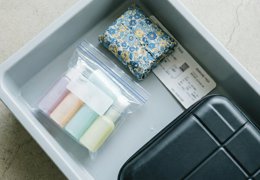
UK airports no longer share one liquids rule. Where the 2 litre allowance applies, where 100ml still stands, and how...

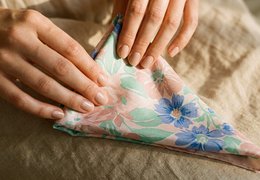




If you have ever wondered which gem is truly "yours", the answer usually starts with your birthstone, the stone traditionally linked to your month of birth. It is a centuries-old custom rather than anything medical, but it is the easiest, most personal way to choose a first crystal. Below you will find the full month-by-month list, the difference between traditional and modern birthstones, and a few tips on wearing yours.
A birthstone is the gem associated with the month you were born, a tradition with roots in antiquity and formalised by jewellers in the early twentieth century. People keep it as a small token of identity, a little like a lucky charm. It carries symbolism only, never a promise to heal.
| Month | Birthstone | Associated with |
|---|---|---|
| January | Garnet | energy, constancy |
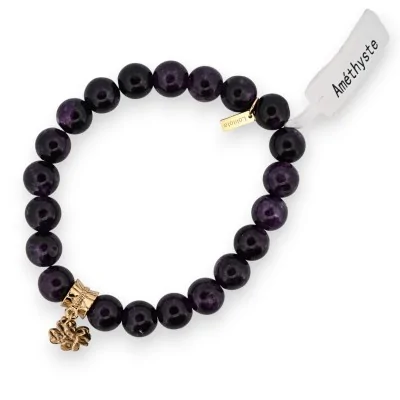
| February | Amethyst | calm, clarity |
| March | Aquamarine | serenity, communication |
| April | Rock crystal | purity, focus |
| May | Green agate | balance, growth |
| June | Moonstone | softness, intuition |
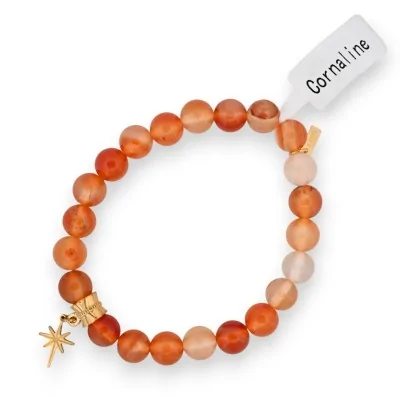
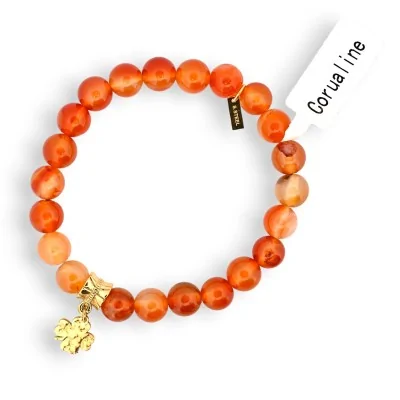
| July | Carnelian | drive, creativity |
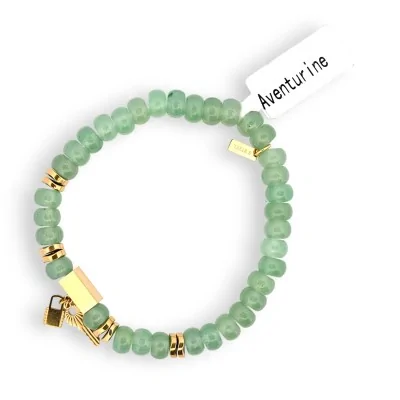
| August | Aventurine | luck, calm |
| September | Lapis lazuli | wisdom, expression |
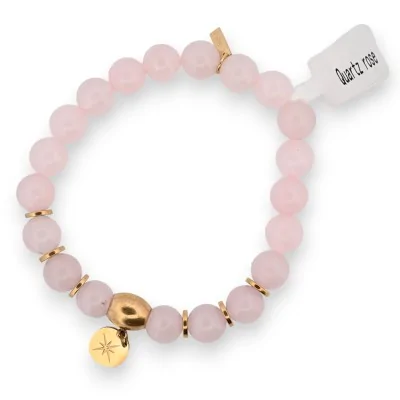
| October | Rose quartz | tenderness, trust |
| November | Citrine | joy, motivation |
| December | Turquoise | protection, travel |

You will sometimes see two stones listed for the same month. That is because the old folklore lists were revised by the jewellery trade in 1912 and updated since, partly by availability. Garnet for January or amethyst for February are remarkably stable, while months like June or December often show a traditional choice alongside a modern alternative. Neither is more "correct", so pick the one that speaks to you.
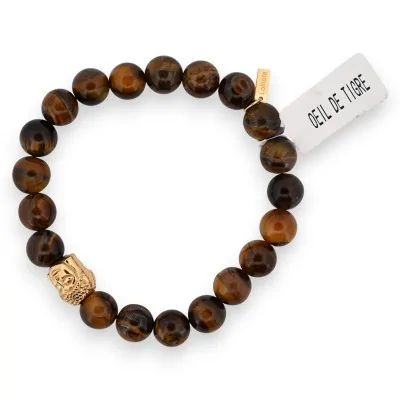
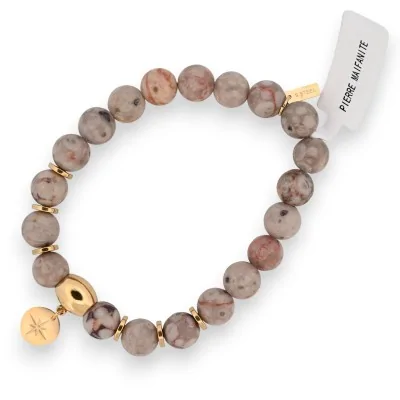
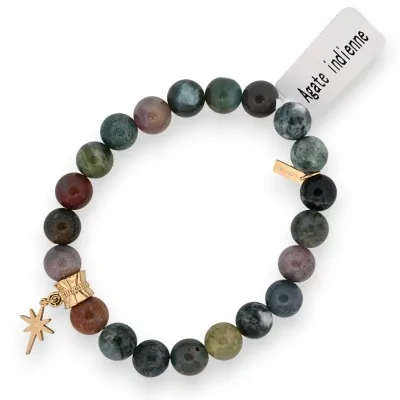
Start with a single stone rather than a full set. Worn as a natural stone bead bracelet on the wrist, or simply kept in a pocket, it stays close without fuss. You can layer more later as your taste grows. To explore each gem on its own, browse our crystal collection, sorted stone by stone.

The link between stones and birth months has a documented history. It is often traced back to the breastplate of Aaron described in the Book of Exodus, set with twelve stones that were later matched to the twelve months and zodiac signs. The modern birthstone chart was standardised in 1912 by the American association of jewellers and has been amended several times since, which is why the traditional and modern lists sometimes disagree for the same month. Knowing both lists simply gives you more than one legitimate birthstone to choose from.
Alongside the month system, tradition also assigns stones to zodiac signs, and the two do not always match. An April Aries may find diamond on the month list and bloodstone on the zodiac list, both historically valid. The zodiac route is worth exploring if your month stone does not appeal to you: tradition offers it as an equally rooted alternative, and it often opens up more affordable options than the precious month stones.
Whatever its symbolism, a birthstone also has measurable properties. The Mohs scale ranks minerals from 1 to 10: diamond sits at 10 and shrugs off daily wear, sapphire and ruby at 9 are nearly as robust, while emerald is harder than it is tough because of its inclusions. Opal and pearl sit much lower and dislike knocks, cosmetics and hot water. For a ring worn every day, hardness matters more than for a pendant, which is useful to know before setting your birthstone in jewellery.
Of course. The lists are traditions, not rules: many people choose the stone of a child, a partner or simply a colour they love. A birthstone is meaningful, not mandatory.
Then choose another. The month chart is a starting point, not a rule. Many people prefer the stone tied to their zodiac sign or simply the colour they are drawn to. Your stone should feel like yours.
Absolutely. A common pairing is one grounding stone and one heart stone, and plenty of people rotate theirs with the seasons. There is no limit beyond your own taste.
Rinse it under clear water and dry it gently to remove dust. Keep perfume and household chemicals off the surface. Some like to set stones in daylight, which is tradition rather than a requirement.
No. There is no scientific evidence of any therapeutic effect. Birthstones and crystals belong to symbolism and felt wellbeing, and never replace medical advice.
 Hoop Earring Trends 2026: 8 Looks to Wear Now
 Autumn/Winter 2026 jewellery trends: 7 pieces to adopt
 Bee in the House: Meaning, Symbolism and Superstition
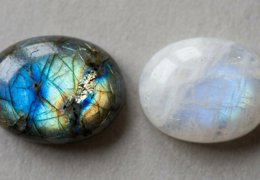 Labradorite vs moonstone: how to tell them apart
 What it means when a butterfly comes into your house
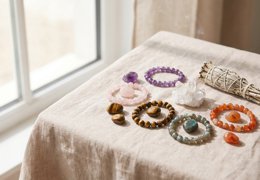 How to cleanse and charge crystals: the complete guide
 Which side to wear a brooch: the rule explained
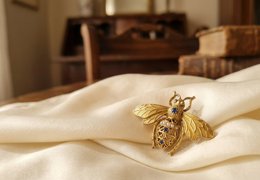 Bee symbolism: meaning, the Manchester worker bee and spiritual sense