A clear guide to carrying medication in hand luggage: UK rules, the 100 ml exemption, doctor's letters and controlled...


A clear guide to carrying medication in hand luggage: UK rules, the 100 ml exemption, doctor's letters and controlled...

UK rules, clinical age guidance, choosing a safe piercer, first studs and the full healing timeline for a child's ear...

Sizing in inches and centimetres, teeth spacing, spring strain and materials: how to pick a claw clip that actually...

What pin-up style is, how it differs from rockabilly, and how to build the silhouette from clothes you already own.

UK airports no longer share one liquids rule. Where the 2 litre allowance applies, where 100ml still stands, and how...






The 2026 British SERP for « how to wear a brooch » returns a recurring anxiety : « How to wear a brooch and not look old ? », a question that Glamour UK addresses head-on in their long-running editorial. The brooch came back to British high streets in 2024 through Liberty London and Selfridges, helped by the Madeleine Albright Smithsonian travelling exhibition and the rise of Lauren Sands's Substack newsletter on contemporary jewellery styling. Yet many British wearers still hesitate. This article runs through the modernisation rules first, then details 12 specific placements across jumpers, coats and jackets, with British weather and tailoring conventions in mind.
The British anxiety has three sources : memory of the Princess Margaret era brooches in the 1960s, the residue of the « old lady on the bus » trope, and the long absence of brooches from high-street ranges between 2005 and 2020. Three modernisation rules answer the anxiety.
Lauren Sands of the popular Substack newsletter Cool Girl's Guide to Brooches sets the size at 4 to 6 cm for solo pieces, 3 to 4 cm for cluster arrangements. Anything beyond 7 cm reads as the 1980s tailoring brooch and triggers the great-aunt association. The 2026 trend favours intentional minimalism : one statement piece, not a constellation.
The British designer Paula Bolton, whose hand-crafted pieces appear in Liberty London since 2019, builds her styling guides around metal coherence. A yellow gold brooch on a beige cardigan paired with a silver watch and a rose gold bracelet creates visual noise. Pick one dominant metal (yellow gold, rose gold, silver, matte black) and align the whole silhouette on it. Mixed metals work only as a deliberate statement, not by accident.
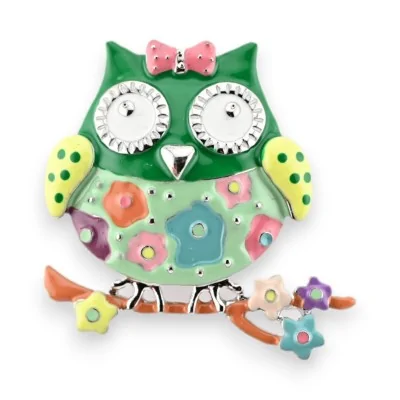
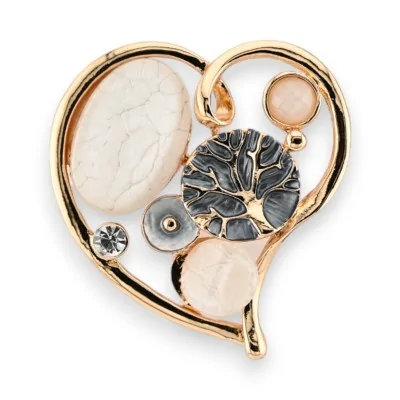
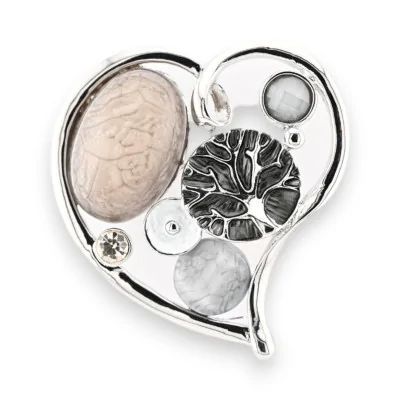
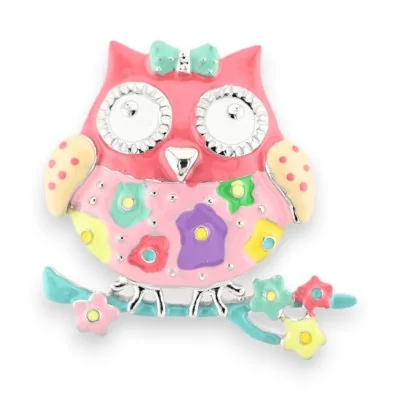
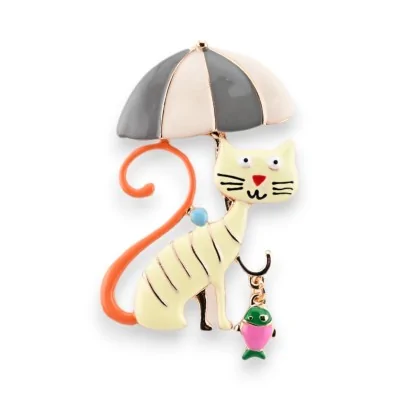
Figurative motifs of the 1980s tailoring era (cane, greyhound, fox-hunting horn) read dated. Motifs that work in 2026 : friendly animals (cats, butterflies, bees, owls), geometric (circle, star, line), stylised botanical (leaf, abstract flower), symbolic (heart, key, anchor). Glamour UK's 2026 editorial leans heavily on the friendly-animal category as the safest entry point for first-time brooch wearers.
The British convention has the brooch on the left lapel, at chest pocket height, point angled slightly toward the shoulder. The rule comes from medieval heraldry (the family coat of arms worn over the heart) and was codified in Victorian etiquette manuals. The convention survives in 2026 across British weddings, royal events and editorial photography.
One exception : a heavy statement necklace already occupying the left side justifies moving the brooch to the right for visual balance, particularly in formal evening wear. This shift is documented in Vogue UK's bridal editorials since 2020.
The jumper is the trickiest support. The knit warps under heavy pins, the unbroken colour creates a strong focal point, and the cut (crew, V-neck, cardigan, polo) dictates a different placement every time.
A fine cashmere or wool crew neck takes a 3 to 5 cm brooch placed halfway between neckline and chest, slightly offset to the left. Use a magnetic backing rather than a classic pin (our guide to the magnetic brooch in 6 uses covers the mechanism). Floral or animal motifs work best on plain knit, never heavy rhinestones that overload the silhouette.
The V-neck offers a natural geometric anchor : the tip of the V becomes the focal point. A small brooch (2 to 3 cm) placed exactly on the tip, or 1 cm above, closes the neckline visually and structures the silhouette. Cap the size to avoid overpowering the neckline itself.
An open cardigan offers two placements : on the left lapel at chest pocket height (classic) or on the open edge at collarbone height, working as a clip that holds the two sides closer (functional). The second placement solves the problem of cardigans falling open in movement.
The polo neck (or roll neck) smothers classic chest brooches in the fabric of the collar. The fix : move the brooch to the left shoulder, in a larger 5 to 7 cm format. This shoulder placement is the signature 2026 trend across Vogue UK and Glamour UK winter editorials.

British winter weather makes the overcoat the brooch's most generous canvas : thick wool supports classic pins, large surface area accepts XXL pieces, and maximum visibility for street photography.
The classic wool overcoat (Mackintosh, Margaret Howell, Aspinal of London) takes a brooch on the left lapel, at chest pocket height, like a blazer. Recommended size : 5 to 7 cm, motif that reads in outdoor light (animal, floral, geometric). The thick wool tolerates classic pins without risk of distortion to the weave.
The trench (Burberry, Mackintosh) does not lend itself to classic lapel placement : the double-breasted button line and the epaulettes already structure the silhouette. Two options : at the belt knot (visible when the trench is open or half-closed), or on the left epaulette (military-inspired revival). Avoid chest pocket height where the double-breasted buttons create visual crowding.
The padded gilet (Barbour, Joules, Aigle for the Anglo-French market) struggles with classic pins : the nylon shell pierces easily and the down insulation shifts. Solution : place the brooch on the hood drawstring or on the collar fastening strap, where the fabric is doubled. Compact format (3 to 4 cm), functional motif (flower, star, anchor) in dialogue with the outdoor character of the piece.
The cape (Margaret Howell, Sézane in UK distribution) or wool poncho offers a large draped surface that calls for a statement piece (6 cm or more). Placement : on the draped edge, at left shoulder height, pinching the two panels together. Structural effect that revives a classic drape.
The jacket is the classic British brooch support : tailored blazer (Hobbs, Reiss), fitted blazer (Whistles), denim jacket (Levi's, Acne Studios), collarless jacket (Cos, Toteme). Four placements by cut.
The default placement, inherited from Saville Row and Hobbs tailoring. Brooch 4 to 6 cm on the left lapel, at chest pocket height, point angled toward the shoulder. Compatible with all motifs (animal, floral, geometric). One brooch at a time, no competing statement necklace.
The modern fitted blazer (Whistles, Reiss) often has a real topstitched chest pocket. The brooch sits directly on the pocket flap, replacing a fabric pocket square. Compact format (3 to 4 cm), graphic motif. Cleaner effect than on the lapel and more modern in 2026 British editorials.
The denim jacket (Levi's, Acne Studios, Saint Cuthbert's Mill) needs an off-centre placement to avoid the « cowboy costume » association. Two options : on the collar, at left shoulder height (vintage pin-style), or on the topstitched chest pocket patch. Compact format (2 to 4 cm), animal or figurative motifs in contrast with the utility character of the piece.
The collarless jacket (Cos, Toteme, The Frankie Shop) removes the lapel reference point : the brooch sits at left shoulder height, 5 cm from the neckline, as a signature detail. Medium format (4 to 5 cm), statement motif. This placement is one of the most modern in 2026 and suits androgynous minimalist silhouettes particularly well.

At Mode Tendance we offer a brooch selection built around animal, floral and symbolic motifs, in 3 to 6 cm formats suited to the 12 placements documented above. Our brooch collection covers classic pin versions for sturdy coats and tailored jackets, and our magnetic brooch range protects fine cashmere knits and silk blouses from piercing.
Three rules. Left lapel for women, at chest pocket height (medieval heraldry tradition). One brooch at a time, or three maximum in a diagonal cluster. On plain fabric, never on a busy print, to avoid visual cacophony. Then adapt size to support : 3 to 4 cm on fine knit, 5 to 7 cm on a winter coat.
Three modernisation rules. Modest size (cap at 6 cm for solo pieces). Metal coherence across the silhouette (one dominant metal, not a mix). Modern motifs (friendly animals, geometric, stylised botanical), not the figurative 1980s motifs (cane, greyhound, hunting horn). A small gold cat brooch on a cream cashmere V-neck reads contemporary in 2026, a large rhinestone fox on a beige twinset reads dated.
Yes. The brooch returned to the British high street in 2024 through Liberty London, Selfridges and John Lewis. The Madeleine Albright Smithsonian travelling exhibition (still on UK tour in 2026), the rise of Lauren Sands's Cool Girl's Guide to Brooches Substack, and Paula Bolton's Liberty collection have rebuilt the brooch's credibility with British wearers under fifty. Glamour UK identifies the brooch as one of the three returning accessories of the 2026 spring season.
Left side, on the left lapel, at chest pocket height. The convention comes from medieval heraldry (family coat of arms worn over the heart) and remains the default in British editorial photography in 2026. Exception : a heavy statement necklace already on the left justifies moving the brooch to the right for visual balance, particularly in formal evening wear.
Use a magnetic backing rather than a classic pin. The magnetic system holds on 1 to 4 mm fabric thicknesses (fine jersey, cashmere knit, fine linen), with a metal plate slid inside the garment. Our companion piece on the magnetic brooch in six uses details the mechanism for fine fabrics. For thick chunky knits (Aran wool, alpaca), a classic pin passes without visible damage.
 Hoop Earring Trends 2026: 8 Looks to Wear Now
 Autumn/Winter 2026 jewellery trends: 7 pieces to adopt
 Bee in the House: Meaning, Symbolism and Superstition
 Labradorite vs moonstone: how to tell them apart
 What it means when a butterfly comes into your house
 How to cleanse and charge crystals: the complete guide
 Which side to wear a brooch: the rule explained
 Bee symbolism: meaning, the Manchester worker bee and spiritual sense