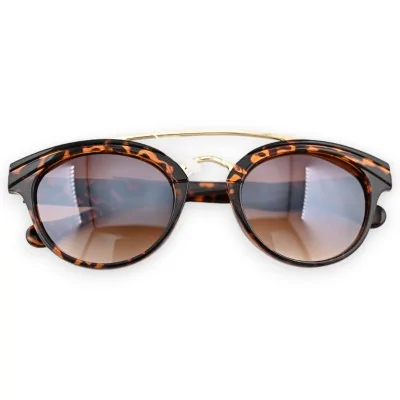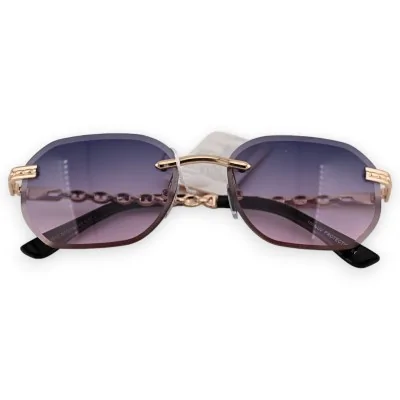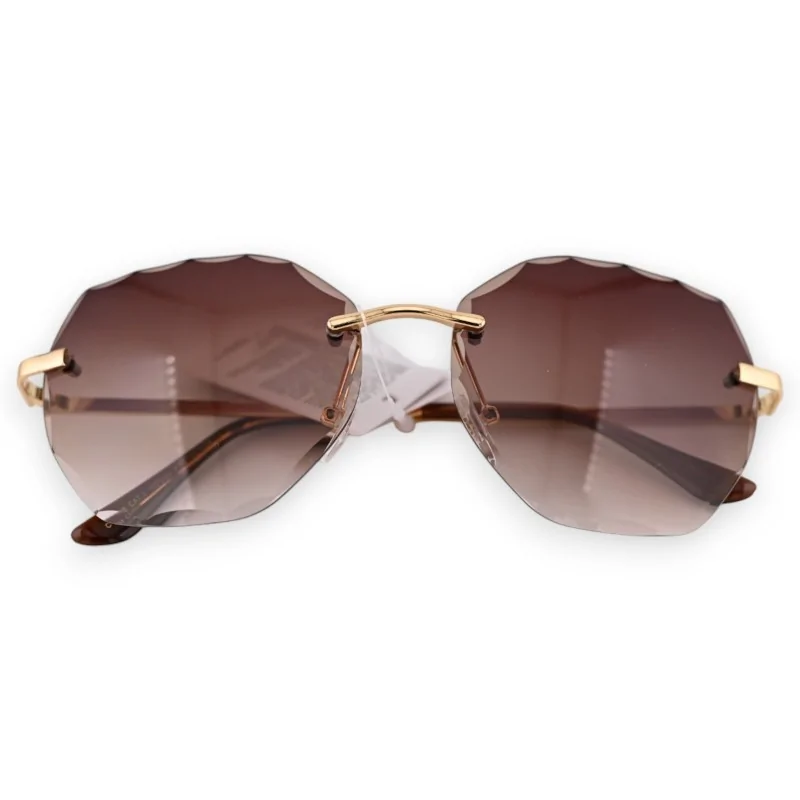
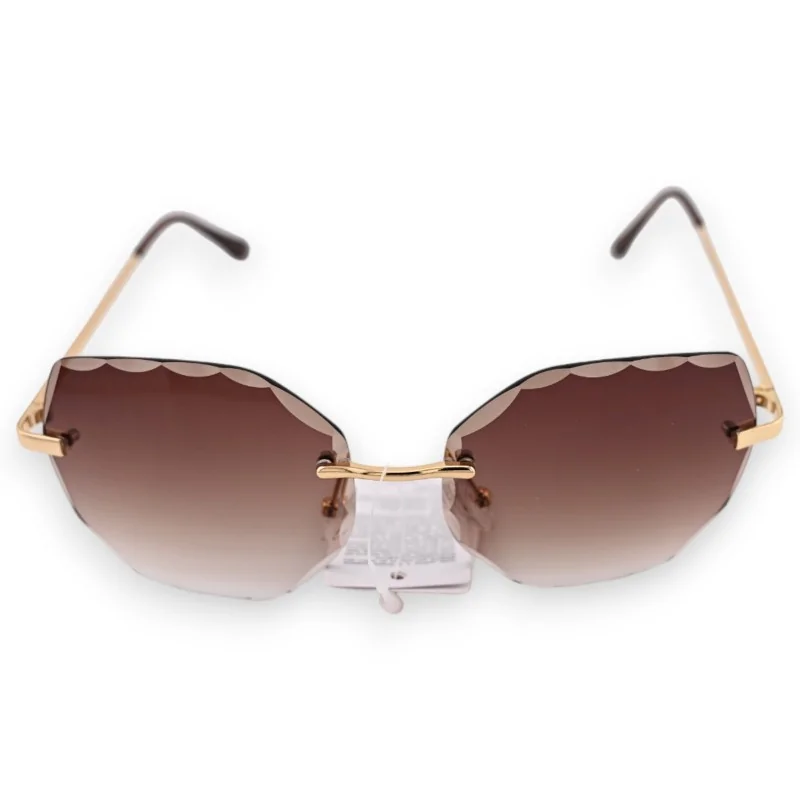
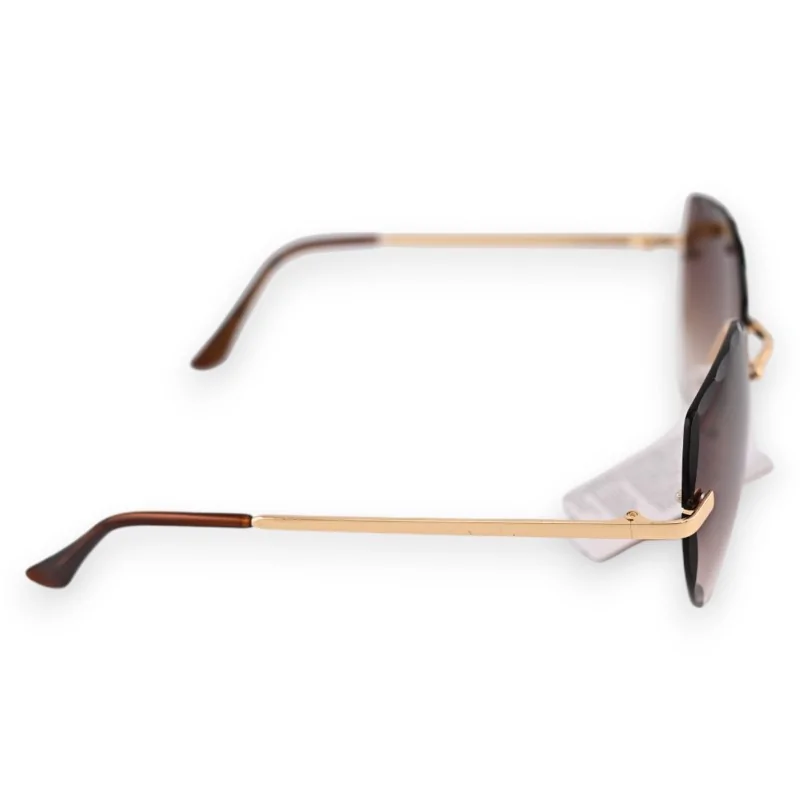
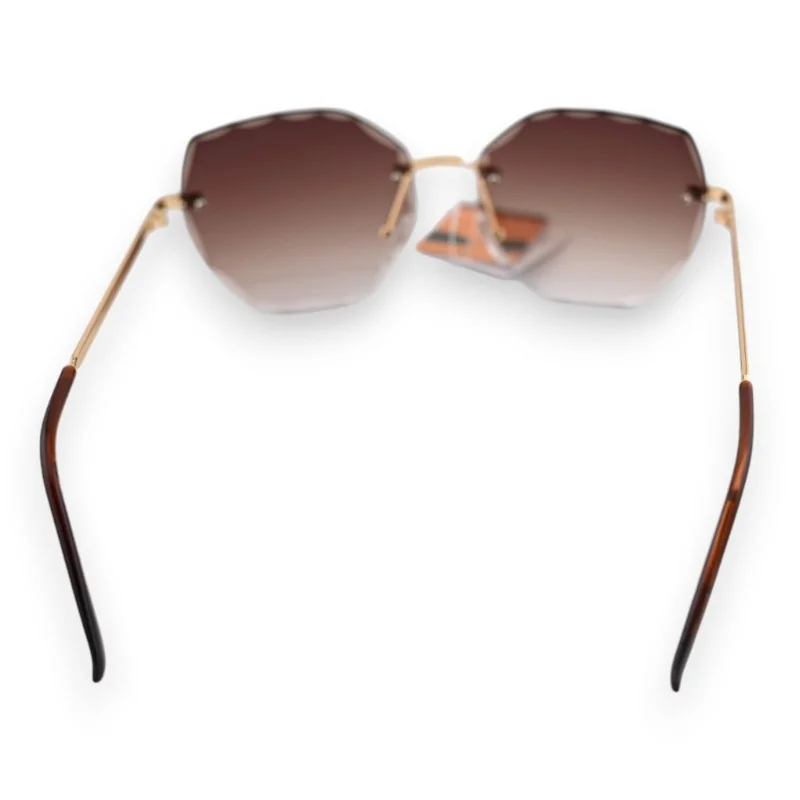



A pair held together by five gold-toned parts and nothing else, so the cut edge of the lens stays in plain view all the way round. The brown is at full strength across the top of each lens and gives way as it drops, so the base is left with almost no colour. Each arm ends in a tortoise tip, and that tip is where the only bend sits.
Look along the outline and you will not find an arc. The edge is a run of flat panels meeting at open angles, the bar across the nose is a strip rather than a hoop, and each arm leaves its fixing block and travels back without deviating at all. Even the notching on the upper edge is set into a straight run. That is unusual: on most pairs it is the frame that rounds things off, and here nothing at all plays that part.
One shape does break the rule, and it waits right at the back. After running flat and straight for its whole length, each arm finishes in a tortoise moulding that turns downwards. It is the only curve on the whole pair, and it is the only piece that is neither glass nor gold.
The gold stops well before the ear. From there the tortoise takes over, first as a straight continuation, then dropping away in a long, shallow sweep. Because the changeover of material and the change of direction happen at the same point, the eye reads them as one event rather than two.
A straight arm sits against the head instead of gripping it, and the weight ends up carried mainly by the flat bar on the nose. The curve at the back is what stops the pair sliding forward, so the hold comes from that final section and not from pressure along the temples. To see how the edge and the arms are handled elsewhere, put this pair beside the other cut-edge frames in this range.
Brown and gold ask very little of the rest of what you wear. Against a pale shirt the lens carries the only strong colour in the outfit; against something darker it recedes and the two thin arms are what catch the light instead. To finish the look, have a browse through the smaller things that round out an outfit.
Data sheet