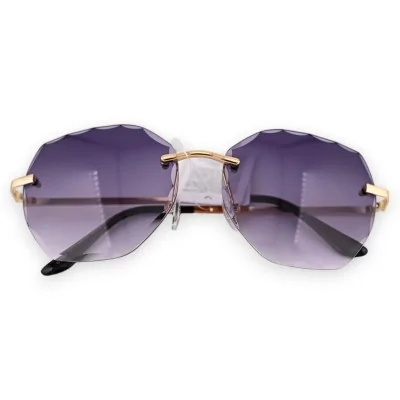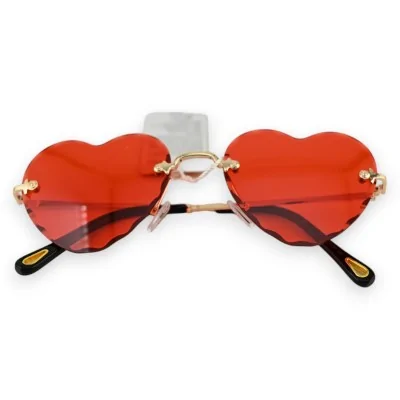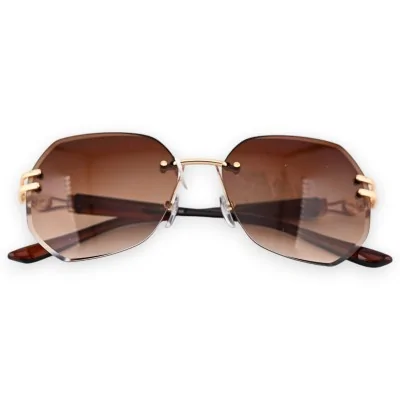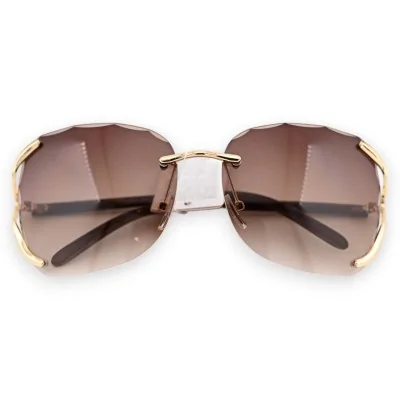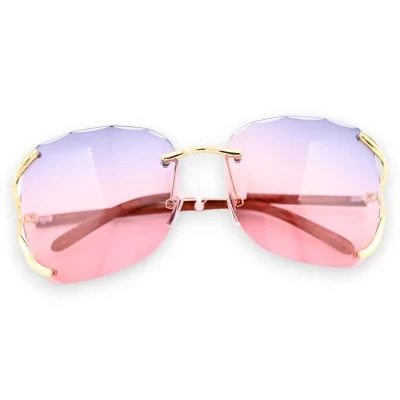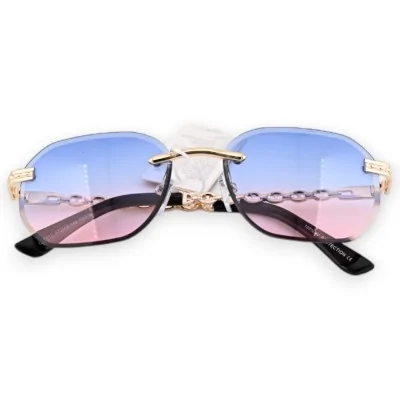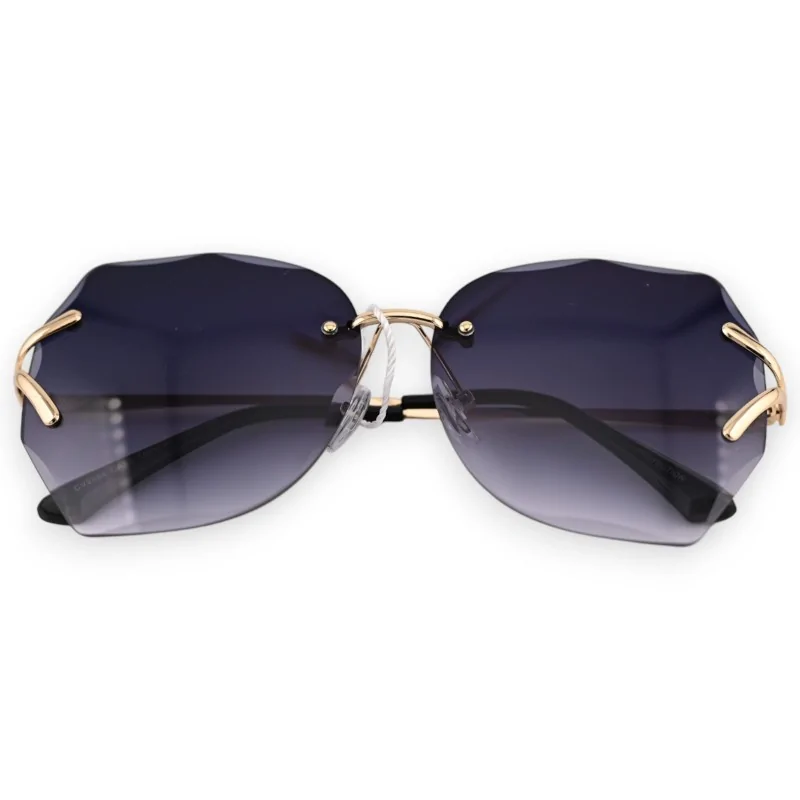
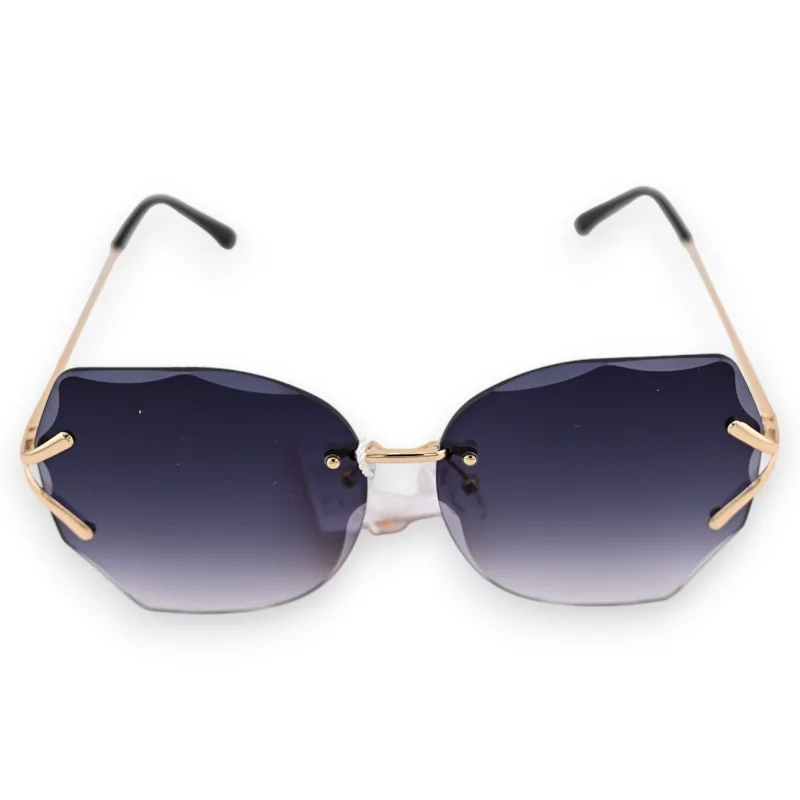



On each lens the colour sits at its heaviest along the top edge and has nearly disappeared by the base. There is no rim anywhere, so nothing interrupts that fade.
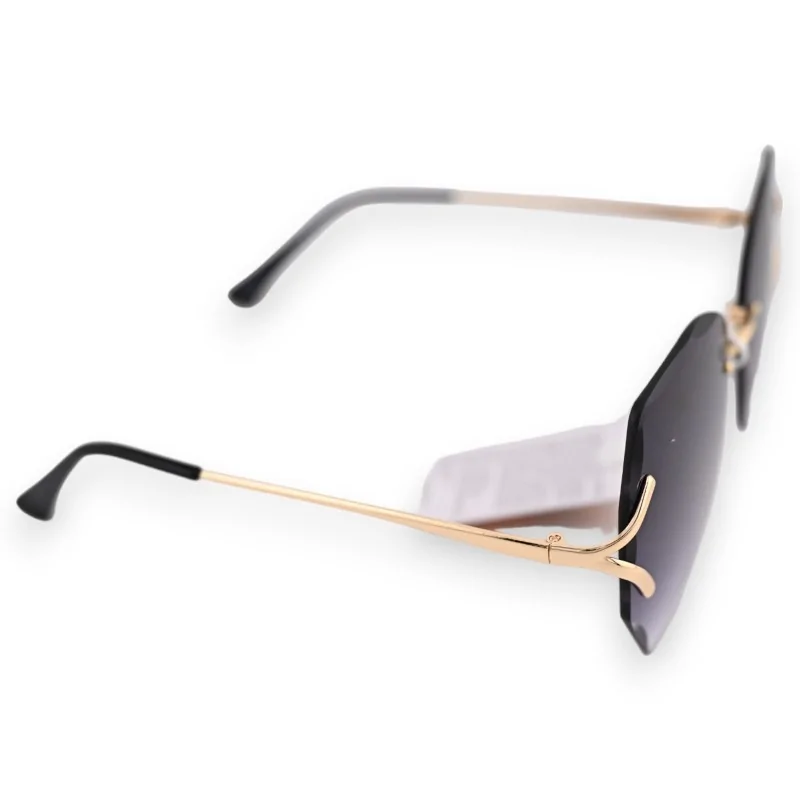
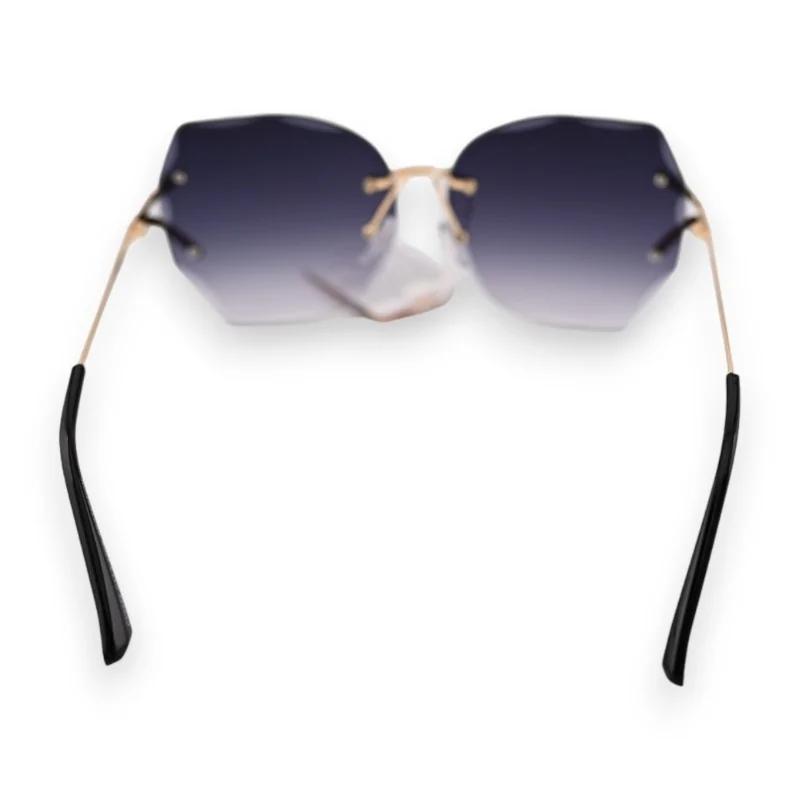
Four gold-toned pieces hold the pair together: a flat bar at the bridge and a shaped block at each outer corner. The arms are thin gold wire, and each one finishes in a long black tip.
Hold either lens up and the change is easy to follow. The upper stretch is dense enough that you cannot see anything behind it. Lower down the colour thins, and by the last part of the lens it has gone altogether, leaving plain glass with a cut edge. The fade is not a band with a hard start and finish; it is a slow withdrawal, and the point where it ends sits well below the middle of the lens.
Because no surround is fitted, the lens itself draws the outline: a series of straight facets joined by wide corners, with a line of small notches worked into the upper edge only. Apart from the bridge bar and the two corner blocks, nothing is laid over the glass. Look along the shelf and you will see the other fronts where the tint runs out early.
All of this has a practical consequence that shows up the moment the pair is on a face. The dark section falls across the eyes, which is where you want it; the clear section reaches down over the top of the cheek, which stays plainly visible to anyone opposite. A pair tinted evenly from edge to edge would hide both. Here the lens gives back the lower half of the face, and the wearer still gets shade exactly where the light comes in. The same gold tone turns up elsewhere in the pieces filed under accessories.
Data sheet