A clear guide to carrying medication in hand luggage: UK rules, the 100 ml exemption, doctor's letters and controlled...


A clear guide to carrying medication in hand luggage: UK rules, the 100 ml exemption, doctor's letters and controlled...

UK rules, clinical age guidance, choosing a safe piercer, first studs and the full healing timeline for a child's ear...

Sizing in inches and centimetres, teeth spacing, spring strain and materials: how to pick a claw clip that actually...

What pin-up style is, how it differs from rockabilly, and how to build the silhouette from clothes you already own.
UK airports no longer share one liquids rule. Where the 2 litre allowance applies, where 100ml still stands, and how...




The cork in a handbag, a wine stopper or an insulation panel begins on a tree in southern Portugal. How cork is made is unlike any other material story: nothing is cut down, the bark is simply peeled and grows back on its own. Here is how cork is made, step by step, from the cork oak to a finished material.
Understanding how cork is made means following a slow farming calendar set by nature rather than by a factory line. The whole craft of how cork is made starts with the tree itself.
Cork is the outer bark of the cork oak, Quercus suber, a Mediterranean tree that grows mainly in Portugal, Spain and southern France. This thick, light bark shields the tree from heat and fire. It is the part that is harvested, while the living trunk underneath is never touched.
Its honeycomb structure, made of millions of tiny air-filled cells, gives cork its qualities: a light, waterproof and elastic material. Suberin, a natural substance in its cell walls, makes it impermeable to liquids and resistant to stains.
The cork oak is a slow, long-lived tree that can reach one hundred and fifty to two hundred years of age. It is first stripped at around twenty-five years old, and then only once every nine years. This patient rhythm is what makes cork a rare and carefully managed resource rather than an industrial crop.
In Portugal the tree is protected by law and cannot be felled. A cork oak is never cut down to harvest it, which is why the same trees are passed down across generations of farming families.

Cork is harvested by detaching the bark with a special curved axe, without cutting into the wood. The work happens in summer, between May and August, when the sap is flowing and the bark separates cleanly. Skilled harvesters peel large curved planks from the trunk and main branches.
The first harvest, called virgin cork, is irregular and goes mostly into granules and panels. Only the third harvest, more than forty years after planting, yields the fine, even cork used for wine stoppers. This long wait shapes how cork is made for every grade.

Turning planks into a finished material takes several months. The harvested planks first rest outdoors for about six months, then they are boiled in water for roughly an hour, which flattens, cleans and expands them. After a second rest, the cork is sorted by thickness and quality.
The finest planks are punched into stoppers. Everything else is ground into granules and bound into agglomerated cork. Nothing from the bark is wasted, from offcuts to dust, which all return to the process.
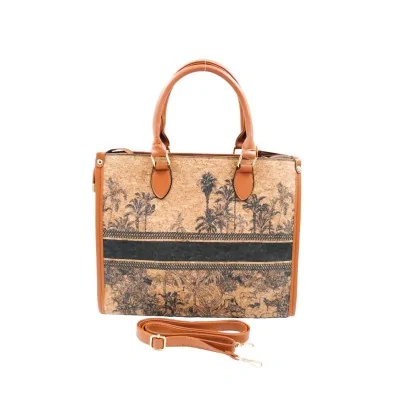
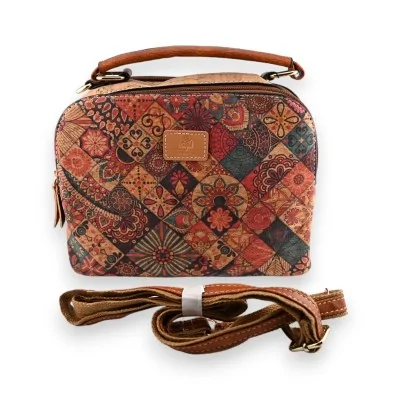
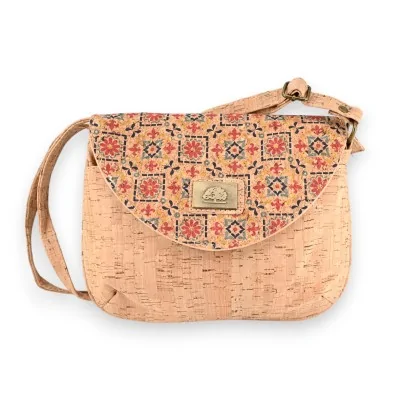
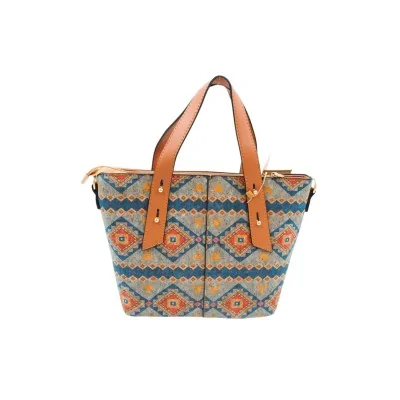
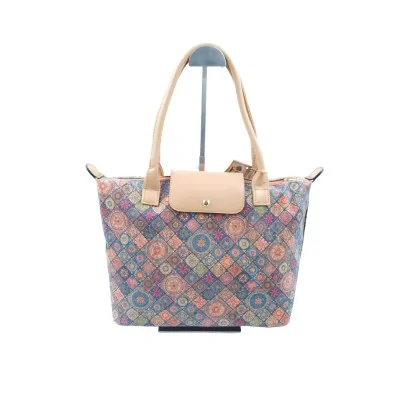
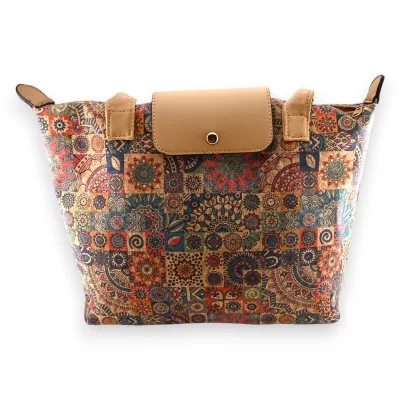
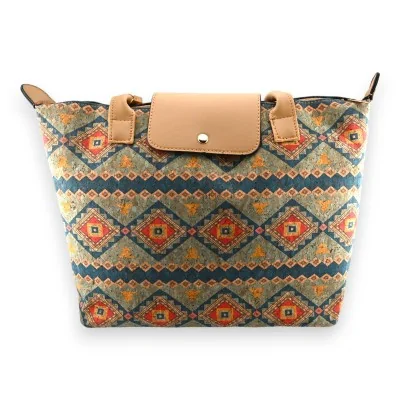
The same raw material branches into very different products. Granulated and agglomerated cork becomes flooring, pin boards, soles and insulation, while thin shaved sheets glued onto a textile backing become cork fabric, also called cork leather. This is the version used for bags and accessories, the visible end of how cork is made.
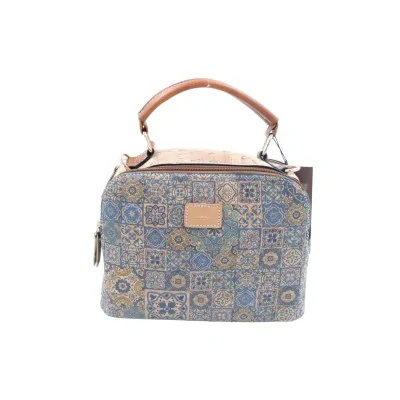
Cork fabric is light, washable and vegan, which makes it a durable choice for everyday items. Our cork bags show this final stage, where harvested bark becomes a finished accessory.
Cork is renewable and biodegradable, and its harvest fells no trees. The cork oak forest stores carbon, resists fire and shelters protected wildlife such as the Iberian lynx. Portugal alone produces about half of the world's cork, ahead of Spain, making the country the heart of how cork is made.
Portugal produces half the world's cork, and buying a cork object supports a farming model that keeps the tree standing.
No, the cork oak does not die: only its bark is removed, and it grows back naturally within nine years. The living wood is never cut. A single tree can be harvested around fifteen times over a lifespan of one hundred and fifty to two hundred years.
It takes about twenty-five years before the first harvest, then nine years between each following one. Fine cork for stoppers only appears at the third harvest. After stripping, the bark still needs several months of seasoning and resting before it becomes a finished material.
Cork comes mainly from the western Mediterranean. Portugal is the leading producer, followed by Spain, then Italy, Morocco, Tunisia, Algeria and southern France. Most processing is concentrated in Portugal, especially in the Alentejo region.
They share the same raw bark but differ in processing. A stopper is punched from a single fine plank, while cork fabric is made from thin shaved sheets glued to a textile backing. Both come from the cork oak, yet only fabric is flexible enough for bags.
Yes, cork is renewable, recyclable and biodegradable. Its harvest cuts down no trees, and the cork oak forest captures carbon while protecting wildlife. Used cork, from stoppers to offcuts, can be recycled into granules, insulation or new products.
Sources: APCOR (Portuguese Cork Association), Corticeira Amorim, WWF Mediterranean (montado and biodiversity), Food and Agriculture Organization of the United Nations.
Mode Tendance, fashion and accessories desk. Published on 15 June 2026.
 Medication in hand luggage: prescriptions, exceptions and security checks Ear piercing for a child: what age, uk rules and safety How to wear pin-up style in 2026 without looking like a costume Liquids in hand luggage: UK airport rules and limits 2026
 How to change a watch battery yourself: a step-by-step guide
 Nickel allergy and jewellery: symptoms and safe metals to choose
 What to give a woman who has everything: the anti-duplicate method
 How to change a watch strap: steps and mistakes to avoid