A clear guide to carrying medication in hand luggage: UK rules, the 100 ml exemption, doctor's letters and controlled...
€12.90 €6.45 -50%


A clear guide to carrying medication in hand luggage: UK rules, the 100 ml exemption, doctor's letters and controlled...

UK rules, clinical age guidance, choosing a safe piercer, first studs and the full healing timeline for a child's ear...

Sizing in inches and centimetres, teeth spacing, spring strain and materials: how to pick a claw clip that actually...

What pin-up style is, how it differs from rockabilly, and how to build the silhouette from clothes you already own.
UK airports no longer share one liquids rule. Where the 2 litre allowance applies, where 100ml still stands, and how...






You want to order a ring online, give one to a loved one, or simply know your finger size without walking into a jeweller? Good news: three at-home methods will get you to within half a millimetre. Here is how to measure, how to convert between UK letters, US numbers, EU/French circumference and Asian sizes, and the mistakes that wreck online orders.
Every at-home method relies on the same principle: measure the circumference of the finger (in millimetres) at the spot where the ring will sit, then convert that figure to the local sizing system. Accuracy depends on the tool you use.
Cut a thin strip of paper one centimetre wide, or take a thin non-stretch string. Wrap it around the base of the target finger at the widest point. Mark the overlap with a fine pencil, unfold, and measure the length in millimetres with a ruler. That figure equals your EU/French ring size directly (52 mm = size 52). For a UK letter or US number, use the conversion chart below.
Pick a ring that already fits the target finger. Measure its inside diameter in millimetres with a flat ruler. Multiply by 3.14 (π) and you get the circumference, hence the size. Example: a 17 mm inside diameter gives a 53.4 mm circumference, so EU size 53 / US 6 ½ / UK M.
Most jewellers offer a printable paper sizer with calibrated circles for each size. Print it at 100 % scale (verify with a ruler that the circle marked "50" measures 16 mm inside). Slide your existing ring over each circle until you find the exact diameter. This is what jewellers use in store: accurate within 0.5 mm.

The UK system uses alphabetical letters from A to Z, the US uses numbers from 3 to 13, the EU/French system reads directly in millimetres of circumference, and Asia uses a separate numbered scale. Here is the standard cross-reference used by most British and American jewellers.
| Circumference (mm) | UK | US | EU / FR | Asia |
|---|---|---|---|---|
| 47 mm | H | 4 | 47 | 7 |
| 49 mm | I ½ | 4 ½ | 49 | 9 |
| 50 mm | J ½ | 5 | 50 | 10 |
| 52 mm | L ½ | 6 | 52 | 12 |
| 54 mm | N | 6 ¾ | 54 | 14 |
| 55 mm | N ½ | 7 | 55 | 15 |
| 57 mm | P | 8 | 57 | 17 |
| 59 mm | Q ½ | 8 ¾ | 59 | 19 |
| 60 mm | R ½ | 9 | 60 | 20 |
| 62 mm | T ½ | 10 | 62 | 22 |
If you measure a circumference of 54 mm, you wear a UK size N, US 6 ¾, EU/FR 54. The most common adult women's size in the UK falls between L and N, which is why jewellery brands often sample those letters as their default stock.
Getting your finger size wrong is expensive in resizing fees and return shipping. Here are the recurring traps.
Measuring first thing in the morning or right after exercise. Fingers swell on waking and after exertion. The reliable measurement is taken at the end of the day, at room temperature, without recent salt or alcohol. Forgetting the knuckle: the base of the finger is narrower than the knuckle. A ring must pass the knuckle to reach its resting position. Measure both spots and use the larger value.
Confusing dominant and non-dominant hand. The dominant hand (right for nine out of ten people) is on average half a millimetre wider than the other. Measuring only once: take three readings a minute apart and use the average. Ignoring the season: fingers run wider in summer due to heat and vasodilation. If you buy in July a ring meant to be worn year-round, measure in mid-season.
The trickiest case: choosing a ring as a gift without spoiling the surprise. Three techniques work in practice without asking directly.
Discreetly pick up a ring the person wears regularly on the target finger. Within a few hours, measure its inside diameter with a ruler (method 2 above) or with a printed sizer. Put the ring back exactly where it was before it gets missed. Tip: if it is too tight to remove, wet the finger and slide it off gently.
If you cannot borrow the ring, take its imprint on a piece of soap or modelling clay. Measure the inner circle of the imprint with a ruler. Less precise (within 1 mm), but enough to avoid being more than one size off.
Often overlooked but very effective: a sister, best friend or mother usually knows the size. A casual question slipped into conversation is enough. The lowest-risk method if you fear waking a favourite ring kept in a drawer.

Your finger size is not fixed. Several factors change it over the years, and remeasuring every two to three years is worth doing after any major physiological change.
Temperature matters at the margin: a finger reads 0.5 to 1 mm larger at 30 °C than at 5 °C. A weight change of five kilos shifts a full size. Pregnancy widens the hands by one size on average, sometimes two, with partial recovery after delivery. Water retention linked to the menstrual cycle moves the reading by up to half a millimetre. Regular weight training also thickens the knuckles.
For an engagement or wedding ring bought for life, plan a future resize (downsizing or upsizing at a jeweller) rather than relying on a perfectly exact measurement today.
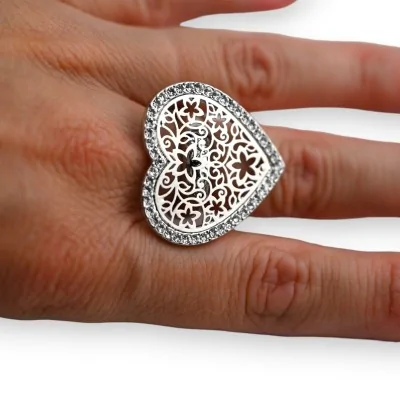
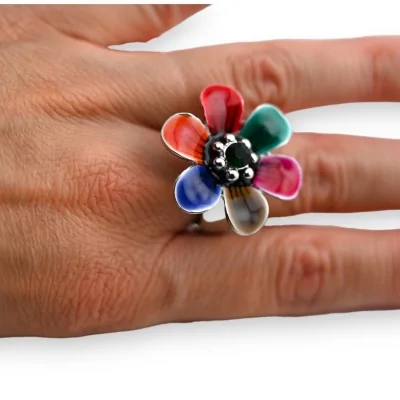
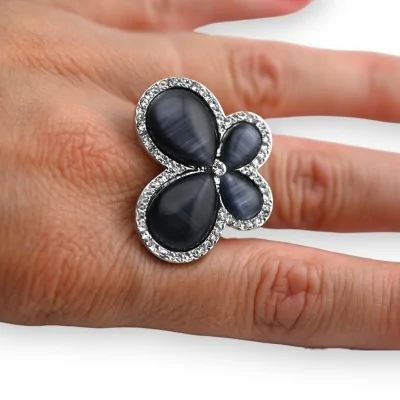
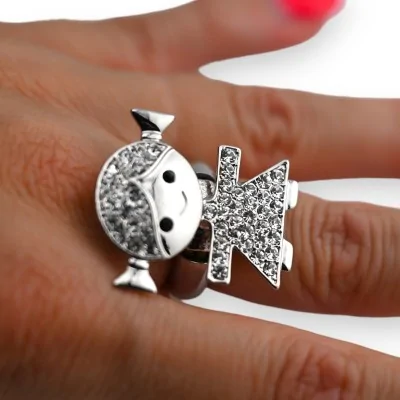
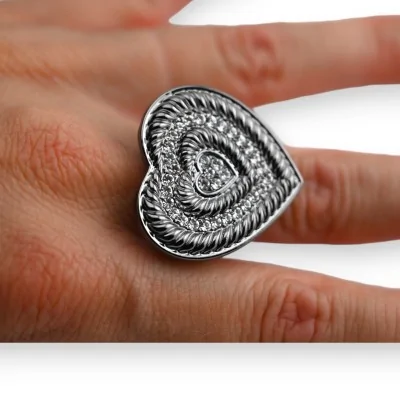
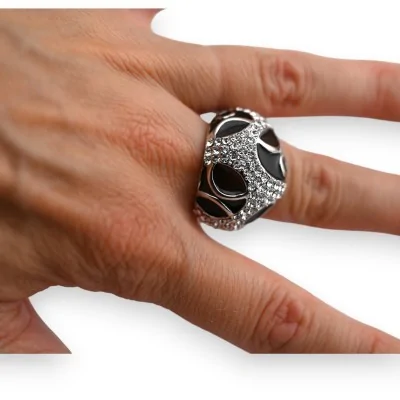
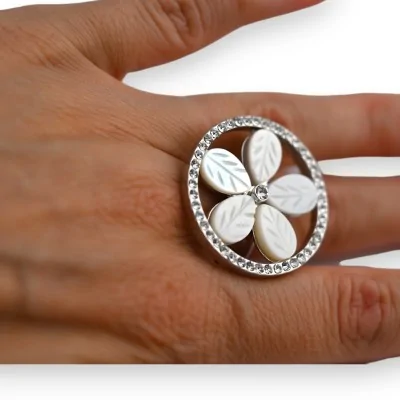
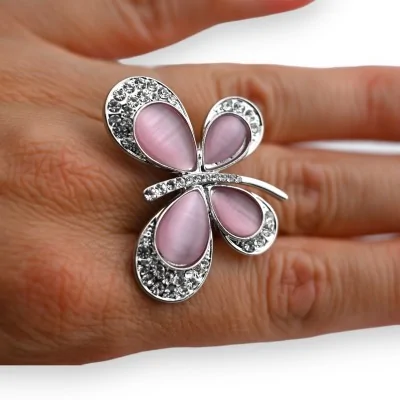
At Mode Tendance we have curated a fashion ring collection in shapes and materials that forgive half a millimetre: slim bands, hearts, butterfly with rhinestones, multicoloured flowers. If you want to try a ring that adapts to neighbouring sizes, our silver-tone fashion ring selection is built for that immediate comfort, with no painful sizing miss.
UK size N corresponds to a 54 mm inner circumference and an inside diameter of about 17.2 mm. It maps to US 6 ¾, EU/FR 54, and Asia 14. It is the median size for adult women in the UK.
Use a thin paper strip or a non-stretch string. Wrap it around the base of the finger, mark the overlap, unfold and measure the length in millimetres with a ruler. That number is the circumference in mm, which converts directly to EU/FR size and to UK/US via a chart.
Several apps offer screen-based measurement by placing an existing ring on the screen. Accuracy depends on screen calibration and on the model used. For a serious online order, cross-check the result against a paper or string measurement.
A US size 7 has an inside diameter of about 17.3 mm and a circumference of 54.4 mm. It maps to UK N ½ and to EU/FR 55. It is one of the most common female sizes ordered online.
UK uses alphabetical letters (A is smallest, Z is largest), US uses numbers from 3 to 13 (3 smallest). One US whole size equals roughly two UK letters. The conversion is not linear so always use a reference chart, never estimate.
 Medication in hand luggage: prescriptions, exceptions and security checks Ear piercing for a child: what age, uk rules and safety How to wear pin-up style in 2026 without looking like a costume Liquids in hand luggage: UK airport rules and limits 2026
 How to change a watch battery yourself: a step-by-step guide
 Nickel allergy and jewellery: symptoms and safe metals to choose
 What to give a woman who has everything: the anti-duplicate method
 How to change a watch strap: steps and mistakes to avoid