A clear guide to carrying medication in hand luggage: UK rules, the 100 ml exemption, doctor's letters and controlled...


A clear guide to carrying medication in hand luggage: UK rules, the 100 ml exemption, doctor's letters and controlled...

UK rules, clinical age guidance, choosing a safe piercer, first studs and the full healing timeline for a child's ear...

Sizing in inches and centimetres, teeth spacing, spring strain and materials: how to pick a claw clip that actually...

What pin-up style is, how it differs from rockabilly, and how to build the silhouette from clothes you already own.
UK airports no longer share one liquids rule. Where the 2 litre allowance applies, where 100ml still stands, and how...





Every winter the same question pops up: should you go for touchscreen gloves to keep using your phone at every bus stop, heated gloves for hands that turn numb at five degrees, or simply warm gloves made from decent wool and a proper lining? The honest answer fits in one sentence: it depends on how you actually spend your winter. Here is how to decide, without falling for marketing copy, and without overpaying for tech you will never use.
Marketing tends to blur the categories. Let us draw clean lines between them before getting into use cases, separating real function from sales argument.
The tips of the thumb and index finger are usually woven with a conductive thread (silver or copper based) that lets your phone's capacitive screen register the touch as if it were bare skin. The big plus: no more taking the glove off in the rain at a Tube stop or while paying contactless. The trade-off is precision. Typing a long message stays harder than with bare fingers, especially on a small keyboard.
A small lithium battery hidden in the cuff powers a heating element across the back of the hand, sometimes extending to the fingers. Good models offer three intensity levels and last between two and six hours depending on how hard you push them. They are the radical solution for Raynaud's syndrome, long ski lift waits, or anyone whose hands simply refuse to warm up no matter how thick the wool.
The widest and most versatile family. Wool, merino, cashmere, lambskin lined with silk, knitted mittens: warmth here comes from fabric thickness and weave quality, not from electronics. It is also the most durable family, and frankly the most stylish. The selection ranges from the technical (Polartec liners) to the elegant (lambskin opera-length gloves).

Rather than comparing the three families in the abstract, let us look at how you actually spend cold days. Five scenarios most readers will recognise.
For these short transitions, a thin merino or stretch-knit touchscreen glove does the job. You can check your route, tap your Oyster or contactless card, reply to a text without stopping. Warmth matters less than dexterity because you spend most of the journey indoors or in motion.
Leather remains the reference choice. It moulds to the hand, grips the steering wheel reliably, and does not generate static. Lined with silk, cashmere or fleece, it stays warm without making the gear stick feel distant. Avoid bulky knitted models which dull steering feedback, especially on wet roads at night. That becomes a real safety matter, not a style point.
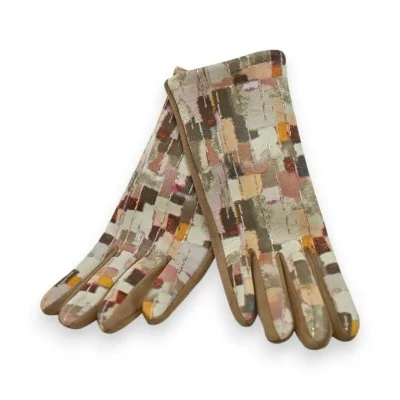
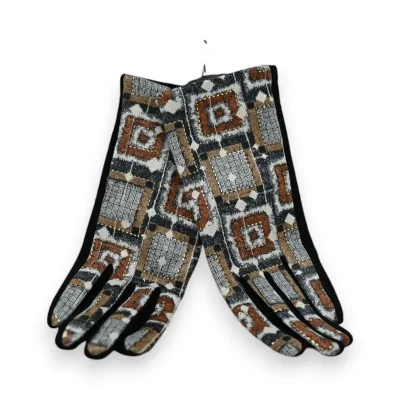
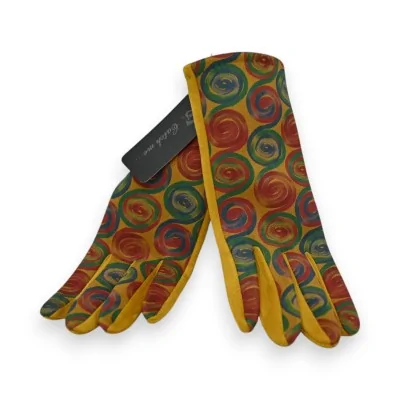
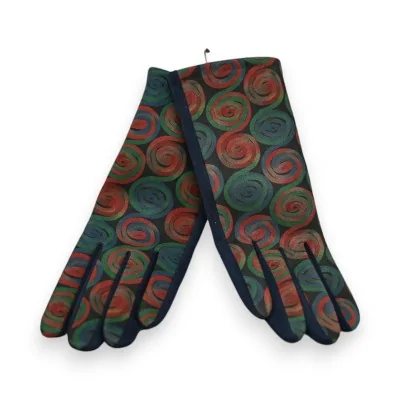
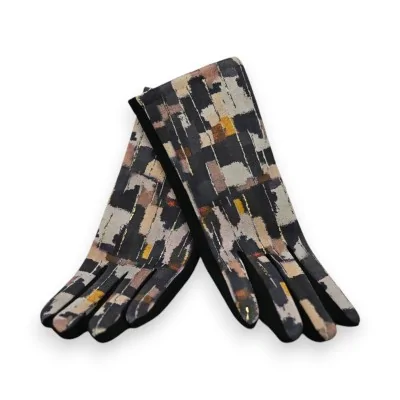
Function takes a back seat to style. A pair of suede gloves, fine lambskin or printed velvet adds the polished detail that completes an outfit. Warmth is secondary because you move between heated cars and heated venues. Pay attention to the wrist cut, the finish at the seams, and how the colour talks to the rest of your wardrobe. This is precisely the territory of our velvet suede gloves with painterly prints, designed more as evening accessories than thermal protection.
If you take a lot of winter pictures, navigate on foot, or rely on contactless payments at street markets, touchscreen gloves become essential. Look for conductive coverage on at least thumb, index and middle finger, ideally with a grippy palm so the phone does not slip out of your hand at minus three. Pairs with a single conductive dot on the index degrade fast and disappoint after a month.
Heated gloves only really pay off when you stay still in the cold: winter photography, lift queues, expedition base camps. If you are moving, your body warms your hands naturally and a thin merino touchscreen layer is enough. A heated pair worn during exertion becomes too hot, makes you sweat, and the sweat then chills the hand faster afterwards. Wrong call.
They deliver on the warmth promise, but only under certain conditions. First, battery life: an entry-level pair lasts about two hours at maximum heat, barely longer than a school run on a snow day. For a full day on the slopes, plan a spare set of batteries. Second, bulk: the battery on the cuff adds the equivalent of a thick marker pen, which can be awkward under a fitted coat sleeve.
Third, weight: 350 to 500 grams per pair compared to 80 to 150 grams for a wool glove. The difference is felt within a half-day of wear. Last, care: most models require hand washing with the battery removed, ruling out a quick machine cycle. For genuinely cold hands or diagnosed Raynaud's, these inconveniences are worth absorbing. For occasional use, the cost-benefit is plainly less obvious.
Before splurging on a high-tech option, a few low-key habits change the warmth game. The trick is the trapped-air principle. Wear a thin silk liner underneath a medium wool glove and you get better insulation than from one thick glove alone. This layering, borrowed from alpine skiing, also works on a London or Edinburgh commute.
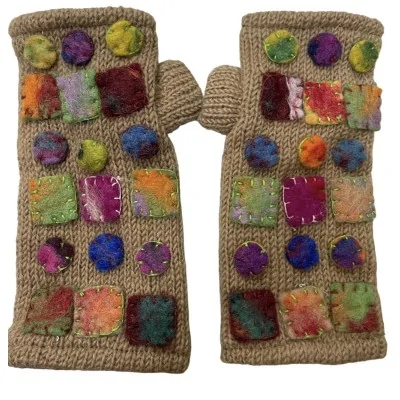
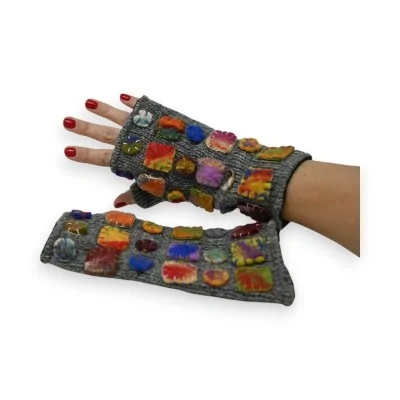
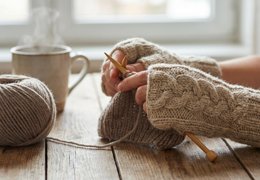
The second underrated lever is traditional knit construction. Hand-loom knitting traps mechanically more air than industrial weaving at equal density, which translates into noticeably better thermal comfort in the first minutes. That is the philosophy behind our Nepalese fingerless mittens in pure virgin wool, with geometric embroidery: they leave the fingertips free for the phone while the palm and the back of the hand stay warm. A smart compromise when you switch between indoor and outdoor ten times an hour.
Finally, do not underestimate cuff coverage. The hand's blood supply runs through the wrist. A glove that covers the wrist by a clean five centimetres holds far more warmth than a longer glove that stops at the base of the hand.

At Mode Tendance we have deliberately picked two complementary universes rather than chasing the technical glove race. The urban elegance of printed velvet suede on one hand, made for dressy evenings and polished commutes. The authenticity of Nepalese wool craft on the other, serving daily life with its colourful geometric embroidery. Two philosophies of warmth, and no tech commitment that becomes obsolete in three years.
Yes, provided the conductive thread covers more than just the very tip of the thumb. Aim for at least thumb, index and middle finger, and look for a grippy palm. The cheap pairs with one tiny silver dot on the index tend to disappoint after a few washes.
All else equal, mittens beat gloves because the fingers warm each other inside the same pocket. Then come heated gloves at full power, leather lined with cashmere, and finally classic thick wool.
For genuinely extreme cold (below minus ten), use a mitten with a removable inner glove, ideally in down or Primaloft. For mild UK winters, a lined leather glove or a thick knit mitten is more than enough.
The conductive material wears off after repeated washing on the cheapest pairs. Precision stays lower than a bare finger. Some thicker gloves also need a firmer tap than bare skin to register on the screen.
Two to three hours at full power, four to six at medium intensity. Always check the manufacturer's quoted runtime at "max" and assume you will get about 70 % of that figure in practice in real cold.
 How to style a winter coat: what to wear under each type
 How to knit a headband: a step-by-step beginner tutorial
 Cashmere, merino, lambswool and alpaca: the warm fibres compared
 How to Wash a Beanie Without Shrinking It
 How to knit fingerless mitts: easy tutorial for beginners