A clear guide to carrying medication in hand luggage: UK rules, the 100 ml exemption, doctor's letters and controlled...
Mode Tendance, Click here to understand delivery to the United States, Australia and United Kingdom
English GB


A clear guide to carrying medication in hand luggage: UK rules, the 100 ml exemption, doctor's letters and controlled...

UK rules, clinical age guidance, choosing a safe piercer, first studs and the full healing timeline for a child's ear...

Sizing in inches and centimetres, teeth spacing, spring strain and materials: how to pick a claw clip that actually...

What pin-up style is, how it differs from rockabilly, and how to build the silhouette from clothes you already own.

UK airports no longer share one liquids rule. Where the 2 litre allowance applies, where 100ml still stands, and how...




Four leaf clover or hamsa hand? Horseshoe or Italian horn? Every tradition has its own answer to the same question: which good luck charm is the most powerful? This guide reviews the symbols with the strongest reputations across cultures, explains where that reputation comes from, and offers a simple way to choose the right one for your own goal.
No laboratory has ever ranked amulets, so "power" in this context means reputation, and reputation rests on three pillars. Age: a symbol in continuous use for millennia inspires trust by sheer persistence. Reach: when distant cultures independently adopt the same sign, its status grows. Personal meaning: the decisive factor. The most powerful good luck charm is the one that means something to you, which is why a grandmother's pendant outranks any store-bought talisman in practice. The rankings below reflect tradition, not measurable effect, and that honesty matters when choosing well.
Three symbols top almost every European list, each with a very concrete origin story. The four leaf clover rules the luck category through genuine botanical rarity: roughly one clover in five thousand has four leaves, so finding one was proof of fortune itself. Among good luck charms, the horseshoe owns the prosperity category by stacking three ancient prestiges, protective iron, precious horse and respected blacksmith, and hangs points up to hold the luck in. The blue evil eye bead, the nazar, is the defensive champion: glass eye beads have been made almost unchanged for some twenty-five centuries, their job being to reflect envy back at the sender.

Beyond the big three, several regional good luck charms carry equally strong reputations on home turf, and each guards its own speciality. Every culture crowns its own protective champion, which is why no universal ranking exists.
Across North Africa and the Middle East, the open palm of the hamsa, often with an eye at its centre, doubles up two defensive symbols in one piece of jewellery, earning its name as the complete shield of the Mediterranean.
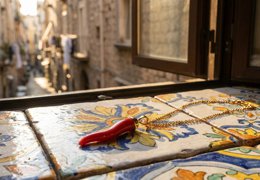
Naples' red cornicello specialises in deflecting the evil eye and comes with its own rulebook: received as a gift, never self-bought, and replaced once broken. Its full story, legends and gifting etiquette have their own chapter in our guide to the meaning of the Italian horn.
A closed fist with the thumb between index and middle finger, the figa absorbs envy in place of its owner according to Luso-Brazilian tradition, and follows the same lifecycle as the cornicello: gifted, worn, replaced when it breaks.
Japan's beckoning cat waves fortune into homes and businesses, left paw for customers, right paw for wealth, and has gone global as a charm and pendant far beyond shop counters.
The simplest method is to start from what you want. For exams, interviews and fresh starts, tradition points to the clover and the star. For protecting a person or a home, the evil eye bead, the hamsa and the Italian horn lead the field. For prosperity, the horseshoe and the trunk-up elephant are the classics, while hearts and the tree of life cover love and family bonds. One symbol chosen with intent beats five chosen at random, both in tradition and in style. On the jewellery side, these symbols live happily as a single pendant or gathered on a charm-laden wrist: our collection of bracelets with symbolic charms is designed for exactly that kind of personal line-up.
Many traditions say yes, and the rituals are half the fun: the cornicello and the figa must be gifted, the horseshoe must point upwards, the nazar should be replaced once cracked. Behind the folklore sits a consistent idea, documented in our wider guide to the history of lucky charms: the ritual transfers intention from giver to wearer, and that intention is what people actually feel when they touch the charm before a big moment. Treat the rules as culture rather than obligation, and they add a layer of story to any good luck charm you wear.

Traditions never crowned a single champion: the four leaf clover leads for pure luck, the evil eye bead and hamsa for protection, the horseshoe for household prosperity. The only consensus is the criterion: the charm that carries personal meaning for its wearer is the one that counts.
Tradition says yes, psychology says not quite: a charm works on the confidence and persistence of its wearer, believer or not. Receiving one as a gift from someone you love often gives it all the meaning it needs, regardless of any superstition.
Yes, no tradition forbids it, and some cultures deliberately stack protections in one piece. The only real rule is aesthetic: keep metals consistent, gold with gold or silver with silver, so the combination reads as a collection rather than a clutter.
Some do by design: a broken cornicello or figa is considered to have absorbed a blow meant for you, and gets replaced. Others improve with age, like a clover kept under glass or a horseshoe passed down the family, carrying more story with every generation.
Mode Tendance, jewellery and accessories editorial team. Published 7 June 2026. Sources: European and Mediterranean folk traditions as documented in folklore literature; botanical frequency of four leaf clovers, public naturalist surveys; cornicello and figa gifting customs, Campanian and Brazilian folklore.
 Hoop Earring Trends 2026: 8 Looks to Wear Now Autumn/Winter 2026 jewellery trends: 7 pieces to adopt
 Bee in the House: Meaning, Symbolism and Superstition
 Labradorite vs moonstone: how to tell them apart
 What it means when a butterfly comes into your house
 How to cleanse and charge crystals: the complete guide
 Which side to wear a brooch: the rule explained
 Bee symbolism: meaning, the Manchester worker bee and spiritual sense