A clear guide to carrying medication in hand luggage: UK rules, the 100 ml exemption, doctor's letters and controlled...


A clear guide to carrying medication in hand luggage: UK rules, the 100 ml exemption, doctor's letters and controlled...

UK rules, clinical age guidance, choosing a safe piercer, first studs and the full healing timeline for a child's ear...

Sizing in inches and centimetres, teeth spacing, spring strain and materials: how to pick a claw clip that actually...

What pin-up style is, how it differs from rockabilly, and how to build the silhouette from clothes you already own.
UK airports no longer share one liquids rule. Where the 2 litre allowance applies, where 100ml still stands, and how...





Fingerless mitts are the perfect bridge between your first scarf and more ambitious knitting. They are small, quick, forgiving, and you get to keep your fingers free for your phone, your keys and your coffee. This tutorial walks you through a complete beginner pattern knitted flat on straight needles, with a sizing chart, yarn guidance and the mistakes worth avoiding. No circular needles, no double pointed needles, no fear.
Yes, and arguably the best one after a scarf. A pair of fingerless mitts uses every skill a beginner needs to practise, casting on, knit and purl stitches, ribbing, binding off and one straight seam, on a project small enough to finish in a weekend. Unlike a hat, there is no crown shaping; unlike full mittens, there are no fingers or complicated thumb gussets in this version. And because the fabric sits snugly on the hand, small tension wobbles simply do not show the way they do on a flat scarf.
To knit fingerless mitts you need one ball of medium weight yarn, a pair of straight needles, a tapestry needle and a tape measure: the complete kit fits in a small pouch. Pick a smooth, light coloured yarn so you can read your stitches easily. A wool and acrylic blend is elastic and forgiving, while pure cotton has no stretch and makes ribbing harder work than it needs to be.
For a medium weight yarn, 4 mm to 5 mm straight needles are the sweet spot: stitches stay visible and the fabric grows quickly. Always check the band on your ball of yarn first, as the recommended needle size printed there beats any general rule. If your knitting tends to be tight, go up half a millimetre.
A pair of adult fingerless mitts takes roughly 50 to 80 grams of medium weight yarn, which means one standard 100 g ball covers the project with leftovers to spare. In UK terms, an aran or worsted weight works perfectly; a DK weight also works with 4 mm needles and a few more stitches cast on.
This pattern produces a flat knitted rectangle with one seam, and that single seam is what creates the thumb opening. It is the simplest construction that exists for handwear, and it is the reason no special equipment is required. The instructions below fit an average adult hand; the sizing chart in the next section covers everything else.

Cast on 36 stitches loosely with 4.5 mm needles. Work in 2x2 rib, knit two, purl two, for 6 cm. This elastic band will hug the wrist and stop the mitt sliding down. If your cast on edge always turns out tight, cast on over both needles held together and pull one out before row one.
Continue in 2x2 rib for another 10 to 12 cm, or switch to stocking stitch, one row knit, one row purl, if you prefer a smooth fabric. Stop when the piece reaches the base of your fingers when held against your hand. Knitting flat means you can try as you go, which is exactly what a first project should allow.
Bind off all stitches loosely, in rib pattern if you ribbed the body. Fold the rectangle in half lengthways with right sides together. With two pins, mark a 4 to 5 cm gap along the open side, starting about 2.5 cm below the top edge. That pinned gap is your future thumb opening, no extra knitting required.
Thread the tapestry needle and seam from the cuff upwards using mattress stitch, stop at the first pin, skip the gap, then seam from the second pin to the top. Weave in the yarn ends on the wrong side. Knit the second mitt identically: a finished pair typically takes two relaxed evenings.
Knit a 10 cm square first and count your stitches; with medium yarn most knitters land between 18 and 20 stitches per 10 cm. Then measure around the knuckles, thumb excluded, and read the chart. One rule saves every project: swatch before you cast on, because ten minutes of swatching prevents hours of reknitting. Keep cast on numbers in multiples of four so the 2x2 rib pattern repeats cleanly.
| Size | Hand circumference | Cast on | Total length |
|---|---|---|---|
| Child 8 to 12 | 15 to 16 cm | 28 sts | 13 to 15 cm |
| Adult S | 17 to 18 cm | 32 sts | 15 to 17 cm |
| Adult M | 19 to 20 cm | 36 sts | 16 to 18 cm |
| Adult L | 21 to 22 cm | 40 sts | 17 to 19 cm |
Not sure how to measure your hand correctly? The method in our guide on finding the right glove size applies to mitts in exactly the same way.
When you knit fingerless mitts for the first time, almost every disappointing result comes down to one of five fixable habits. Casting on too tightly, which makes the cuff impossible to pull over the hand. Skipping the swatch, which produces mitts two sizes off. Seaming with a different yarn colour, which shows on ribbing. Making the thumb opening too low, which twists the hand position. And binding off tightly at the top, which cuts into the knuckles. Bind off as loosely as you cast on and every one of these problems disappears with practice.

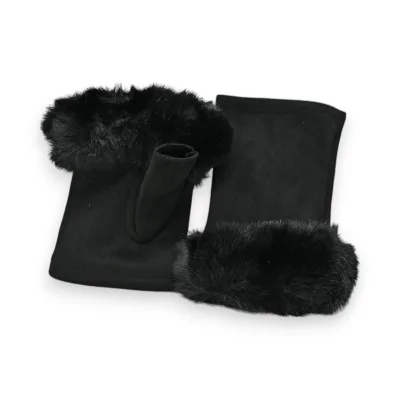
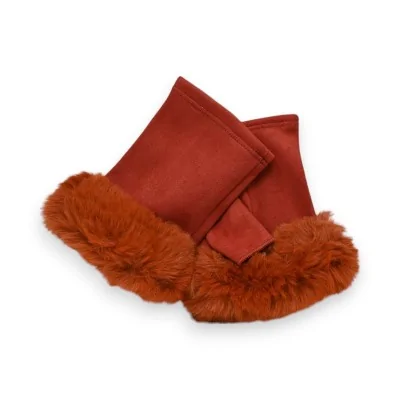
If you love the look but not the hours, there is no shame in shortcuts. Our collection of knitted and faux fur mitts offers ready to wear models, including convertible styles that fold into a closed glove for colder days. And when winter turns properly harsh, our comparison of touchscreen versus warm gloves helps you pick full finger protection that still works with a phone.
One mitt per evening is a realistic pace for a beginner, so a full pair takes about two evenings, four to six hours in total. The ribbed cuff is the slowest section; the body flies by. Experienced knitters working with chunky yarn on 6 mm needles can absolutely finish a complete pair in a single sitting.
Yes, the same measurements work on double pointed needles or a short circular needle using the magic loop technique, and you skip the seam entirely. Cast on the same stitch count, join in the round, and leave the thumb gap by knitting a few rows flat where the opening should sit. Flat knitting simply remains the easier entry point.
Medium weight yarn, called worsted or aran and listed as category 4 by the Craft Yarn Council, is the best all rounder: warm, quick to knit and easy to handle. DK weight gives a finer, more elegant fabric with a few more stitches. Chunky yarn knits fastest of all but produces bulkier mitts that fit less neatly under coat sleeves.
Reinforce the two ends of the opening when you seam, by working two or three small stitches over each end point before continuing. Those anchor points absorb the pulling that happens every time you slide the mitt on. If an opening has already stretched, a discreet round of single crochet around the edge tightens it back up.
Mode Tendance, fashion and accessories editorial team. Published 11 June 2026.
Sources: Craft Yarn Council, Standard Yarn Weight System (craftyarncouncil.com); DROPS Design public pattern library (garnstudio.com).
 How to style a winter coat: what to wear under each type
 How to knit a headband: a step-by-step beginner tutorial
 How to change a watch strap: steps and mistakes to avoid
 Cashmere, merino, lambswool and alpaca: the warm fibres compared
 How to Wash a Beanie Without Shrinking It
 Touchscreen gloves vs warm gloves: how to choose for your daily use