A clear guide to carrying medication in hand luggage: UK rules, the 100 ml exemption, doctor's letters and controlled...


A clear guide to carrying medication in hand luggage: UK rules, the 100 ml exemption, doctor's letters and controlled...

UK rules, clinical age guidance, choosing a safe piercer, first studs and the full healing timeline for a child's ear...

Sizing in inches and centimetres, teeth spacing, spring strain and materials: how to pick a claw clip that actually...

What pin-up style is, how it differs from rockabilly, and how to build the silhouette from clothes you already own.
UK airports no longer share one liquids rule. Where the 2 litre allowance applies, where 100ml still stands, and how...

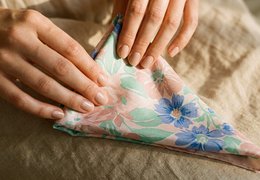




A glove that is too loose lets cold air in at the fingertips; a glove that is too tight presses on circulation and stresses the seams. Size is not a detail: it is what separates a winter spent shivering from a winter spent forgetting you are wearing gloves at all. Here is the full method to measure your hand, read a UK and US size chart, and pick between two sizes depending on the fabric.
Take the measurement on your dominant hand (usually half a size larger than the other) with a soft tape measure. Three readings prevent 90% of online ordering mistakes.
The reference measurement. Wrap the tape around the widest part of your palm, just below the knuckles, with the thumb tucked out. The tape should be snug but not tight. Record the centimetre value: that is your numeric glove size (7 inches / 18 cm = size 7; 8 inches / 20 cm = size 8).
Measure from the base of the palm (at the life line) to the tip of the extended middle finger. This confirms the glove fingers will not be too short (uncomfortable) or too long (loose puckers and poor grip). For a palm of 18 cm, expect a length around 17 to 18 cm.
Your dominant hand (right for most) is slightly broader than the other, particularly for those who write or cook a lot. If the gap between the two readings exceeds one centimetre, pick the size of the larger hand. Gloves come in identical pairs, and comfort is decided by the hand that suffers first under a tight fit.

European glove sizes are based on palm circumference in centimetres, which UK and US brands often publish in inches. The standard conversion for adult women looks like this.
Palm circumference 16 cm / 6.3 in = size 6 = XS, fine hand, less common in adults.
Palm 17 cm / 6.7 in = size 6.5 = S, smaller hands, often petite frames.
Palm 18 cm / 7 in = size 7 = S/M, the most common UK womens glove size.
Palm 19-20 cm / 7.5-7.9 in = size 7.5 to 8 = M, medium to broader hand.
Palm 21 cm / 8.3 in = size 8.5 = L, broader hand.
Palm 22 cm and above / 8.7 in = size 9 to 10 = XL, less common for womens cuts, often best taken from a unisex or mens range when not stocked.
UK shops increasingly publish the size in inches following the lead of Dents and Sealskinz. Multiply the cm value by 0.394 to find the inch reading. Size 7 = 7 inches = 17.8 cm. A size 7.5 is still considered medium, not large, despite the borderline name.
The classic pitfall of online ordering. The rule changes depending on whether the glove hugs the hand, covers it, or insulates it.
Knit fabric stretches over time. When in doubt between two sizes, pick the smaller one. A size 7 at the start of the season that softens to a 7.5 after two months is the ideal break-in. The size up gives up entirely and ends up slipping out of coat sleeves.
These fabrics do not give. Pick the larger size when your measurement falls between two. A size 7 suede glove that runs tight will never stretch: the seams will split at the knuckles within the first season.
The lining adds 1 to 2 mm of thickness inside. If you usually wear a size 7 in an unlined glove, take a size 7.5 in a fur-lined model. The hand must close fully without pulling on the wrist strap or button.

Different glove cuts follow different sizing logics. Three categories to remember.
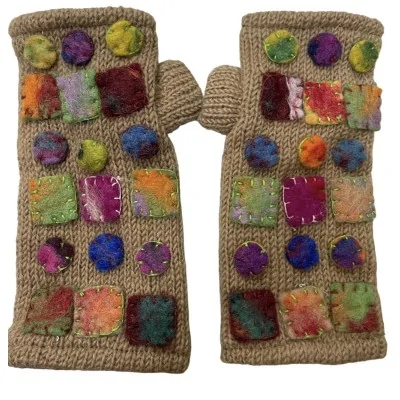
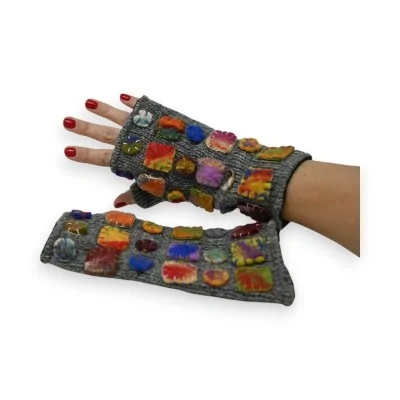
Unlined suede or leather dress gloves (smart-day models) sit closest to the published measurement. Follow the chart to the centimetre. Fur-lined winter gloves (cold-weather models) need a quarter size up for the lining. Knit fingerless mittens (wool, alpaca, cashmere) are the most forgiving: their natural stretch absorbs half a size in either direction. When unsure between M and L on a mitten model, pick M, it will soften with wear.
To work out which glove category fits your daily routine before you even measure your hand, our article on touchscreen gloves vs warm gloves: how to choose for your daily use walks through the buying logic by commute and weather.
At Mode Tendance we curate a womens glove collection built for everyday wear, from dress glove to weekend mitten, with model-specific size charts on every product page to keep returns down. Our womens glove collection covers sizes S to L (XL on some cuts), and our fingerless glove range offers the format that forgives imprecise measurements.
Measure your palm circumference with a soft tape, excluding the thumb. 17 cm = S, 18 cm = M, 20 cm = L. Then check the length of your middle finger. Between two sizes, pick the smaller for knit and the larger for suede or leather.
UK brands typically publish the size in inches. Multiply your palm circumference in centimetres by 0.394 to find the equivalent inch value. A 7-inch palm corresponds to a UK size 7 (medium for womens cuts), which is also the most common size sold across British accessory shops.
A 7-inch palm circumference equals UK and European size 7, equivalent to a small-medium in letter sizing. It is the most common adult womens glove size and the default stocked at British accessory brands.
No, a 7.5 sits in the medium range. Womens large typically starts at 8 to 8.5 (palm of 20 to 21 cm). A 7.5 corresponds to a medium hand, slightly broader than the average size 7 but well below the large threshold.
Brands often round to the nearest half size. If your palm reads 19.5 cm and the brand only offers S and M, pick by fabric: knit goes to S, leather or suede to M. Always check the product page for a model-specific chart, which is often more accurate than the general one.
Medication in hand luggage: prescriptions, exceptions and security checks Ear piercing for a child: what age, uk rules and safety How to wear pin-up style in 2026 without looking like a costume Liquids in hand luggage: UK airport rules and limits 2026 How to change a watch battery yourself: a step-by-step guide
 Nickel allergy and jewellery: symptoms and safe metals to choose
 What to give a woman who has everything: the anti-duplicate method
 How to change a watch strap: steps and mistakes to avoid